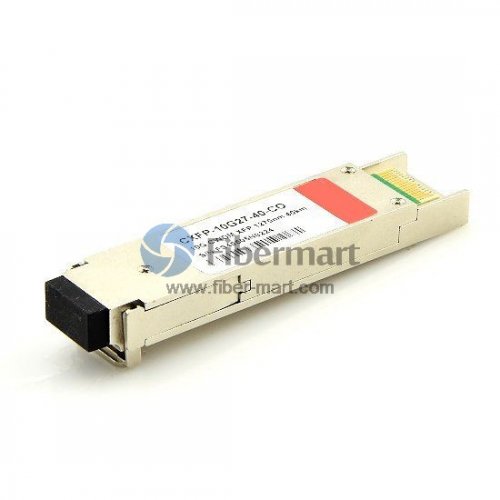
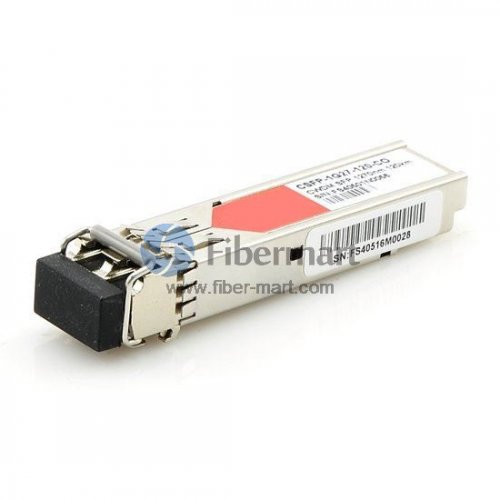
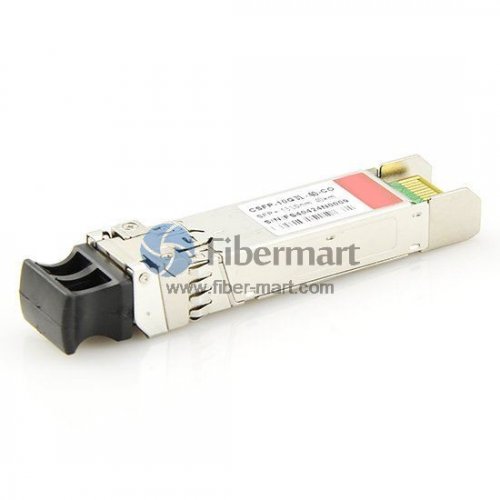
1.25Gbps 1550nmTX/1490nmRX BiDi GBIC 80km Transceiver

BGBIC-1G54-80

The BIDI GBIC series optical transceivers meet the Gigabit Interface Converter (GBIC) specification Rev.5.5. It satisfies the optical interface specifications defined in IEEE 802.3z Drift 5.0 for Gigabit Ethernet. This module is designed for singlemode fiber and operates at a nominal wavelength of 1490nm/1550nm. The transmitter section uses a multiple quantum well FP laser and is a class 1 laser compliant according to International Safety Standard IEC-60825. The receiver section uses an integrated InGaAs detector preamplifier (IDP) mounted in an optical header and a limiting post-amplifier IC. A PECL input /output logic interface is used. TTL RX-LOS output simplifies interface to external circuitry. A 20-pin SCA-2 host connector is used to connect the converter to the host system.

Key Features

    • Support 1.25Gbps data links
    • A type: 1490nm FPTx/1550nmRx
    • B type: 1550nm FPTx/1490nmRx
    • Average Output Power:-5~0dBm
    • Receiver Sensitivity:-23dBm
    • 80km with 9/125um SMF
    • 3.3/5V Power supply and TTL Logic Interface
    • Hot-Pluggable SFP Footprint Simplex SC Connector Interface
    • Class 1 FDA and IEC60825-1 laser safety compliant
    • Compliant with GBIC Specification Rev.5.5
    • Compliant with IEEE 802.3z Gigabit Ethernet 1000BASE-SX
    • Compliant with Fiber Channel FC-PH-2 for 100-M5-SN-1 and 100-M6-SN-1


Applications

    • Gigabit Ethernet Switches and Routers
    • Fiber Channel Switch Infrastructure
    • Other optical link


Ordering Information

Part No. Data Rate (Gbps) Wavelength (nm) TX Power (dBm) Re Sens. (dBm) Transmission Distance Fiber Type Connector Type Temp. Range
BGBIC-1G35-2 ≤ 1.25 1310~1550 -9~-3 <-21 2km MMF SC 0~70°C
BGBIC-1G53-2 ≤ 1.25 1550~1310 -9~-3 <-21 2km MMF SC 0~70°C
BGBIC-1G35-10 ≤ 1.25 1310~1550 -9~-3 <-21 10km SMF SC 0~70°C
BGBIC-1G53-10 ≤ 1.25 1550~1310 -9~-3 <-21 10km SMF SC 0~70°C
BGBIC-1G34-20 ≤ 1.25 1310~1490 20km SMF SC 0~70°C
BGBIC-1G43-20 ≤ 1.25 1490~1310 20km SMF SC 0~70°C
BGBIC-1G35-20 ≤ 1.25 1310~1550 -8~-3 <-22 20km SMF SC 0~70°C
BGBIC-1G53-20 ≤ 1.25 1550~1310 -8~-3 <-22 20km SMF SC 0~70°C
BGBIC-1G34-40 ≤ 1.25 1310~1490 40km SMF SC 0~70°C
BGBIC-1G43-40 ≤ 1.25 1490~1310 40km SMF SC 0~70°C
BGBIC-1G35-40 ≤ 1.25 1310~1550 -2~-3 <-24 40km SMF SC 0~70°C
BGBIC-1G53-40 ≤ 1.25 1550~1310 -2~-3 <-24 40km SMF SC 0~70°C
BGBIC-1G45-80 ≤ 1.25 1490~1550 -5~0 <-23 80km SMF SC 0~70°C
BGBIC-1G54-80 ≤ 1.25 1550~1490 -5~0 <-23 80km SMF SC 0~70°C
BGBIC-1G57-100 ≤ 1.25 1510~1570 100km SMF SC 0~70°C
BGBIC-1G75-100 ≤ 1.25 1570~1510 100km SMF SC 0~70°C
BGBIC-1G59-120 ≤ 1.25 1510~1590 120km SMF SC 0~70°C
BGBIC-1G95-120 ≤ 1.25 1590~1510 120km SMF SC 0~70°C

Packaging

    • Antistatic bag
    • Packed on pallets in a box(Default Customer Options)
    • Specific Labels as Request
    • Seperate white Box for each transceiver


OEM and ODM

Combining our extensive design and engineering capability in optical transceiver industry, with our competitive advantages from integrated manufacturing capability, internal supply chain, and cost competitive and scalable operation infrastructure, Fiber-Mart provides OEM, ODM, and contract manufacturing service to world leading customers with our manufacturing facilities in China.We are also mainly engaged in providing complete sets of optoelectronic device solutions to gain more brand extensions and influence for Fiber-Mart in the world.

  • OEM/ODM order is available
  • We can supply BGBIC-1G54-80 according to your requirements, and design BGBIC-1G54-80 label and packaging for your company. We welcome any inquiry for customized BIDI GBIC optical transceiver.

Order Procedure

Please contact us with any special requirements you may have, we can help you create a custom solution to meet almost any application. Our engineer will review the project and provide a quotation within 1-2 business days.
a. Email (sales@fiber-mart.com) us a rough sketch to a detailed drawing.
b. Our engineer will review the project and provide a quotation within 24 hours.
c. We can arrange production as low as 1 piece and as high as 1,000 pieces in 1~4 business days once an order is placed.


product link: https://www.fiber-mart.com/125gbps-1550nmtx1490nmrx-bidi-gbic-80km-transceiver-p-16499.html

1000Base 1SFP+1RJ45 Ports Gigabit Fiber Media Converter online sale

Best 1000Base 1SFP+1RJ45 Ports Gigabit Fiber Media Converter product for you

Media converters can be used anywhere in the network to integrate newer technology with existing equipment to support new applications, technologies and future growth. Instead of costly, across-the-board upgrades, media converters can extend the productive life of the existing cabling as well as the active equipment.

Fiber-Mart.COM supply 10/100Base Ethernet Fiber Media Converters, 1000Base Gigabit Fiber Media Converter,SFP Fiber Media Converter, Options in singlemode dual fiber, multimode dual fiber and singlemode single fiber. We also supply Media Coverter Chassis, like 14 slot media converter chassis and 16 slot media converter chassis, used to manage the various media converters.

Features

    • AutoCross™: Automatically detects and configures the twisted pair port on the converter to the correct MDI or MDI-X configuration.
    • Link Pass Through: Link Pass Through is a troubleshooting feature that allows the media converter to monitor both the fiber and copper RX ports for loss of signal.
    • Automatic Link Restoration: The media converters will automatically re-establish link in all network conditions.


Key Features

One SFP ports and one SFP sockets ,It can convert Optical-Electric Ethernet signals between 1000M UTP ports and 1000M optical fiber ports and switch Ethernet signals between port and port.

  • Auto negotiation function supports UTP ports to auto 1000M and Full Duplex/Half Duplex.
  • Broadcast storm protection
  • Supports VLAN and QoS
  • Supports the max 1536 bytes frame
  • Small power consumption (3W), low heat, good stabilit


Applications:

Gigabit Ethernet Network Distances
It uses the 1000BASE-T to 1000BASE-X speed setting (back-to-back) to extend the distance between two 100BASE-T devices up to 80km. Using single mode fiber without a repeater.


Specifications

    • Operating standards: IEEE802.3z/AB, 1000Base-T and 1000Base-SX/LX
    • MAC address: 1K
    • Frame buffer memory: 512Kb RAM
    • UTP cable: Cat. 5 (the max distance up to 100m)
    • Multimode Fiber: 50/125, 62.5/125μm(the max distance up to 224/550m)
    • Single-mode Fiber: 8/125, 8.7/125, 9/125, 10/125μm (the max distance up to 100km)
    • Flow control: Full Duplex: IEEE802.3x flow control; Half Duplex: bake pressure flow control
    • Power: AC100 ~ 240V, 50~60Hz; DC5V 2A;
    • Operating Temperature: 0℃~+50℃
    • StorageTemperature: -20℃~+85℃
    • Relative Humidity: 5%~95%
    • Dimension (mm): 26*70*95 (with external power), 30*110*140 (with built-in power)


    • Note: Port Base VLAN is optional, please contact sales@fiber-mart.com for more details.


Label Customized

Note: We can design Fiber Media Converter label for your company according to your requirements. Print any logo in the label is for free. If you need to print your company logo on the equipments, MOQ is 1000pcs.
please contact sales@fiber-mart.com for more details.


Product link:https://www.fiber-mart.com/1000base-1sfp1rj45-ports-gigabit-fiber-media-converter-online-sale-p-16575.html

What are the Differences of SFP, SFP+, XFP?

Transceivers are essential for wireless communication devices.SFP, SFP+ and XFP are all terms for a type of transceiver optics. and the commonly used SFP, SFP+ and XFP are all with LC connector. SFP and SFP+ with an identical pinout that is different with XFP optics. This article , we will talk about the difference of  SFP,SFP+ ,XFP.

Transceivers are essential for wireless communication devices.SFP, SFP+ and XFP are all terms for a type of transceiver optics. and the commonly used SFP, SFP+ and XFP are all with LC connector. SFP and SFP+ with an identical pinout that is different with XFP optics. This article , we will talk about the difference of  SFP,SFP+ ,XFP.


Difference of SFP,SFP+ and XFP module

SFP stands for “Small Form-factor Pluggable.” It is most often used for Fast Ethernet of Gigabit Ethernet applications. They are capable of supporting speeds upto 4.25 Gbps. It interfaces a network device motherboard (for a switch, router, media converter or similar device) to a fiber optic or copper networking cable. It is specified by the SFP transceiver multi-source agreement.

1sfp.jpg


SFP+ can be referred to as an expansion of the SFP standard. It has the capability to support speeds of 10 Gbps or even higher over fiber. The SFP+ product family includes cages, connectors, and copper cable assemblies. It is also similar to the performance requirements of SFF-8431 and also supports 8G Fiber Channel and 10G Ethernet applications. SPF+ comes with various advantages. It is a more compact factor package than compared to that of XFP. The cost of SFP+ is also less than that to the XFP.

sfp+.jpg


XFP is a standard for the transceivers. This type of transceiver is not dependent on the protocol. Generally, it operates at optical wavelengths corresponding to 850nm, 1310nm or 1550nm. The modules belonging to the XFP are hot swappable which means that the function of replacing the computer system components can be performed without shutting down the system. The specifications of XPF were developed by the XFP Multi Source Agreement Group.

4dd01cc90cd94c07f56960a662506541.image.500x500.jpg

SFP module:

  • SFP stands for Small Form Factor Pluggable and it is also called as mini GBIC.
  • SFP transceiver modules support SONET, Fast Ethernet, Gigabit Ethernet, Fibre Channel, and other communications standards.
  • Copper cables and fiber cables can be used in SFP module.
  • SFP supports data rate up to 5 Gbps.


SFP+ module:

  • SFP+ stands for small form factor pluggable plus.
  • SFP+ transceiver modules support Gigabit Ethernet, Fibre Channel, and other communications standards.
  • Twinax cables, Copper Cables and fiber cables can be used in SFP+ module.
  • SFP+ supports data rate upto 10 Gbps.


 XFP module:

  • XFP stands for 10 Gigabit Small Form Factor Pluggable.
  • XFP transceiver modules support SONET, 10 Gigabit Ethernet, 10 Gigabit Fibre Channel, and other communications standards.
  • XFP is a slightly larger form factor than the popular small form-factor pluggable transceiver, SFP, and SFP+.
  • XFP modules are hot-swappable and protocol-independent.
  • XFP supports data rate up to 10 Gbps.


Conclusion:

With growing demand for reliable and high speed mobile communication, optical transceivers are increasingly being used for the communication network infrastructure and be bound to thrive in optical network. 10G Ethernet is still the mainstream among small size data centers,The XFP transceiver module is not as popular as the SFP and SFP+ transceiver, but it still has a place. For more information, welcome to visit www.fiber-mart.com or contact us e-mail:service@fiber-mart.com

What fiber Patch Cables should we use in a harsh environment?

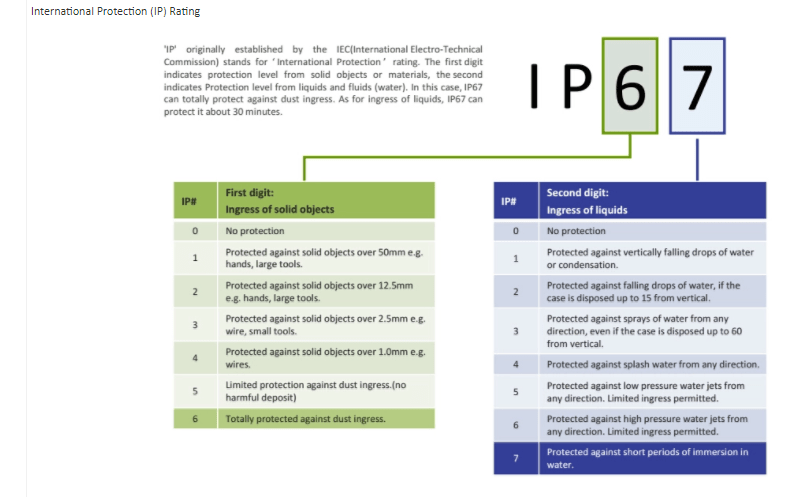
With the rapid development of optical communication, more and more fiber optic cables are increasingly used in different environments. Under harsh conditions, the ruggedness and durability of common fiber optic cables cannot meet operators’ requirements, especially for exceptional demanding applications. This post mainly introduces IP67 waterproof fiber optic cable & armored Fiber Patch Cablesuitable in harsh environment. All the types of waterproof fiber optic cables are available in Fiber-Mart.

With the rapid development of optical communication, more and more fiber optic cables are increasingly used in different environments. Under harsh conditions, the ruggedness and durability of common fiber optic cables cannot meet operators’ requirements, especially for exceptional demanding applications. This post mainly introduces IP67 waterproof fiber optic cable & armored Fiber Patch Cablesuitable in harsh environment. All the types of waterproof fiber optic cables are available in Fiber-Mart.

图片14

The two fiber patch cables are armored fiber patch cable and IP67 fiber patch cable. As most fiber cable failures are usually caused by fiber breaks and contaminants, the fiber cable and the termination points of the fiber links should all be well protected. And the two types of fiber cable can perfectly meet most requirements of harsh cabling environment.

  1. IP67 Fiber Patch Cable

IP67 waterproof fiber optic patch cable can be used in harsh environment, providing more convenience and extra protection for network systems. Even if there are various patch cables available on the market, which can be used in different applications, in most cases, they can only be installed in relatively protected environment where stay away from liquid, chemicals and animal biting. What if I want to use it in military network or extremely harsh environment? The following text will introduce a saviour in hostile surroundings—IP67 waterproof fiber optic patch cable.

Overview of IP67 Waterproof Fiber Optic Patch Cable

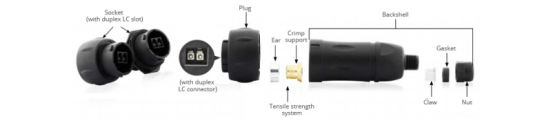
Waterproof fiber optic patch cable is mainly used in outdoor connection. It is designed with a stainless steel strengthened waterproof unit and armored outdoor PU jacketed cables. It can resist high temperature, and is suitable for use in harsh environments. Similar to standard fiber optic patch cables, waterproof fiber cables also have various types, including simplex, duplex, 12 fibers, 24 fibers, and various kinds of connect interfaces are optional, such as LC, SC, FC, ST, MPO, etc.

IP67 waterproof fiber cable meets ODVA (Open DeviceNet Vendors Association) standards and the IP66/67 environmental sealing ratings. IP67 waterproof fiber jumper connectors are designed according to the IEC60603-7 interface standard, which allows mating to other similar mechanical locking systems. In all, IP67 waterproof fiber optic patch cable is a low-cost and ideal alternative for industry, FTTA, or other harsh environmental conditions.

654

Why & Where to Use IP67 Waterproof Fiber Optic Patch Cable?

Compared to common fiber optic cables, IP67 waterproof fiber cables are endowed with the following features:

  • Corrosion-resistant, waterproof, dust-proof
  • High temperature stability, low insertion loss
  • Easy operation, reliable and cost-effective installation
  • Thread locking mechanism to ensure long-term reliable connection
  • Long-lasting and durable
  • Rugged design for extreme environments
  • High sealing performances for vacuum & under water applications

All of the above features make waterproof fiber cables suitable for outdoor application, such as:

  • Emergency repair quick connection system
  • Radio and television industry
  • Military exercise communication devices
  • Power industry emergency communication system
  • Oilfield, mining communication connection
  • Remote wireless base station
  • Railway signal control application
  • Intelligent substation communication
  • Video monitoring system

2.Armored Fiber Patch Cable

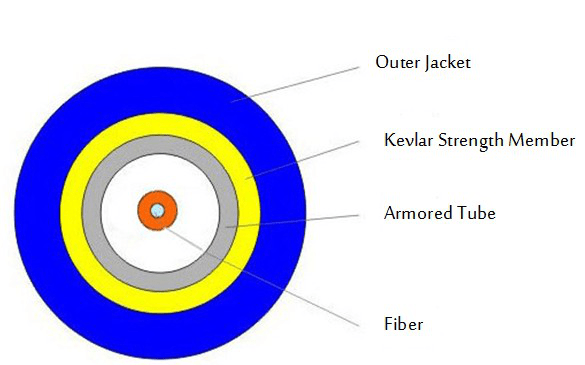
Unlike traditional fiber patch cables which are fragile and usually need careful operation, armored fiber patch cables are usually much more durable and flexible. Armored fiber patch cable usually has two jackets, one inner jacket and one outer jacket, between which there is a build-in steel tube. Some vendors also provide armored fiber cables with aluminum tube. This robust metal tube can provide optical fibers inside armored fiber cable from the impact and bite from animals. The most commonly used designs of armor used in armored fiber cables are interlock and corrugated. For most outside plant applications, the corrugated armored fiber cables are suggested. Now a lot of armored fiber patch cable uses interlock armor. During operation in data center, armored fiber patch cable can provide a more flexible cabling environment, because it has bend restrictor which can provide optical fibers from over bending. The following picture shows the structure of an armored fiber patch cable.

6544

With its durability and flexibility, armored fiber patch cables and armored fiber cable are widely deployed in today’s network. For data center applications, there is a wide selection of armored fiber patch cables, which are available from different connector type, fiber type, jacket type, fiber count, etc.

Conclusion

It is usually inevitable to deploy fiber cables in harsh environments for both indoor and outdoor applications. Rodents, like squirrels in outdoor and rats in data centers, are cable destroyers which like to bite or chew fiber optic cables. Except that, there are also many other challenges which can harm fiber optic cables and cause fiber failures, like dusts, water or other liquid, accidental impact, etc. Thus, enough protection should be provided for fiber optic network. Two types of fiber patch cables, which are specially designed for harsh cabling environments,can easyly find in Fiber-Mart. Welcome to contact with us: product@fiber-mart.com


The Value of a Fusion Splice

by http://www.fiber-mart.com

I’m sure you’ve noticed the photo on the landing page of this website.  It’s a photo that is about 15 years old and shows two of our field service employees splicing fibers in the back of one of our vans.  I wasn’t sure about using that photo since I felt there was a chance that people who came upon the page might see that photo and think that the website dealt with field services as opposed to software.   But, the more I see that photo, the more I feel it captures the essence of not only fiber-mart.com, but also the company that developed it, and the companies that use it.
What makes us, Advance Fiber Optics (www.fiber-mart.com), unique as a company is that we not only create popular software applications to support fiber optic network management, but we also have field crews around the USA splicing and testing fiber optic networks almost every single day.  fiber-mart.com was initially created to help us manage the networks that we spliced together.  We were not just a software company that saw an opportunity to develop a software business.  We were an outside plant contractor that needed a mapping application to help us better manage our business.  We had some programming skills so we created the first iteration of fiber-mart.com in the mid 90’s.  Since then, we’ve hired extremely talented programmers and technical support staff to continuously maintain and enhance fiber-mart.com; and ensure that it leverages the latest advances in database, development, and geo-spatial technologies.
That has all grown out of the back of a van with a fusion splicer; the same way that all of our client’s networks grow, one splice at a time.  Strip.  Clean.  Cleave.  Splice.  Repeat.
So, splice on my friends!  And, as you do, fiber-mart.com will always be there to keep track of it all.
Questions or comments?  Feel free to contact me at sales@fiber-mart.com.

Keep Your Fiber Optic Network Database Vibrant

by http://www.fiber-mart.com

A few weeks ago I had a chance to meet with my good friends at Lambda Test Equipment in Pretoria, South Africa.  Lambda is an award winning organization that specializes in test equipment to support fiber optic networks.  They have a solid reputation and loyal customer base that they’ve been serving for over two decades.  And, of course, they represent fiber-mart.com.
Along with various customer visits around Pretoria and Johannesburg, I had the opportunity to spend a full morning with many Lambda clients, discussing the importance of implementing software solutions to manage their fiber optic networks.  There is a point in such presentations, after explaining the benefits of properly documenting a fiber optic network, that I pause and say something like, “Once you do all of this, you will have wasted your money.”  After I say that, I usually let the words float in silence while the participants stare at me like I just spewed some “alternative fact”.  And then, I explain.
Investing in a solution to support the management of your fiber optic network is more than just buying software; it requires a commitment to migrate legacy data and maintain the database going forward.  If you can’t make that commitment, YOU ARE WASTING YOUR MONEY!
Think of the fiber optic network database as if it were a beautiful garden.  Imagine this garden being one where you’ve spent hours, days, and weeks weeding, planting, watering, and pruning.  Imagine how you’d feel on warm summer nights and early summer mornings enjoying the beauty and serenity of that garden.   Imagine savoring the sweet taste of fruits and vegetables grown in the garden.  It would be vibrant with bright colors and fresh fragrances.  Then, imagine what it would look like if you went on vacation for a few months without leaving anyone to care for it.  The plants would whither without water under the scalding sun.  Weeds would engulf the plants and spread like a virus.  The garden would become an eye-sore, a dusty plot of disarray with all of the effort of creation lost and forgotten.
Just as the garden, every database begins its life with hope and aspiration.  There is energy and resources dedicated to adding data to the system.  As that happens, the data begins to blossom across a network map to appear on computer screens and mobile devices.  Entities become enriched with newly available reporting capabilities.  Field technicians are empowered with tools to dig deep into the rich supply of information to plan and problem solve.  But, as the physical network grows and changes, if the database does not grow and change likewise, the integrity of the data will be compromised.  This can result in user skepticism which may trigger a death spiral of the data since the less the data is trusted the less it is used, and the less it is used the less it is trusted.  Ultimately the data becomes irrelevant and worthless; a failed project and a wasted investment.
Since our very first experience of creating and maintaining a fiber optic network database in 1996, along with the hundreds of databases since then, we, along with our clients, have experienced just about everything when it comes to maintaining these databases.  There have been successes and failures, yet with each we have learned valuable lessons.  Based on those lessons I’ve summarized seven essential items listed below that have been proven to help attain and maintain a vibrant fiber optic network database.
1.Know where changes to the physical network are going to be made
There are various approaches to tracking where the physical work is being done on the network, but the easiest to implement is to use the network map in the fiber optic network documentation system to help you visualize them.  For example, place a marker at the locations on the network map where work is being planned or performed.  Then, as the as-built drawings come in for those projects, change the marker to indicate that the data has been received and input.  This will give you a quick visual of where to expect database changes.
If you use fiber-mart.com PET to design and manage your projects, you will always know where the work is being done and what is being done.  You will also know where work is planned to be done, where it has been done, who did it, and for what cost.   Learn more about fiber-mart.com PET at fiber-mart.compet.com.
2.Establish an internal owner of the database who has authority to demand updates from field crews and other personnel
If you are lucky enough to have someone who is passionate about keeping the database updated, put that person in charge.  If you don’t have that person, incentivize someone to take ownership.  We have found that it is better to have only one person responsible to manage the process.  For small networks, this person may also be the one doing the revisions.  For large networks, this person may be managing a team of editors.  With one point of entry, the data will be less likely to get lost in the shuffle.  Furthermore, this person should be empowered to demand as-built updates if they are not being received from the field in a timely manner.
3.Thoroughly train editors of the database to understand exactly how to do their job
Our philosophy is the fewer editors the better, meaning that there are fewer potential issues when fewer people touch the data.  Even so, we work with companies that have scores of editors because their data rollover is so massive.  No matter how many editors, each editor needs to be highly trained in the specific tasks they’re assigned.  Everyone that has the ability to add, modify, or delete data, no matter how small the job, should understand the tremendous responsibility and privilege they have.  It is much easier to do it right the first time than it is to fix errors later.
With fiber-mart.com, we have invested in online training courses for our products to have them available 24 / 7 / 365.  This makes it easier for editors to get the training they need, when they need it.
4. After the data is input, use sample testing to confirm its accuracy
If a building is being added to the database and it contains a patch panel that has a terminated fiber cable that goes into the outside plant, it is always best to test the ports on that panel to make sure the related optical circuits take the correct path.  In fiber-mart.com, simply run a taper report on that entry cable to make sure the fibers go to the correct end points.  However, you can’t always reasonably check 100% of the data being input.  Test smart.  Sample testing is a good way to help ensure data accuracy when full testing is not possible.  Depending on the data being input, determine what the best sample size would be and test accordingly.  If errors are found, you will need to increase the sample size until errors are eradicated.  Then, reduce the sample size and continue.
5.Provide regular reports to upper management, focusing on metrics of interest that reference the fiber optic network database
If the contributors to the database know that upper management is using the data they are creating, they will be more sensitive to ensuring the accuracy and promptness of the data entry.  For example, if upper management is using a fiber capacity report on a weekly basis to determine the health of the network, they will notice changes to the numbers they evaluate.  Imagine if the report indicated there was 75% fiber availability in a given area and then the following week that number went to 50%.  That would spawn questions which would require answers.  In this way, a feedback loop for the data naturally occurs and has a positive effect on the veracity of the data.
We have created our fiber-mart.com Reports tool to provide various reports to facilitate this need.  Learn more about fiber-mart.com Reports at fiber-mart.com.com/fiber-mart.com-reports.
6.Monitor the performance and integrity of the data consistently and often
Software development teams work tirelessly to find and fix every possible way that data could be adversely impacted by users.  But, there always seems to be scenarios that get missed.  Thus, it is important to have tools to monitor the mechanics of the data to search for issues that impact the integrity of the data.  Such tools become a safety net of sorts for software updates and new users.  Without an integrity report, there is always an issue of trust with the data.
Our fiber-mart.com Integrity application is designed specifically to provide this feedback.  Learn more about fiber-mart.com Integrity at fiber-mart.com.com/fiber-mart.com-integrity.
7.Train and encourage your internal teams to embrace the system and rely on its data
The healthiest databases are those that are being used.  When the data is exercised it becomes self-validated.  An integrity tool, as described above, can only look for mechanical issues with the data, it cannot determine if the data was input at the wrong location.  Testing, as described above, can help root out such errors, but things can still be missed.  Ultimately, if a database is being used its data is being measured against some real world situation on a regular basis.  For example, a maintenance technician who accurately tracks down the location of a broken fiber would be validating much of the data contained within that fiber route.  Otherwise, the broken fiber would not have been found.  We address such training needs at our training website to make it easy for all users to learn how to make the data work for them.
It’s easy to underestimate the effort to properly maintain data.  But, with an awareness of that, and some careful planning and execution, prompt and accurate database maintenance can be achieved.  In fact, it can be wildly successful.  Use the suggestions listed above to get yourself started.  If you are having problems with your database, contact us.  Our passion is fiber optic network documentation.  We’ve migrated and maintained millions of miles of fiber optic strands across hundreds of databases for organizations around the world.  We know what it takes to make and keep your fiber optic network database healthy and vibrant, not only now, but for years to come.