Tag: SFP+ transceiver
Passive CWDM VS DWDM – Which to choose?
With current industry advancements trend that has equalized costs of transceivers, in technical battle of CWDM vs DWDM more advancements are in DWDM.
Lets compare passive CWDM vs DWDM from pure technical application viewpoint:
CWDM vs DWDM – Channel Uniformity:
As CWDM spectrum for 18 channels spans from 1260nm up to 1620nm compared to DWDM C-band 1530 – 1565 nm, CWDM has weakness from channel uniformity aspect. Attenuation in wide spectrum is different based on wavelength – for example, typical attenuation of G.652.C optical fiber is 0.38 dB/km at 1310nm wavelength and 0.22 dB/km at 1550nm. So in CWDM system You can get quite great disparity of channel optical performance using different CWDM wavelength. Uniformity of optical channels across whole 1260-1620nm spectrum depends on fiber cable specification. – we suggest checking carefully if You plan using passive CWDM. Especially it is very important for old G.652 specification fiber – it has so called “water-peak” phenomena in range of 1390 and 1490 nm that are not usable for CWDM connections at all. DWDM is clear winner here – due it’s narrow spectrum channel properties on same fiber will be almost identical.
CWDM vs DWDM – Capacity:
It’s clear winner here – while maximum capacity of CWDM system is 18 wavelengths all spectrum, DWDM using traditional C-Band 1530 – 1565 nm allow to have 45 100GHz spaced DWDM channels, but with introduction of 50 GHz spaced transceivers we can double number of channels up to 90. In future, we can expect to have 25 GHz and even 12.5 GHz frequency offset even multiplying number of possible channels to 180 or 360. If that is not enough – there is S-band (1460-1530 nm) and L-band (1565-1625 nm) which can be used with DWDM as well, just is not mainstream yet.
CWDM vs DWDM – Distance:
Maximum distance of xWDM connection depends on two main factors – maximum budget of optical transceivers and attenuation of all passive elements – fiber itself, number of joints and splices, attenuation of passive filters (Chromatic dispersion as well, but we don’t consider it much a factor up to 80km). If looking on 10G connection data rate, with both, CWDM and DWDM, passive technologies You can have up to 23 dB guaranteed budget using popular SFP+ transceivers (With XFP You can have 26dB budget), what is enough to have 80km WDM link with both technologies. But big advantage of DWDM is, that due it’s narrow spectral width it’s possible to use cost efficient and widely available EDFA (Erbium Doped Fiber Amplifier) boosters, which is one very cost efficient way allowing extension of DWDM reach.
CWDM vs DWDM – Spare Parts:
Even optical transceivers are mature elements and failure-rates are very uncommon, introducing WDM technology You would like to have backup stock of all active elements. If You are planning to have just small scale deployment and connect just two or few network nodes, it could mean that You basically need to back up everything – resulting on doubling up of your investment. DWDM is a winner here as well, due availability of Tunable DWDM transceivers, with can replace all Your different wavelength DWDM transceivers with one or two units.
Conclusion
CWDM still has price advantages for connection rates below 10G and for short distances with low data rates it’s currently most feasible technology. For more information,welcome to visit www.fiber-mart.com, pls feel free to contact me at service@fiber-mart.com
How to choose 3G Digital Video SFP ?
In fiber optic network industry, Digital video SFP is responsible for transmitting HD or higher standard video.
In fiber optic network industry, Digital video SFP is responsible for transmitting HD or higher standard video, so there are 3G digital video SFPs suitable for SD/HD/3G-SDI. and so more and more people are interested in SFP modules.
What is SDI?
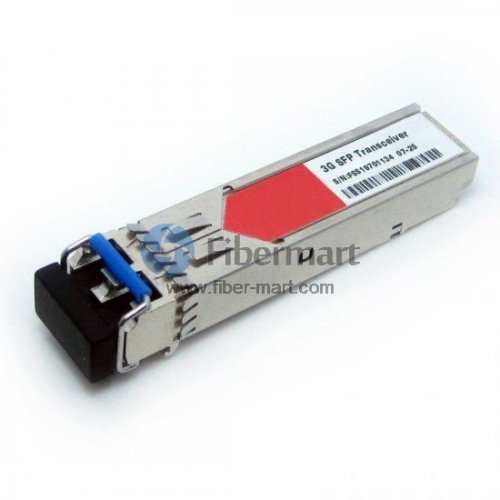
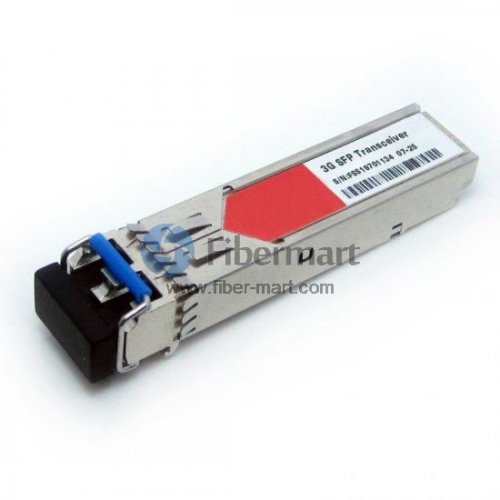
Digital Video SFP is a 3G-SDI standard optical transceiver designed to transmit SDI, HD-SDI, or DVB digital video signals over fiber. It is a dual channel optical transmitter module which transmits optical serial digital signals that defined in SMPTE 297-2006.

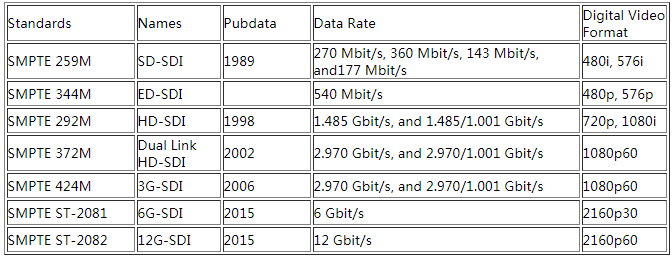
Fiber Optic Transport of HD/SD-SDI It is becoming increasingly necessary and economically feasible to transport HD/SD-SDI signals over fiber instead of coaxial cable. SDI, the abbreviation for Serial Digital Interface, is a digital video interface standard made by SMPTE organization. This serial interface transmits every bit of data word and corresponding data through single channel. Due to the high data rate of serial digital signal(a kind of digital baseband signal), it must be processed before transmission.Additional SDI standards include HD-SDI, 3G-SDI, 6G-SDI, and 12G-SDI. HD-SDI was standardized by SMPTE 372M in 1998. It can support 1.485Gbps interface. 3G-SDI consists of a single 2.970Gbps serial link that allows replacing dual link HD-SDI.
3G Digital Video SFPs Types
3G digital video SFPs include 3G SDI SFP, BiDi SFP and CWDM SFP. According to different standards, it can be divided into different types. Based on the transmission mode, it can be divided into single Tx, single Rx, dual Tx, dual Rx and TR transceivers; by standards into MSA and non-MSA; by operating wavelength into 1310nm, 1490nm, 1550nm and CWDM wave length.It also exists video modules of electrical interfaces that adapting mini BNC port to coordinate with SFP slot-supporting digital matrix. Currently there are also on the market some crossover video transceivers, for example, transfer the encoded SG-SDI to IP protocol conversion module can be used in traditional Ethernet switch, replacing video codec equipment. 3G digital video SFPs also have 3G video SFP and 3G video pathological patterns due to different applications.the data rate of digital SDI as below.

Now we say that what are 3G-SDI pathological patterns? Pathological patterns, also called SDI proving ground, are a whole test signal. And it must be done during blackout. This signal is tough to handle by serial digital system, and significant to check the system performance. Pathological patterns often contain the richest low-frequency energy which statistically happens one per frame. Pathological patterns test is also an important indicator of video SFP modules. Fiber-Mart provides a series of 3G-SDI SFP modules to support transmission rates from 50 Mbps to 3 Gbps. These digital video modules are specifically designed for SMPTE SDI pathological patterns, allowing hot-plug capability with the 20-pin SFP connectors.
According to this article, i believe you have known some knowledges about 3G Digital Video SFP. Fiber-MART can provide you custom service and a series of 3G-SDI SFP modules to support transmission rates from 50 Mbps to 3 Gbps. Any question pls not hesitate to contact us.E-mail:service@fiber-mart.com
What is SFP+ Direct Attach Copper Cable(DAC)?
In today’s market, Direct Attach Cables (DAC)provide an excellent pre-terminated and factory assembled & tested solution for both copper and fiber optic cabling in data centers.
In today’s market, Direct Attach Cables (DAC)provide an excellent pre-terminated and factory assembled & tested solution for both copper and fiber optic cabling in data centers. It is a kind of optical transceiver assembly widely applied in storage area network, data center, and high-performance computing connectivity etc. The DAC cables are used to connect one mobility access switch with another when forming a stack.
Direct-Attach Cables (DAC) are cost efficient close-range interconnection media widely used in telecom operator equipment rooms, data centers and corporate networks for connecting LAN and SAN equipment in same or neighboring racks. Our multi-vendor compatible Direct-Attach Cables portfolio support full range of transmission speeds from 10 Gbps up to 100 Gbps applications, customizable length of cables and current most popular interface assembly form factors – QSFP and SFP. Our multi-vendor compatible Direct-Attach Cables portfolio is compatible with 80% of networking equipment, where is not implemented a special algorithm for protection against third party modules. However – we can provide Direct-Attach Cables with custom-encoded firmware in order to make it work almost in any equipment and we can support encoding of each end to support different vendor equipment, allowing using Direct-Attach Cables as cross-platform interconnection medium.
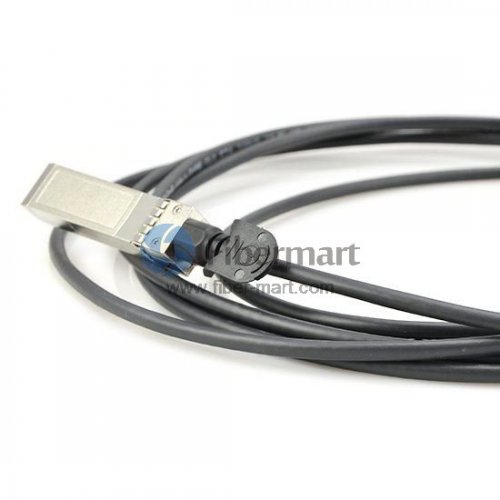
SFP+ direct attach cable (DAC) is a fixed assembly that is purchased at a given length, with the SFP+ connector modules permanently attached to each end of the cable. SFP+ DAC provides high performance in 10 Gigabit Ethernet network applications, using an enhanced SFP+ connector to send 10 Gbps data through one paired transmitters and receivers over a thin twinax cable or fiber optic cable. The 10G SFP+ Cable is designed to use the same port as an optical transceiver, but compared with optical transceivers, the connector modules attached to the cable leave out the expensive optical lasers and other electronic components, thus achieving significant cost savings and power savings in short reach applications.
SFP+ DAC is a low cost alternative to traditional fiber and twisted-pair copper cabling in data center deployments. SFP+ DAC provides better cable management for high-density deployments and enhanced electrical characteristics for the most reliable signal transmission

Passive and Active 10G SFP+ Direct Attach Cable (DAC)
SFP+ Direct Attach is known as the successor technology to 10GBASE-CX4. SFP+ Direct Attach, as implied in the name, uses SFP+ MSA and by using the inexpensive copper twinaxial cable with SFP+ connectors on both sides, provides 10 Gigabit Ethernet connectivity between devices with SFP+ interfaces. SFP+ Direct Attach has a 10 meter distance limitation, thus the target application is interconnection of top-of-rack switches with application servers and storage devices in a rack.
Passive cables are much less expensive but require the host to do the work of driving it properly.
Benefits:
- Lower Costs
- Higher Reliability
- Lower Power Consumption
- Plug and Play Simplicity
Fewer Components (No Active Tx /Rx Components)
Only Capacitors, Resistors, EEPROM, Cable
Tradeoffs:
- Reduced Cable Flexibility
- Reduced Modularity
- Limited Distance
- No LOS
- No TX Disable
- No Interrupts
- Limited Management Interface
- Host must drive Cu cable
Active cables offer the benefit of optical-module.
Benefits:
- Enhanced Signal Integrity
- Longer Cable Lengths
- Transmit Pre-emphasis
- Active/Adaptive Receive Equalization
- Tx Disable
- Loss of Signal (LOS)
- Interrupts
- Management Interface
Tradeoffs:
- Higher price
Fiber-Mart supplies various kinds of high speed interconnect DAC cable assemblies. All of our direct attach cables can meet the ever growing need to cost-effectively deliver more bandwidth, and can be customized to meet different requirements. For more information, pls visit www.fibermart.com. pls not hesitate to contact us for any question:service@fiber-mart.com
Guide to SFP+ Transceiver For 10 Gigabit Ethernet
Fiber Optic Transceiver
SFP modules allows for an optical or electrical interface when using a managed switch, unmanaged switch or media converter. These interchangeable SFP modules are available for use with copper media, multimode optical fiber
With the economic development, the communication technologies are increasingly applied to all walks of life.
Let’s talk about SFP Transceiver-—Data can usually travel only one way in a fiber optic cable, so most transceivers have two ports for bidirectional communication: one for sending and the other for receiving signals. Alternatively, a single cable can be used, but it can only send or receive data at a time but not both. The opposite end of the transceiver has a special connector for fitting it into specific models of enterprise-grade Ethernet switches, firewalls, routers and network interface cards. A modern fiber optic transceiver is a small device because it is intended to plug into the aforementioned network devices; this type of transceiver is called a small form-factor pluggable transceiver.
SFP modules allows for an optical or electrical interface when using a managed switch, unmanaged switch or media converter. These interchangeable SFP modules are available for use with copper media, multimode optical fiber, or single mode optical fiber. The optical fiber SFP modules are available in Fast Ethernet one and two fiber versions and Gigabit Ethernet one and two fiber versions.
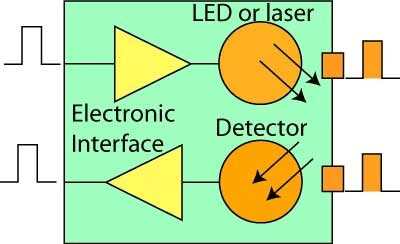
Transceivers include transmission and receiver in a single module. The transmitter takes an electrical input and converts it to an optical output from a laser diode or LED. The light from the transmitter is coupled into the fiber with a connector and is transmitted through the fiber optic cable plant. The light from the end of the fiber is coupled to a receiver where a detector converts the light into an electrical signal which is then conditioned properly for use by the receiving equipment. And this is conversion from electricity to light, light to electricity.

They also are available with LC or SC optical connectors.A fiber optic transceiver is a device that uses fiber optical technology to send and receive data. The transceiver has electronic components to condition and encode/decode data into light pulses and then send them to the other end as electrical signals. To send data as light, it makes use of a light source, which is controlled by the electronic parts, and to receive light pulses, it makes use of a photo diode semiconductor.
As with most devices, there are many kinds and models of transceivers available, which range in size, performance and price.
Transmitting Rates and Range—Both the single-mode and multi-mode fiber optic transceiver can handle the 10G speeds. However, distance requirements are quite critical. The multi-mode optical transceivers generally have a reach of approximately 550 meters, while the single-mode transceivers can get you through 10 km, 40 km, 80 km and even farther.
Price—The optics used in the single-mode fiber are twice those used in the multimode fiber. But when installed as part of a project, the extra cost of single-mode fiber is negligible compared to multimode fiber. The fragility and increased cost to produce single-mode fiber makes it more expensive to use.
Compatibility—When it comes to issues dealing with compatibility, the two types of transceivers are not compatible. You cannot mix the multi-mode and the single-mode fiber between any two endpoints.
Power Dissipation—Multimode transceivers consume less power than single-mode transceivers, which is an important consideration especially when assessing the cost of powering and cooling a data center.
Fiber-MART is is a leading communication systems technologies integrator and optical solutions provider. We are dedicated to helping you build, connect, protect and optimize your optical infrastructure.pls feel free to contact with us for any question. e-mail: service@fiber-mart.com