CABLE TIES FOR CABLE BUNDLING SOLUTIONS

by http://www.fiber-mart.com

Cable ties are necessary tools for cable or wire organizing or bundling solutions. A cable tie is also known as a zip tie or tie-wrap, it is type of fastener, expecially for binding bulk and organize electronic or fiber cables or wires together. The cable ties are usually made of very strong and durable materials, and they can usually used for multiple purpose such as gardening, decoration or even electrical purpose. Ingellen is one of China’s main fiber optic cable manufacturers providing not only series fiber optic cables but also many other cable management tools, among which are the cable ties available in a wide range of sizes, styles and materials for fastening, bundling, clamping and identifying in a variety of applications throughout the physical infrastructure. Velcro cable ties and Nylon cable ties are two kind of common bundling solutions for fiber optic cable or wires that are available from Ingellen.
Nylon Cable Ties
Nylon cable tie is a common form of cable ties. A nylon cable tie consist of a tape section with triangular teeth that slope in one direction. At the head of the cable tie there is a slot with a flexible pawl that rides up the slope of these teeth when the tape is inserted. The pawl engages the blackside of these teeth to stop removal of the tape. Ingellen nylon cable is made up of Nylon 6.6, which is especially ideal for outdoor use because of its high strength and a wide temperature range. It meet UL 94 V-2 flammability classification and military specification MS 3367, structure with teeth on both sides for enhance strength and is used in continuous or extended exposure to high temperatures up to 250°F.
Magic Velcro Cable Ties
Velcro is known as magic tie. Velcro is the brand name of a company that produces the first commercially marked Velcro cable ties. Velcro tie is actually a hook and loop cable tie. A velcro cable tie wraps around wires, cables and objects and then back onto themselves for a secure hold. Because a velcro cable tie is made using soft and flexible, hook and loop materials, they are gentle on cables. This characteristic is what makes them such a popular choice for securing CAT-5 cables and fiber optic wiring. Velcro cable ties have grown in popularity in part because they are reusable and so easy to use. Ingellen provides Velcro cable ties in different colors including blue, black, gray, red and green and sized with 20 x180, 20 x160 MM hook and loop.
Generally cable ties no matter Velcro cable ties and Nylon cable ties are important components used to secure wire bundles and harness components quickly, they are usually with flexible designs that allows user to slip ties easily under and around cables and harnesses, and they can be used with most standard tensioning/cutoff tools for fast production line fastening. There are now host of cable ties wholesalers or distributers in the markets, choosing the good and reputable ones for your suppliers is very important because it means the cable ties are totally comply with or even exceed the industry standards to delivery the maximum reliability and optimize your cable tie installation safety and speed, and as the result, contributing to lower totally cost.

WHAT IS ARMORED FIBER OPTIC PATCH CABLES

by http://www.fiber-mart.com

An armored fiber patch cable is a fiber optic patch cable with stainless armor inside the cable jacket to protect the central unit of the cable. It is considered to be an advanced or structures improved fiber optic patch cable. Because of the special structures that the armored fiber optic patch cable has, it makes the armored fiber patch cord shares some special features compared with the standard fiber patch cables, which can be listed below:
Armored fiber optic patch cable retain all the features of standard patch cord, but they are much more strong and flexible. Because of the stainless steel armor inside, it can be resistant of high tension and pressure, even it is step by an adult person, the armored fiber optic patch cables will not get damaged. It is also almost impossible to be bent or dragged to broken. Armored fiber patch cable also shares anti-rodents features, when they are used for outdoor use, people do not need to worry about the rodent animals like rates may bite the cables and make them broken. Usually the armored fiber optic patch cords are smaller outer diameter than the standard patch cords, this make them space saving and actually light weight. And they can be handled as easily as other electric cables. Armored fiber patch cables are with different jacket colors or jacket types like PVC, PE or OFNR and different types of termination types including SC, ST, FC, LC, MU,SC/APC, ST/APC,FC/APC,LC/APC etc.
Get the summary from the above, the armored fiber optic patch cables are designed for being used in harsh environment, in which the traditional standard fiber optic patch cable can not fit or get good performance. It is made with special strong connector and fiber armored cable, it can protect the cable from damage caused by twist, pressure or rodent bite. Installation procedure and maintenance is also easy when use the armored fiber patch cables, which is actually an ideal choice for people who is looking for fiber optic patch cords with additional durability, protection and light weight features. Ingellen online wholesale platform which ingellen.com supplies ranges of armored fiber optic cables for different application requirements like simplex or duplex SM9/125, OM1 62.5/125, OM2 50/125, 10G OM3 or OM4 fiber patch cables with SC,FC,ST,LC,MU,MTRJ,UPC,APC connector types. 10G OM3 fiber armored optic patch cable with 50/125 multimode is typically used in 10 Gigabit Ethernet to transmit 10G signals and the bandwidth supported is as specified IEEE802.3z. And our OM4 fiber optic patch cable assemblies are ready to meet the requirement for future 40G and 100G fiber optic networks, the flexible, light and compact features of the OM4 armored fiber patch cables makes it an ideal alternative to standard OM4 patch cables where excellent crush and kinking resistance. Buy armored fiber optic cables no matter armored fiber patch cables or fiber armored cables from professional fiber optic cable manufacturer, Ingellen Technology.

A COMPREHENSIVE UNDERSTANDING OF FIBER OPTIC CONNECTORS

by http://www.fiber-mart.com

Fiber optic connectors have traditionally been the biggest concern in using fiber optic systems. While connectors were once unwiedy and difficult to use, connector manufacturers have standardized and simplified connectors greatly. This increases the user use convenient increase in the use of optical fiber systems; It is also emphasising taken proper care of and deal with the optical connector. This article covers connector basics including the parts of a fiber optic connector, installing fiber optic connectors, and the cleaning and handling of installed connectors. For information on connector loss, see Connector Loss Test Measurement. Optical fiber to fiber optic interconnection can be made by a joint, a permanent connection, or a connector, and is different from the plug in it can be to disconnect and reconnect. Fiber optic connector types are as various as the applications for which they were developed. Different connector types have different characteristics, different advantages and disadvantages, and different performance parameters. But all connectors have the same four basic components.
The Ferrule: The fiber is installed in a long, thin cylinder, the ferrule, which act as a fiber alignment mechanism. The ferrule is bored through the center at a diameter that is slightly larger than the diameter of the fiber cladding. The end of the fiber is located at the end of the ferrule. Ferrules are typically made of metal or ceramic, but they may also be constructed of plastic.
The Connector Body: Also known as the connector housing, the body holds the ferrule. It is usually constructed of metal or plastic and includes one or more assembled pieces which hold the fiber in place. The details of these connector body assemblies vary among connectors, but the welding and/or crimping is commonly used to attach strength members and cable jackets to the connector body. The ferrule extends past the connector body to slip into the couping device.
The Cable: The cable is attached to the connector body. It acts as the point of entry for the fiber. Often, a strain relief boot is added over the junctioni between the cable and the connector body, providing extra stength to the junction.
The Coupling Device: Most fiber optic connectors do not use the male-female configuration common to electronic connectors. Instead, a coupling device such as an alignment sleeve is used to mate the connectors. Similar devices may be installed in fiber optic transmitters and receivers to allow these devices to be mated via a connector. These devices are also known as feed-through bulkhead adapters.
Cleaving Cleaving involves cutting the fiber end flush with the end of the ferrule. Cleaving, also called the scrible-and-break method of fiber end face preparation, takes some skill to achieve optimum results. Properly handled, the cleave produces a perpendicular, mirror-like finish. Incorrect cracks will cause the lips and the comb as shown in Figure 2. While cleaving may be done by hand, a cleaver tool, available from such manufacturers as Fujikura and FiberStore, allows for a more consistent finish and reduces the overall skill required. The steps listed below outline one procedure for producing good, consistent cleaves such as the one shown in Figure 3. 1. Place the blade of the cleaver tool at the tip of the ferrule. 2. Gently score the fiber across the cladding region in one direction. If the scoring is not done lightly, the fiber may break, making it necessary to reterminate the fiber. 3. Pull the excess, cleaved fiber up and away from the ferrule. 4. Carefully dress the nub of the fiber with a piece of 12-micron alumina-oxide paper. 5. Do the final polishing.
The use of index-matching gel, a gelatinous substance that has a refractive index close to that of the optical fiber, is a point of contention between connector manufacturers. Glycerin, available in any drug store, is a low-cost, effective index-matching gel. Using glycerin will reduce connector loss and back reflection, often dramatically. However, the index-matching gel may collect dust or abrasives that can damage the fiber end faces. It may also leak out over time, causing backreflections to increase.

Understanding Loss in Fiber Optic & How to Reduce It ?

Fiber optic cable, which is lighter, smaller and more flexible than copper, can transmit signals with faster speed over longer distance. However, many factors can influence the performance of fiber optic transmission. Losses in optical fiber are negligible issues among them, and it has been a top priority for every engineer to work with and figure out solutions for.

Fiber optic cable, which is lighter, smaller and more flexible than copper, can transmit signals with faster speed over longer distance. However, many factors can influence the performance of fiber optic transmission. Losses in optical fiber are negligible issues among them, and it has been a top priority for every engineer to work with and figure out solutions for.

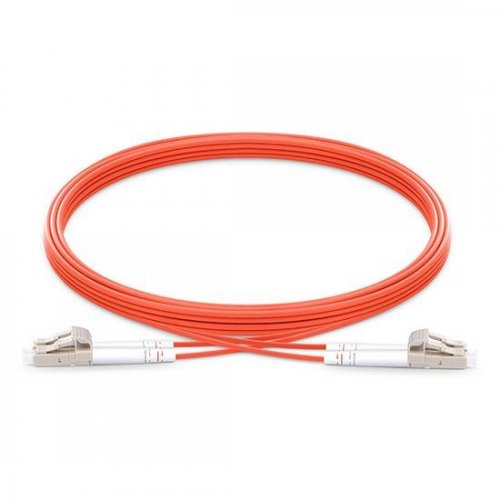
Light traveling in an optical fiber loses power over distance. The loss of power depends on the wavelength of the light and on the propagating material. For silica glass, the shorter wavelengths are attenuated the most (see Fig. 1). The lowest loss occurs at the 1550-nm wavelength, which is commonly used for long-distance transmissions.
44

Transmission of light by fibre optics is not 100% efficient. There are several reasons for this including absorption by the core and cladding (caused by the presence of impurities) and the leaking of light from of the cladding. When light reflects off the cladding /core interface it actually travels for a short distance within the cladding before being reflected back. This leads to attenuation (signal reduction) by up to 2db/Km for a multi-mode fibre. For example, with this level of attenuation, if light travelled over 10kM of cable only 10% of the signal would arrive at the following end.

The amount of attenuation for a given cable is also wavelength dependent. Figure 1 shows the attenuation profile for the two main types of fibre; multi-mode and single-mode cable (described in detail below). The absorption peak at 1000nm is caused by the peculiarities of single mode fibre while the peak at 1400nm is caused by traces of water remaining in the fibre as an impurity. Due to this water absorption peak there are two standard single-mode wavelengths in use, 1310nm and 1550nm. 1310nm has been a standard for many years, only now is there a trend towards using 1550nm brought about by the need to extend the distances between repeaters.

The loss of power in light in an optical fiber is measured in decibels (dB). Fiber optic cable specifications express cable loss as attenuation per 1-km length as dB/km. This value is multiplied by the total length of the optical fiber in kilometers to determine the fiber’s total loss in dB.

Optical fiber light loss is caused by a number of factors that can be categorized into extrinsic and intrinsic losses:

  • Extrinsic
  • Bending loss
  • Splice and connector loss
  • Intrinsic
  • Loss inherent to fiber
  • Loss resulting from fiber fabrication

1

Figure 1. Optical fiber operating wavelengths.

  • Fresnel reflection

Bend Loss. Bend loss occurs at fiber cable bends that are tighter than the cable’s minimum bend radius. Bending loss can also occur on a smaller scale from such factors as:

  • Sharp curves of thefiber core
  • Displacements of a few millimeters or less, caused by buffer or jacket imperfections
  • Poor installation practice

This light power loss, called microbending, can add up to a significant amount over a long distance.

Splice and Connector Loss. Splice loss occurs at all splice locations. Mechanical splices usually have the highest loss, commonly ranging from 0.2 to over 1.0 dB, depending on the type of splice. Fusion splices have lower losses, usually less than 0.1 dB. A loss of 0.05 dB or less is usually achieved with good equipment and an experienced splicing crew. High loss can be attributed to a number of factors, including:

  • Poor cleave
  • Misalignment of fiber cores
  • An air gap
  • Contamination
  • Index-of-refraction mismatch
  • Core diameter mismatch to name just a few.

Losses at fiber optic connectors commonly range from 0.25 to over 1.5 dB and depend greatly on the type of connector used. Other factors that contribute to the connection loss include:

  • Dirt or contaminants on the connector (very common)
  • Improper connector installation
  • A damaged connector face
  • Poor scribe (cleave)
  • Mismatched fiber cores
  • Misaligned fiber cores
  • Index-of-refraction mismatch

Loss Inherent to Fiber. Light loss in a fiber that cannot be eliminated during the fabrication process is due to impurities in the glass and the absorption of light at the molecular level. Loss of light due to variations in optical density, composition, and molecular structure is called Rayleigh scattering. Rays of light encountering these variations and impurities are scattered in many directions and lost.

The absorption of light at the molecular level in a fiber is mainly due to contaminants in glass such as water molecules (OH-). The ingress of OUT molecules into an optical fiber is one of the main factors contributing to the fiber’s increased attenuation in aging. Silica glass’s (Si02) molecular resonance absorption also contributes to some light loss.

Figure 1 shows the net attenuation of a silica glass fiber and the three fiber operating windows at 850, 1310, and 1550 nm. For long-distance transmissions, 1310- or 1550-nm windows are used. The 1550-nm window has slightly less attenuation than 1310 nm. The 850-nm communication is common in shorter-distance, lower-cost installations.

Loss Resulting from Fiber Fabrication. Irregularities during the manufacturing process can result in the loss of light rays. For example, a 0.1 percent change in the core diameter can result in a 10-dB loss per kilometer. Precision tolerance must be maintained throughout the manufacturing of the fiber to minimize losses.

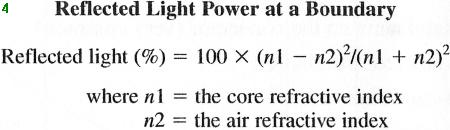
Fresnel Reflection. Fresnel reflection occurs at any medium boundary where the refractive index changes, causing a portion of the incident light ray to be reflected back into the first medium. The fiber end is a good example of this occurrence. Light, traveling from air to the fiber core, is refracted into the core. However, some of the light, about 4 percent, is reflected back into the air. The amount being reflected can be estimated using the following formula:
2

At a fiber connector, the light reflected back can easily be seen with an optical time domain reflectometer (OTDR) trace. It appears as a large upward spike in the trace. This reflected light can cause problems if a laser is used and should be kept to a minimum.

The reflected light power can be reduced by using better connectors. Connectors with the “PC” (Physical Contact) or “APC” (Angle Physical Contact) designations are designed to minimize this reflection.

How to Reduce Losses in Optical Fiber?

In order to ensure the output power can be within the sensitivity of the receiver and leave enough margin for the performance degradation with the time, it is an essential issue to reduce the losses in optical fiber. Here are some common approaches in fiber link design and installation.

  • Make sure to adapt the high-quality cables with same properties as much as possible.
  • Choose qualified connectors as much as possible. Make sure that the insertion loss should be lower than 0.3dB and the additional loss should be lower than 0.2dB.
  • Try to use the entire disc to configure (single disc more than 500 meters) in order to minimize the number of joints.
  • During splicing, strictly follow the processing and environment requirements.
  • The connecting joints must have excellent patch and closed coupling so that can prevent the light leakage.
  • Make sure of the cleanliness of the connectors.
  • Choose the best route and methods to lay the fiber cables during design the construction.
  • 3
  • Select and form a qualified construction team to guarantee the quality of the construction.
  • Strengthen the protection work, especially lightning protection, electrical protection, anti-corrosion and anti mechanical damage.
  • Use high quality heat-shrinkable tube.

Summary

When it comes to high-quality fiber patch cables that help in reducing losses in optical fiber, Fiber-Mart offers bend insensitive fiber (BIF) patch cables with ultra low insertion loss (IL) and bend radius, ensuring high performance of data transmission.I believe you can find a suitable fiber optic patch cable for your devices in Fiber-Mart.please contact us: product@fiber-mart.com.

 

FIBER CONNECTOR AND ADAPTER PANEL FOR OPTICAL LINKS TOGETHER

by http://www.fiber-mart.com

Fiber optic connector is used for the connection of optical fibers or fiber optic cables. The Optical Connector provide a mechanical connection for the two fiber cables and align both cores precisely.
There have been over 100 connectors developed over the years, but a select few have stood the test of time and beat out their competition. Fiber Optic Connectors according to the different transmission media can be divided into common silicon-based optical fiber single-mode and multimode connectors, as well as other issues such as plastic and as the transmission medium of optical fiber connector; connector structure can be divided into: FC SC, ST, LC, D4, DIN, MU, the MT and so on in various forms, but SC and LC connectors are the most common types of connectors on the market. ST connector is the most popular connector for multimode networks. Different connectors are required for multimode and single-mode fibers.
In addition to connectors that tie two fiber-optic lines together, there are also Metal Adapter Panel (or fiber adapter plates) that can be used to connect multiple fiber-optic lineself. It enables you to make quick and easy fiber patch panel connections as they can snap into the enclosures easily. In a device such as this, connections can be made between any of the lines plugged into the panel. Though a single adapter panel can usually only hold a dozen or so cables, the panels can also be spliced together, allowing hundreds or thousands of connections to be made.
Specify optical fiber adapter plates for ST-, FC-, SC-, MT-RJ- or LC-type connections. Adapter plates are compatible with all wall and rack mount optical fiber enclosures and available in 6 simplex and duplex, 8 simplex and duplex and 6 quad configurations with fiber counts of up to 24 per adapter plate. They mount easily by means of plunger locks (“pushpins”). ST, FC, SC and LC connec-tor plates can be equipped with 62.5-μm and 50-μm adapters suitable for multimode applications or a sisingle modenly version is available with adapters outfitted with zirconia ceramic sleeves. Our SC and LC 10G multimode laser optimized adapter uses zirconia ceramic sleeves.
Series Features
Available in 6-, 8-, and 12-port fiber configurations,
Panel options available include ST, SC, LC and others,
High density applications can be reached through Dual and Quad LC applications,
Composite, Metal, or Ceramic sleeve options available,
Blank panels are available for use as dust covers,
Plates are available for mounting Bezel style jacks creating a mixed media environment.
In order to customize wall mount or rack mount fiber optic enclosures, FiberStore offers a wide selection of panels with various FC Adapter including ST, SC, MTRJ and LC. All modular adapter panels are assembled with industry standard adapters. FiberStore fiber adapter panels/plates can come with various fiber adapters, such as LC/SC/ST/FC/MT-RJ, E-2000 fiber optic adapters, compatible with simplex or duplex and meet TIA/EIA-568-B.3 requirements. Our adapter plates include phosphor bronze or zirconia ceramic split sleeves to fit specific network requirements. LC and SC adapter housing colors follow the TIA/EIA-568-C.3 suggested color identification scheme. Multimedia modular panels allow customization of installation for applications requiring integration of fiber optic and copper cables. Blank fiber adapter panels reserve fiber adapter panel space for future use.

EPOXY AND POLISHING TERMINATING FIBER OPTIC CABLES GUIDE

by http://www.fiber-mart.com

Article about how to terminate fiber optic cables with expoxy, which is the most cheap, fast and easy method among all the fiber cable termination ways. Go on read! When you have bulk fiber optic cables on hand and need to terminate it with the fiber optic connectors, there are several options for you to handle this job: Epoxy and polish, mechanical cleave and crimp, and the chemical permanent method, fusing splicing the pigtails. The aim of terminating the fiber optic cables is to provide protections for the stripped fiber end in the connector. Poor termination job will result in large optical loss, even cause damages to the connectors and adapters. Among all the method mentioned above, epoxy and polishing is the cheap, fast and easy and low optical loss, so it is welcomed by most cable installers. Follow the steps and see how to terminate fiber optic cables with the Epoxy.
First, prepare you cable by stripping the cable down to the bare fibers with a fiber stripper which you can get from FiberStore. After that, mix the epoxy resin and hardener that you have prepared ahead, and load them into a syrine( Ignore this step,if you are using a pre-loaded epoxy syringes). Now, it’s time to injuct the expoxy directly from the syringe into the connector ferrule.
Once you have prepared your connector with the epox, you re read to insert the fiber cable so that the cable is seated inside of the connector wall and the bare fiber core sticks out about a half an inch from the front of the ferrule. If your cable is jacked, you will need to use the cable crimping tool to protect the connector to the jacket and strength members of the cables. Two crimps would be necessary to finish the job properly.
The next step is curing the epoxy in the connectors. You may need to place the connected end into a curing holder first to make sure that the end of fiber will not get damaged in the process of curing. Then place the cable and curing holder into a curing oven, situate the connector to make the end is facing down, by doing which, it will ensure the epoxy does not come out of the back side of the connector and compromise the strength member of the cable. As to the curing time and the temperature,follow the instruction book of your specific epoxy.
Once the epoxy are cured sufficiently, cleave the excess fiber core with a fiber cleaver tools as close to the ferrule tips as possible while avoiding any sort of twisting motion. After that, remember to dispose the fiber clipping, which could easily end up in your skin or even in you eye or respiratory system.
After the cleaving and disposing jobs done, you are ready to move on to the next step, polishing the fiber end to a smooth finish. Get a fiber polishing machine to effectively remove any excess epoxy from the ferrule tip and buff out the imperfections on the face of the fiber. A coarse surface would cause the optical loss when the light is passing through it.
When you are satisfied with your polishing job, you are now prepared to clean the ferrule and fiber tip. With a wiper dipped in 99% reagent-grade alcohol, gently wipe the surface area of the ferrule and fiber tips, then, use another wiper to dry them. Remember, the two wiper should all be lint-free.
Now, your fiber optic cable is terminated. To measure if your job is done well or not, you can use a proper fiber inspection microscope to inspect the tip and then use an optical fiber cables tester for the loss measurement.