
Why Should You Choose a Wall Mount Rack & Cabinet ?

Network racks are essential for storing your equipment in an organized, safe and efficient manner.

Network racks are essential for storing your equipment in an organized, safe and efficient manner.


Rack solutions allow you to house many IT components in a smaller amount of space, helping you use storage area more efficiently, while also protecting network equipment and maintaining an organized environment. Network racks organize IT equipment into standard-sized server rack cabinets for greater efficiency throughout the data center. Rack styles range from open-frame racks consisting of two or four mounting rails (called posts) without sides or doors to lockable rack cabinets with rails, front and rear doors and side panels.

  • The height of a network equipment rack is measured in units designated by the letter U (each rack unit is 1.75 inches/44.45 mm) high; server cabinets are available with capacities ranging from 2U to 58U.
  • Choose floor-standing racks with rolling casters or wall-mount racks for applications where floor space is limited or extra security is important


Why are Network Racks required?

Network Racks are an important component of the structured cabling system.Network racks are required for neatly, efficiently and safely holding all the networking equipments. If there are no network racks/ patch panels, then the cabling would look cluttered. Network racks can hold many components in a relatively smaller space, which enables one to utilize the available storage space very efficiently. Network racks are required for the physical safety of all the equipments kept within, as most of them could be locked and access denied for unauthorized personnel.Network racks are also required for improving the health of the networking equipments stored inside. For example, when the cables are taken carefully and neatly through the cable managers in the racks, there is little chance of data loss due to excessive cable bends. Also, the cooling fans in the network racks provide additional cooling to prevent any damage to the networking equipments kept inside them, due to over heating.


The benefits of a wall mount rack


These racks do not take up space on the floor.

Though this benefit may seem obvious, it is important. When you are working in a small space, you need to use the space that you do have as efficiently as possible. Wall mount racks allow you to optimize your work space by keeping IT equipment off of floors and desks.


They are easier to setup and install than other types of rack solutions.

Most small or home-based businesses do not have in-house IT solutions and may choose to install network racks on their own. With a basic understanding of how these racks work, you can setup and install wall mount racks yourself.


Wall mount server racks and cabinets save floor space and are ideal for smaller installations or to house system distribution points.Open-frame “rack” styles are great for controlled spaces such as utility rooms. Fully enclosed “cabinet” style models provide security to protect equipment in more open spaces from tampering, dust, and other hazards.Looking for enhanced rear access to equipment and wiring; select from styles that have hinged, or swing, center sections vs. being affixed directly to the wall.


Conclusion

No matter what rack solution you choose, it is important that you maintain network security and proper cable management. Fiber-Mart provides comprehensive solutions for both Wall and Floor applications as well as buried directly underground. And Fiber-Mart Cable Management are suitable for specific layout requirements and provides ideal solution for the distribution of cables and access to power, data and communication services on the wall and under the floor and for pole.any question pls feel free to contact me at service@fiber-mart.com

Customized 40G QSFP+ to 8 LC AOC Breakout Cable

Bandwidth usage is soaring, driven by the proliferation of Internet-connected devices.  In this article, some knowledge of 40G QSFP+ to 8 LC AOC Breakout Cables will be provided.

Bandwidth usage is soaring, driven by the proliferation of Internet-connected devices.  In this article, some knowledge of 40G QSFP+ to 8 LC AOC Breakout Cables will be provided.


40G QSFP+ to 8 LC AOC Specifications

40GBASE QSFP+ to eight LC/SC/ST/FC Connector Breakout Active Optical Cable are a high performance, low power consumption, long reach interconnect solution supporting 40G Ethernet, fiber channel and PCIe. It is compliant with the QSFP MSA and IEEE P802.3ba 40GBASE-SR4. QSFP+ Breakout Cable is an assembly of 4 full-duplex lanes, where each lane is capable of transmitting data at rates up to 10Gb/s, providing an aggregated rate of 40Gb/s. QSFP+ Breakout Cable are suitable for short distances and offer a highly cost-effective way to connect within racks and across adjacent racks. This product is a high data rate parallel active optical cable (AOC), to overcome the bandwidth limitation of traditional copper cable. Consequently, an aggregate data rate of 40Gbps over 100 meters transmission can be achieved by this product, to support the ultra-fast computing data exchange.

65.jpg

All our 40GBASE QSFP+ to LC/SC/ST/FC Connector(8) Breakout Active Optical Cable are 100% compatible with major brands like Cisco, Juniper, Enterasys, Extreme, H3C and so on.


QSFP-8X-AOC-1

  • Connector 1: QSFP+
  • Connector 2: 8 x LC/SC/ST/FC Connector
  • Length: 1 meter
  • Cable Type: AOC Cable
  • Full duplex 4 channel 850nm parallel active optical cable
  • Transmission data rate up to 10.3Gbit/s per channel
  • SFF-8436 QSFP+ compliant housing and hot pluggable electrical interface.
  • Management Interface and digital diagnostic monitoring(DDM) through I2C
  • Support Rx output pre-emphasis
  • 4ch 850nm VCSEL array
  • 4ch PIN photo detector array
  • Helix type multi-mode optical fibre cable of up to 100m
  • OFNP (Optical Fibre Non-Conductive Plenum) rated cable
  • Differential AC-coupled high speed data interface
  • Housing isolated from connector ground
  • Operating Temperature: 0 to 70℃
  • RoHS 6 compliant
  • 3V power supply voltage

Applications

  • Infiniband transmission at 4ch SDR(2.5Gbit/s), DDR(5Gbit/s) and QDR(10Gbit/s)
  • Multi-channel 10Gb Ethernet transmission up to 4 channels
  • Fiber Channel transmission at 8.5Gbit/s per channel, up to 4 channels
  • QSFP+ to LC/SC/ST/FC cables with MT connectors for plugging into existing cable runs or patch pannels
  • Creating a breakout cable with four Duplex LC connectors for port expander applications
  • SDR /DDR /QDR
  • Data Centers

Conclusion

Along with the popularity of 40G Ethernet, the market of 40G QSFP+ AOC cable has been growing over the years. It is definitely a better choice for high speed transmission over short distances. If you would like to order high quality compatible 40GBASE QSFP+ to LC/SC/ST/FC Connector(8) Breakout Active Optical Cable and get worldwide delivery, we believe Fiber-mart.COM is your best choice.any question pls feel free to contact me at service@fiber-mart.com

Very Effective Method of Fiber Optic Cables Selection

After the distribution network plan is developed, the next step we have to do is the selection of the right fiber optic cable. Remember the bulk of the Fiber Optic Cable installed today is for either telephone or office applications. Industrial sites bring some challenges that are not address by many of the common fiber optic cable installation design. Just due to the local telephone company would rather a particular type of fiber optic cable does not mean it is the right one for a facility.

After the distribution network plan is developed, the next step we have to do is the selection of the right fiber optic cable. Remember the bulk of the Fiber Optic Cable installed today is for either telephone or office applications. Industrial sites bring some challenges that are not address by many of the common fiber optic cable installation design. Just due to the local telephone company would rather a particular type of fiber optic cable does not mean it is the right one for a facility.

The common rule of thumb for selection optical cable in industrial setting is to use 62.5/125 μm or 50/125 μm Multi-mode fiber cable. The cable should be rated for both indoor and outdoor use and must have an FT-4 flame rating if it is used for indoors. Aluminum interlock armor is preferred over steel tape for all but long, buried runs. Fiber counts should be a minimum of 12, with 24 fibers as the standard for main backbones. More specific selection details depend on the area where the cable will be installed.

Indoor Office Installation

Fiber selection for office applications is relatively simple. The fiber must be flame-rated for either FT-4 general use or FT-6 for plenum. Typically, tight-buffered cable with Kevlar strength members and a light jacket is used. There is little reason to use loose tube as it is more difficult to install and usually does not meet the flame rating standards. As well, fiber optic cables in these environments do not require armor as the chance of crush or pull damage is relatively low. Because jacketed fiber optic cable is more rugged than most coaxial and twisted-pair cables, plan to armor fiber only in the places where coaxial cables would be Armored Fiber Cable.

Indoor Industrial Installations

If fiber optic cable is being installed in plant-floor conditions. It is possible to be installed in existing cable trays and be subjects to more stresses than office cable systems. Thus, some form of armor is recommended, usually aluminum interlocked (TEC style) armor. This armor must be electrically bonded to ground at all distribution cabinets.

Inter-building Installation

Industrial sites often need a combination of indoor and outdoor fiber routing. Telecommunication industry guidelines recommended switching between indoor and outdoor fiber cable types at each transition, a solution than is not practical for most industrial sites. On a typical site, this would require numerous patch boxes or splices and is not worked for both cost and attenuation(signal loss) reasons. Instead, FT-4 flame-rated, tight-buffered cable should be used so that the cable can transmit both indoor and outdoor environment.

Long-Run Outdoor Installations

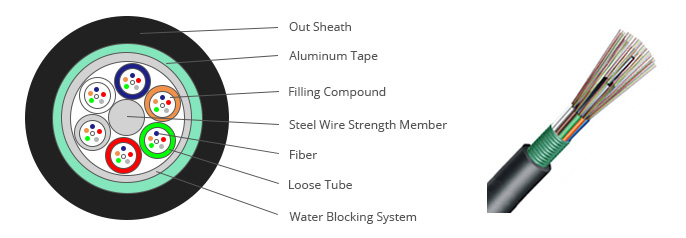
Outdoor fiber cable generally falls into three categories, direct burial, underground conduit, and aerial. These cables are manufactured specifically for outdoor applications and are recommended for any long outdoor cable runs, especially in region subject to cold weather. Most are loose tube designs with high tensile strength, to withstand environmental conditions, and gel filling, to prevent water migration. The jacket materials are specially selected to be abrasion and ultraviolet resistant. If a facility is planning to install long outdoor runs it will need to work closely with the manufacturer ti determine the right cable for its application.

Indoor and Outdoor fiber optic cable delivers outstanding audio, video, telephony and data signal performance for educational, corporate and government campus applications. With a low bending radius and lightweight feature, this cable is suitable for both indoor and outdoor installations. Typical indoor and outdoor cables are loose tube and tight buffer designs, and we also supply ribbon cables, drop cables, distribution cables and breakout cables. These are available in a variety of configurations and jacket types to cover riser and plenum requirements for indoor cables and the ability to be run in duct, direct buried, or aerial/lashed in the outside plant. In addition, Fiber-Mart can supply Indoor and Outdoor fiber optic cable. If you have any questions or requirement of Indoor and Outdoor fiber optic cable,welcome to contact us: product@fiber-mart.com.

Difference Between Tight-Buffered Breakout and Distribution Cables

There are two basic styles of fiber optic cable construction: loose tube and tight buffered. Tight buffered cables provide improved reliability and quick termination for today’s cable installation systems.

There are two basic styles of fiber optic cable construction: loose tube and tight buffered. Tight buffered cables provide improved reliability and quick termination for today’s cable installation systems. Tight-buffered breakout cables and distribution cables are two main types of the tight-buffered cables.loose tube cables hold more than one optical fiber, each individually sleeved core is bundled loosely within an all-encompassing outer jacket. However, in tight buffered cables, there are not so many cables as loose tube cables.


Cable Structures

Breakout Cable Structure

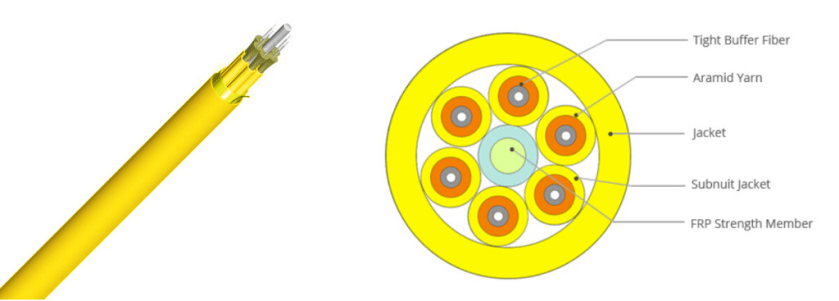
Breakout cable is also known as fan-out cable. As the following picture shows, breakout cable consists two or more simplex cables bundled around a central strength member. Each fiber has its own jacket and all of the fibers are packaged together inside the same outer jacket. Thus, breakout cable can also be broken out into individual simplex cables for separate use when running through walls of a building. Breakout cable is usually designed with tight buffer and the fiber counts are varied from 2 to 24 fibers.

图片1.png


Distribution Cable Structure


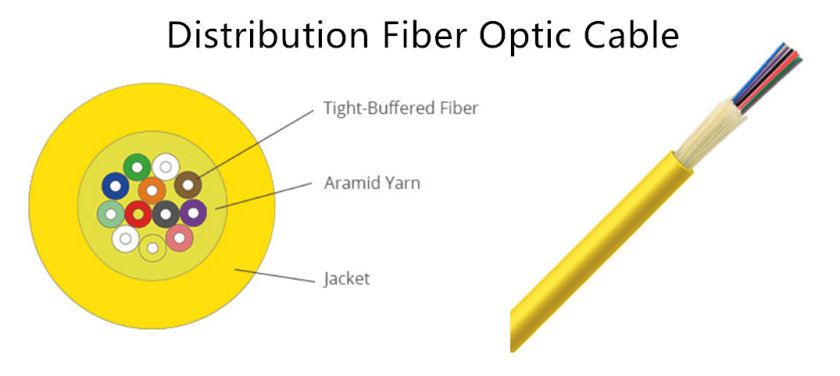
Unlike the breakout cable, distribution cable is smaller in size and lighter in weight. Fiber counts of distribution cable can be more intensive than the breakout cable for up to 144 fibers. Many fibers may not be used immediately but can be left for future expansion. Although the distribution cable has a more compact design, the tight-buffered fibers inside the cable are only bundled in a single outer jacket for protection, as shown in the picture below. Yet this has made the distribution cable to be easily handled and stripped for field termination.


图片2.png


Conclusion

Tight-buffered cables are optimal for indoor applications. With the design of armored layer, they are also used for indoor/outdoor applications. Fiber-Mart provides a wide range of quality optical fiber cables with detailed specifications displayed for your convenient selecting. Per foot price of each fiber cable is flexible depending on the quantities of your order, making your cost of large order unexpected lower. Customers can also have the flexibility to custom the cable plant to best fit their needs.any question pls feel free to contact me at service@fiber-mart.com
The Advantages of CATV EDFA

Optical amplifiers serve as an integrated part of long haul data transmission. Fiber optical transponders and fiber optical amplifier are used in the WDM fiber optic system, and it makes WDM transmission possible.

Optical amplifiers serve as an integrated part of long haul data transmission. Fiber optical transponders and fiber optical amplifier are used in the WDM fiber optic system, and it makes WDM transmission possible. In recent years,fiber optic CATV EDFA System especially 1500nm optical fiber CATV System is being rapidly develop in our country.

What is EDFA?

Erbium Doped Fiber Amplifier is short for EDFA,which was applied in 90 s in the optical fiber transmission system and its popularization and application of optical fiber communication technology has brought a revolution.EDFA is in small volume,low power consumption,easy to us.What’s more,it is convenient to install all kinds of application systems,such as SDH frame inside,CATV machine box, DWDM system frame.as one of a functional modes of the Optical fiber amplifier system,there are generally two kinds of methods to insert the network management system.One is 232 c interface circuit with optical fiber amplifier to transfer parameters of the optical fiber amplifier and alarm information to the network management system,unified management,display and disposal.

An EDFA is an optical amplifier based on Erbium-doped optical fiber, that amplifies optical signals without converting them into electrical form. EDFAs use semiconductor lasers to pump Erbium Doped Fiber to amplify light in 1.5 μm wavelength region where telecom fibers have their loss minimum. It has low noise and can amplify many wavelengths simultaneously, which makes DWDM possible and becomes a key enabling technology for optical communication networks. Since the realization of EDFA, it has developed rapidly and has become the amplifier choice for most applications in optical communication.

f0d6e8c5027c66ab48727b0cf3b882d1.image.500x500.jpg

Advantages of CATV EDFA

EDFA is in the low noise,has the characteristics of good gain trace,large amplifier bandwidth,compatible with wavelength division multiplexing (WDM) systems,with high efficiency,work performance is stable,mature technology and so on and so forth.It is very popular in the modern long-distance high-speed optical communication system.

◆ Good character:

Before the pump generally use 980 nm,after level pump use 1480 nm.Minimizing the NF of EDFA by reasonable optimization to make the system access excellent CNR.

◆ Reliability:

Use 1 u 19 “standard rack, built-in high-performance switching power supply.It can work in 85∽265 vac enterprise voltage.DC48V power supply (reservations) can be an option,too.Chassis cooling can be automatic temperature control.

◆ Intuition:

This machine contains a microprocessor to monitor the working state of the pump laser, LCD displays the working parameters.

◆ Network management model:

Options type monitoring transponder to ensure to meet the national standard with the SCTE HMS standards, which can realize network management monitoring.

◆ Adjustable output optical power:

Output optical power can be changed to -3dB.

◆ The power plug type:

Aluminum structure plug type switching power supply.Be good for heat dissipation and replacement.


Conclusion

The most prominent feature of optical amplifier is that the device can amplify optical signal directly without the need to convert the signal into an electrical one before amplifying. EDFA (Erbium-doped Fiber Amplifier) is the one type of many different optical amplifiers that can achieve signal amplification over long-hual optical communication. Fiber-MART provides broad optical amplification solutions for different applications, from telecom, datacom to CATV and has strong technology and experience to design and manufacture EDFA, EYDFA, Raman and Raman-EDFA hybrid. You can save cost by using the most efficient Fiber-Mart CWDM & DWDM Networks solutions. Pls feel free to contact me at service@fiber-mart.com
SDH SONET 10GBASE SFP+ 1310nm 10km Transceiver

SSFP-10G31-10

Fiber-Mart SDH SFP+ transceiver is a high performance, cost effective modulse for serial optical data communications applications specified for signal rates of 9.95 Gb/s to 11.1 Gb/s. The modules are designed for single mode fiber and operates at a nominal wavelength of 850nm/1310nm/1550nm. The transmitter section incorporates uncooled directly modulated 1310nm distributed feedback laser (DFB) or EML colled laser 1550nm. The receiver section uses PIN photodetector for low dark current and excellent responsivity or APD high sensetivity receiver. CDR chipset is integrated both to transmitter TX and receiver RX side.

Key Features

    • Supports 9.95Gb/s to 11.1Gb/s bit rates
    • Average Output Power:-6~-1dBm
    • Receiver Sensitivity: -14.4dBm
    • SFP 10G with CDR both at TX and RX side
    • IEC 60825-1 Class 1/CDRH Class 1 laser eye safety.
    • Hot-pluggable SFP+ footprint
    • 10km at 1310nm DFB/PIN Transmitter
    • Duplex LC connector
    • Low Power dissipation
    • Superior Thermal and EMI integrity performance to support high port densities
    • LC Duplex optical connector interface conforming to ANSI TIA/EIA604-10 (FOCIS 10)
    • Built-in digital diagnostic functions, DDMI
    • RoHS-6, CE, FDA, FCC, TUV, UL certifactes


Applications

    • 1000BASE-SX 1G Ethernet
    • 1000BASE-LX 1G Ethernet
    • 10GBASE-SR/SW 10G Ethernet
    • 10GBASE-LR 10G Ethernet


Ordering Information

Part No. Data Rate (Gbps) Wavelength (nm) TX Power (dBm) Re Sens. (dBm) Transmission Distance Fiber Type Connector Type Temp. Range Digital Diagnostics
SSFP-10G85-3M 9.95~10.3G 850 -6~-1 ﹤-11.1 300m MMF LC Com./Ex./Ind. Yes
SSFP-10G31-2M 9.95~10.3G 1310 -6.5~-0.5 ﹤-10 220m MMF LC Com./Ex./Ind. Yes
SSFP-10G31-2 9.95~10.3G 1310 -6~-1 ﹤-14.4 2km MMF LC Com./Ex./Ind. Yes
SSFP-10G31-10 9.95~11.1G 1310 -6~-1 ﹤-14.4 10km SMF LC 0~70℃ Yes
SSFP-10G31-20 9.95~11.1G 1310 -3~-1 ﹤-14.4 20km SMF LC 0~70℃ Yes
SSFP-10G31-40 9.95~11.1G 1310 -3~-1 ﹤-14.4 40km SMF LC 0~70℃ Yes
SSFP-10G31-70 9.95~11.1G 1310 2~5 ﹤-20 70km SMF LC 0~70℃ Yes
SSFP-10G55-40 9.95~11.1G 1550 -4.7~4 ﹤-15.8 40km SMF LC 0~70℃ Yes
SSFP-10G55-80 9.95~11.1G 1550 0~5 ﹤-23 80km SMF LC 0~70℃ Yes


Packaging

    • Antistatic bag
    • Packed on pallets in a box(Default Customer Options)
    • Specific Labels as Request
    • Seperate white Box for each transceiver


OEM and ODM

Combining our extensive design and engineering capability in optical transceiver industry, with our competitive advantages from integrated manufacturing capability, internal supply chain, and cost competitive and scalable operation infrastructure, Fiber-Mart provides OEM, ODM, and contract manufacturing service to world leading customers with our manufacturing facilities in China.We are also mainly engaged in providing complete sets of optoelectronic device solutions to gain more brand extensions and influence for Fiber-Mart in the world.

  • OEM/ODM order is available
  • We can supply SSFP-10G31-10 according to your requirements, and design SSFP-10G31-10 label and packaging for your company. We welcome any inquiry for customized SDH SONET SFP+ optical transceiver.