PLC Splitter Applications in FTTH Network

by http://www.fiber-mart.com

TTH mainly uses PON network technology, which requires a large number of low-cost optical splitters and other optical passive. Optical splitter device is an integral part of FTTH and with the promotion of FTTH, there would be a great market demand. The traditional preparation of optical splitter technology is fiber fused biconical taper (FBT) technology. Its characteristics are mature and simple technology. The disadvantage is that the assigned ones too large, and the device size is too large, which caused the decrease in yield and the rising cost of single channel, shunt reactive stars uniformity will deteriorate. FBT technology based fiber optic splitter preparation techniques have been unable to adapt to the market demand.
PLC splitter or planar lightwave circuit splitter is a passive component that has the special waveguide made of planar silica, quartz or other materials. It is employed to split a strand of optical signal into two or more strands. PLC splitter also has lots of split ratios, and the most common ones are 1:8, 1:16, 1:32, 1:64, 2:8, 2:16, 2:32 and 2:64. There are many types of PLC splitters to meet with different needs in OLT and ONT connection and splitting of optical signals over FTTH passive optical networks. There are seven major package types of PLC splitters according to different applications, i.e. bare fiber splitter, module splitter, rack-mount splitter, Mini Type splitter, Tray splitter and LGX splitter.
Bare fiber optical splitter
ABS splitters
Mini Type fiber splitter
Tray splitter
Rack-mount splitter
LGX splitters
PLC splitter in mini plug-in type
Applications
Bare Fiber PLC Splitter
Bare fiber PLC splitter has no connector at the bare fiber ends. It can be spliced with other optical fibers in the pigtail cassette, test instrument and WDM system, which minimizes the space occupation. It is commonly used for FTTH, PON, LAN, CATV, test equipment and other applications.
Mini Type PLC Splitter
Mini Type PLC Splitter has a similar appearance as bare PLC splitter. But it has a more compact stainless tube package which provides stronger fiber protection, and its fiber ends are all terminated with fiber optic connectors. Connectors are commonly available with SC, LC, FC and ST types. Thus, there is no need for fiber splicing during installation. Mini PLC splitter is mainly used for different connections over distribution boxes or network cabinets.
ABS BOX TYPE PLC Splitter
ABS Box PLC Splitter has a plastic ABS box to protect the PLC splitter to adapt to different installation environments and requirements. Common splitter modules are 1×4, 1×8, 1×16, 1×32, 1×64, 2×4, 2×8, 2×16, 2×32. It is widely used with outdoor fiber distribution box for PON, FTTH, FTTX, PON, GOPN networks.
Tray Type PLC Splitter
Tray type PLC splitter can be regarded the fiber Tray which contains PLC fiber splitter inside a tray. It is often directly installed in optical fiber distribution box or optical distribution frame. FC, SC, ST & LC connectors are selective for termination. Tray type PLC splitter is an ideal solution for splitting at the places that are near OLT or ONU.
Tray type PLC splitter
Rack-mount PLC Splitter
Rack-mount PLC Splitter can be used for both indoor and outdoor applications in FTTx projects, CATV or data communication centers. It uses the 19-inch rack unit standard to contain the PLC splitter inside a rack unit.
LGX PLC Splitter
LGX PLC splitter or LGX box PLC splitter has a strong metal box to house the PLC splitters. It can be used alone or be easily installed in standard fiber patch panel or fiber enclosure. The standard LGX mental box housing provides a plug-and-play method for integration in the network, which eliminates any risk during installation. No filed splicing or skilled personnel is required during deployment.
Mini Plug-in Type PLC Splitter
Mini plug-in PLC type splitter is its small version with a compact design. It is usually installed in the wall mount FTTH box for fiber optic signal distribution.
Above these types of PLC splitters are typically installed to serve for PON and FTTH networks. 1xN and 2xN are the common splitter for specific applications. You can choose the correct one according to you projects and if any more questions pls feel free to contact us for any technical problem.

Loose-Tube and Tight-Buffer Cable Application of FTTH

by http://www.fiber-mart.com

FTTH makes use of Fiber Optic technology to enhance communication for households. FTTH stands for Fiber to the Home, and many experts believe that FTTH cable will soon replace the traditional copper cables. There are various other elements of FTTH. FTTH Flat Drop Cable is generally also known as indoor cable. Other elements of the technology include instrumentation cables and cable glands. Next let us make a brief introduction of cable construction and the difference of Loose-Tube and Tight-Buffer Cable.
Optical-Cable Construction
The core is the highly refractive central region of an optical fiber through which light is transmitted. The standard telecommunications core diameter in use with SMF is between 8  m and 10m, whereas the standard core diameter in use with MMF is between 50m and 62.5m. The diameter of the cladding surrounding each of these cores is125m. Core sizes of 85m and 100 m were used in early applications, but are not typically used today. The core and cladding are manufactured together as a single solid component of glass with slightly different compositions and refractive indices. The third section of an optical fiber is the outer protective coating known as the coating. The coating is typically an ultraviolet (UV) light-cured acrylate applied during the manufacturing process to provide physical and environmental protection for the fiber. The buffer coating could also be constructed out of one or more layers of polymer, nonporous hard elastomers or high-performance PVC materials. The coating does not have any optical properties that might affect the propagation of light within the Breakout Fiber Optic Cable. During the installation process, this coating is stripped away from the cladding to allow proper termination to an optical transmission system. The coating size can vary, but the standard sizes are 250m and 900m. The 250- m coating takes less space in larger outdoor cables. The 900- m coating is larger and more suitable for smaller indoor cables.
Three types of material make up fiber-optic cables:
• Glass
• Plastic
• Plastic-clad silica (PCS)
These three cable types differ with respect to attenuation. Attenuation is principally caused by two physical effects: absorption and scattering. Absorption removes signal energy in the interaction between the propagating light (photons) and molecules in the core. Scattering redirects light out of the core to the cladding. When attenuation for a fiber-optic cable is dealt with quantitatively, it is referenced for operation at a particular optical wavelength, a window, where it is minimized. The most common peak wavelengths are 780 nm, 850 nm, 1310 nm, 1550 nm, and 1625 nm. The 850-nm region is referred to as the first window (as it was used initially because it supported the original LED and detector technology). The 1310-nm region is referred to as the second window, and the 1550-nm region is referred to as the third window.
Glass Fiber-Optic Cable
Glass fiber-optic cable has the lowest attenuation. A pure-glass, fiber-optic cable has a glass core and a glass cladding. This cable type has, by far, the most widespread use. It has been the most popular with link installers, and it is the type of cable with which installers have the most experience. The glass used in a fiber-optic cable is ultra-pure, ultra-transparent, silicon dioxide, or fused quartz. During the glass fiber-optic cable fabrication process, impurities are purposely added to the pure glass to obtain the desired indices of refraction needed to guide light. Germanium, titanium, or phosphorous is added to increase the index of refraction. Boron or fluorine is added to decrease the index of refraction. Other impurities might somehow remain in the glass cable after fabrication. These residual impurities can increase the attenuation by either scattering or absorbing light.
Plastic Fiber-Optic Cable
Plastic fiber-optic cable has the highest attenuation among the three types of cable. Plastic fiber-optic cable has a plastic core and cladding. This fiber-optic cable is quite thick. Typical dimensions are 480/500, 735/750, and 980/1000. The core generally consists of polymethylmethacrylate (PMMA) coated with a fluoropolymer. Plastic Fiber Optic cable was pioneered principally for use in the automotive industry. The higher attenuation relative to glass might not be a serious obstacle with the short cable runs often required in premise data networks. The cost advantage of plastic fiber-optic cable is of interest to network architects when they are faced with budget decisions. Plastic fiber-optic cable does have a problem with flammability. Because of this, it might not be appropriate for certain environments and care has to be taken when it is run through a plenum. Otherwise, plastic fiber is considered extremely rugged with a tight bend radius and the capability to withstand abuse.
Plastic-Clad Silica (PCS) Fiber-Optic Cable
The attenuation of PCS fiber-optic cable falls between that of glass and plastic. PCS Fiber Optic Cable has a glass core, which is often vitreous silica, and the cladding is plastic, usually a silicone elastomer with a lower refractive index. PCS fabricated with a silicone elastomer cladding suffers from three major defects. First, it has considerable plasticity, which makes connector application difficult. Second, adhesive bonding is not possible. And third, it is practically insoluble in organic solvents. These three factors keep this type of fiber-optic cable from being particularly popular with link installers. However, some improvements have been made in recent years.
FTTH (Fiber to the Home) network compared with technologies now used in most places increases the connection speeds available for residences, apartment building and enterprises. FTTH network is the installation and use of optical fiber from a central point known as an access node to individual buildings. The links between subscriber and access node are achieved by fiber jumper cables. Loose-tube and tight buffer cables are commonly used to transmit signals with high speed, which are capable of supporting outdoor or indoor environment. Is there a cost-effective solution that can support both indoor and outdoor environment in FTTH network? To answer this, the construction and comparison of loose tube cable and tight buffer cable will be introduced in the following article.
Loose-Tube and Tight-Buffer Cable
The “buffer” in tight buffer cable refers to a basic component of fiber optic cable, which is the first layer used to define the type of cable construction. Typically a fiber optic cable consists of the optical fiber, buffer, strength members and an outer protective jacket (as showed in Figure 1). Loose-tube and tight-buffer cables are two basic cable design. Loose-tube cable is used in the majority of outside-plant installations, and tight-buffered cable, primarily used inside buildings.
Loose-tube and tight-buffer cables
Loose-tube cable consists of a buffer layer that has an inner diameter much larger than the diameter of the fiber see in the following picture. Thus, the cable will be subject to temperature extremes in the identification and administration of fibers in the system. That’s why Loose Tube CST Fibre Cable are usually used in outdoor application. The loose-tube cables designed for FTTH outdoor application are usually loose-tube gel-filled cables (LTGF cable). This type of cable is filled with a gel that displaces or blocks water and prevents it from penetrating or getting into the cable.Tight buffer cable using a buffer attached to the fiber coating is generally smaller in diameter than loose buffer cable (showed in Figure 2). The minimum bend radius of a tight buffer cable is typically smaller than a comparable loose buffer cable. Thus tight buffer cable is usually used in indoor application.
loose buffer cable
Tight buffered indoor/outdoor cable with properly designed and manufactured can meet both indoor and outdoor application requirements. It combines the design requirements of traditional indoor cable and adds moisture protection and sunlight-resistant function to meet the standards for outdoor use. Tight buffered indoor/outdoor cable also meets one or more of the code requirements for flame-spread resistance and smoke generation.
In short, FTTH cable is transforming the way we communicated in the past; and it will soon become the norm. FTTH network can be increased reoffers high quality fiber cable assemblies such as Patch Cords, Pigtails, MCPs, and Breakout Cables etc. All of our custom fiber patch cords can be ordered as Single Mode 9/125, Multimode 62.5/125 OM1, and Multimode 50/125 OM2 and Multimode 10 Gig 50/125 OM3/OM4 fibers. If you have any requirement, please send your request to us.

How to Reduce the Cost of FTTH Architecture

by http://www.fiber-mart.com

In our digital world, people increasingly require higher bandwidth to facilitate daily life, whether for leisure, work, education or keeping in contact with friends and family. The presence and speed of internet are regarded as the key factor that subscribers would take into account when buying a new house. Recently there are a growing number of independent companies offering full fiber to the home (FTTH) services, ranging from local cooperatives and community groups to new operators. Today’s article will pay special attention to the reasons why we should implement FTTH network and the methods to reduce the cost of FTTH network.
Why Should We Deploy FTTH Network?
No denying that the world is changing rapidly and becoming increasingly digital. People nowadays are knowledgeable workers who rely on fast connections to information stored in the cloud to do their jobs. Therefore, installing superfast FTTH broadband is an investment in equipping communities with the infrastructure they need to not just adapt to the present life, but to thrive in the future.
What’s more, the economic benefits of FTTH, for residents, businesses and the wider community are potentially enormous. While there are upfront costs in FTTH deployments, particularly around the last drop, equipment and methodologies are evolving to reduce these significantly. Fiber to the home is proven to increase customer satisfaction, and enables operators to offer new services, such as video on demand, 4K TV and smart home connectivity.
As well as bringing in economic benefits, FTTH broadband provides local businesses with the ability to expand, invest and seek new opportunities by providing rapid connections to major markets. All of this leads to increased investment in the rural economy, providing residents with more choice and stimulating growth.
What to Do?
Although deploying FTTH network might be similar cost as deploying copper network, there are some methods that you should know about reducing the costs of FTTH architecture. Adopting the following three principles helps achieve FTTH deployment, maximizing return on investment and dramatically reducing deployment times.
1. Reuse the Existing Equipment
Time and the total cost of FTTH deployment are typically relevant with the civil engineering side of the project, such as digging a new trench and burying a new duct within it. Where possible, crews should look to reuse existing infrastructure—often there are ducts or routes already in place that can be used for FTTH and in building deployments. These could be carrying other telecommunication cables, power lines, or gas/water/sewerage. Installing within these routes requires careful planning and use of cables and ducts that are small enough to fit through potentially crowded pathways. Figure 2 shows a generic point-multipoint architecture that fiber jumper plays an important part in it.
FTTH architecture
Additionally utilizing the push and pull cables in FTTH infrastructure simply reduce costs and install time as network installers can easily complete FTTH deployment by using pushing or pulling cables: pushing can be aided by simple, cost-effective handheld blowing machines, or pulled through the duct using a pre-attached pull cord. Even for more complex and longer environment, FTTH deployment can be quickly completed other than requiring expensive blowing equipment to propel the cable through duct.
2. Choose the Right Construction Techniques
If it is time to start digging, always make sure you use appropriate construction methods. The appropriate method will minimize cost and time by making construction work as fast and concentrated as possible, avoiding major disruption to customers or the local area. And remember to make sure you follow best practice and use the right fiber cable and duct that can fit into tight spaces and withstand the high temperatures of the sealant used to make roadways good.
The cable and duct used within FTTH implementations is crucial. Ensure that it meets the specific needs of deployments, and is tough, reliable and has a bend radius. It should be lightweight to aid installation and small enough to fit into small gaps and spaces in ducts. Also look to speed up installations with pre-connectorized cables that avoid the need to field fit or splice.
3. Minimize the Skills Required
Staff costs are one of the biggest elements of the implementation budget. Additionally, there are shortages of many fiber skills, such as splicing, which can delay the rate at which rollouts are completed. Operators, therefore, need to look at deskilling installations where possible, while increasing productivity and ensuring reliability. Using pre-connectorized fiber is central to this—it doesn’t require splicing and is proven to reduce the skill levels needed within implementations.
Conclusion
To cope with the digital world, the network is in constant need of enhancements and the increasingly stressed bandwidth and performance requires ongoing adjustment. Regardless of the FTTH architecture and the technology to the curb, the pressure is on for the network installer to deploy FTTH quickly and cost-effectively, while still ensuring a high quality, reliable installation that causes minimal disruption to customers and the local area. Fiberstore offers a variety of optical equipment that are suitable in telecom field. Our fiber optic cables are available in different optical connector, single-mode and multimode fiber as well as indoor or outdoor cables. For example, patch cord LC-LC are also provided.

2 Ports QSFP to QSFP 40G WDM Transponder OEO Converter w/full 3R Support Standalone

FM SKU#:SKU000001G2
Model#:2P-40G-3R-Q-FMOEO
MFG PART#:

QSFP to QSFP 40G WDM Transponder OEO Converter comes with two QSFP ports, are Standalone device that can support the “Three Rs” to Retime,Regenerate and Reshape the optical signal.

Transponders are fiber-to-fiber media converters that convert wavelengths for Wavelength Division Multiplexing (WDM) applications.

Fiber-Mart transponders are protocol and rate-transparent fiber media converters that support SFP, SFP+ and XFP transceivers with data rates up to 11.32 Gpbs, and our transponders provide seamless integration of different fiber types by converting multi-mode fiber to single-mode fiber, and dual fiber to single-fiber.

Fiber-to-Fiber media converters extend network distance by converting wavelengths (1310 to 1550), amplifying optical power. Fiber-MART.Com transponders as re-generators are also an optical – electrical – optical (O-E-O) converter with electrical amplification of the signal by FEC to realize long distances fiber transmission.

Features

    • Support 2U Rack(16 Slots) and independent use.
    • Support network management (Web SNMP, Console).
    • 3R function.
    • Support Jumbo Frame.
    • Transparent Transpor and very low delay.
    • Support DMI function for QSFP fiber module.
    • Support 1*40G Mode and 4*10G Mode.
    • Support Loopback test function.
    • Support hot plugging.
    • Full State Led display.
    • Easy installation.


OEO Converter Standalone

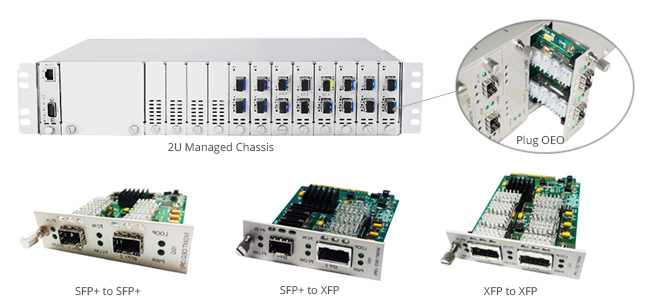
OEO Card for 2U Unified Platefrom Chassis

The 2ports OEO card is compatible with 2U Unified Platefrom Chassis. Each card ( SFP+ to SFP+, XFP to SFP+,XFP to XFP,SFP to SFP ) can coexist together in this 2U 17-slot Managed chassis.

Specifications

Performance Data Technical Indexes
Equipment function 3R Repeater
Protocols Multiple functions in one module:
–40G converter/repeater
–Quad 10G optical multiplexer
40G link interface
–Ethernet/IEEE: 802.3ba 40GE-LR4 /SR4
10G interfaces:
–9.95 – 11.35 Gbps
Access Type 40G Ethernet/td>
Interface Type QSFP To/From QSFP
Transmission Distance Up to QSFP module ( Max 10Km )
Maximum Packet Forwarding Rate 14,880,950/S
Network management information: • Card type information
• QSFP fiber module DMI function ( Temperature , Voltage , Optical power)
• Link status detector
• Enable/Disabled Loopback test function
• Enable/Disable PRBS Generator and checker function
power requirement Rack-mountable: AC 85 ~ 220V OR DC -48V
Standalone: AC 220V OR DC -48V
Power consumption: ≤6W
Work Environment Operating Temp: 0~ 50 ℃
Storage Temp: -10~ 70 ℃
Humidity: 5%~90% ( non-condensing )
Dimension Card: 11.5mm ( W ) × 78mm ( D )
Standalone: 156mm ( W ) × 128mm ( D ) × 32mm (H )


OEO Transponder Application in WDM Network

by http://www.fiber-mart.com

Anyone who has experiences of deploying WDM networks, either DWDM or CWDM networks, may be familiar with OEO transponder. Since in WDM network deployment, especially for long haul transmission, OEO transponder plays an important role. OEO transponder, also known as WDM transponder, means optical-to-electrical-to-optical. That is to say, it converts an optical signal to an electrical signal, and then recovers it to an optical signal. In some cases, OEO transponder serves as fiber mode converter or repeater for long distance transmission.
Functions of OEO Transponder
Wavelength Conversion
As we all know, when add a CWDM Mux/Demux or DWDM Mux/Demux into a WDM network, there is a requirement to convert the optical wavelengths like 850nm, 1310nm and 1550nm to CWDM or DWDM wavelengths. Then the OEO transponder comes to assist. The OEO transponder receives, amplifies and re-transmits the signal on a different wavelength without changing the signal content.
Fiber Mode Conversion
It’s know to us that multimode fiber optic cables (MMF) are often used in short distance transmission, while single mode fiber optic cables (SMF) are applied in long optical transmission. Therefore, in some network deployment, considering the transmission distances, MMF to SMF or SMF to MMF conversions are needed.
Signal Repeating
In long haul fiber optic transmission, OEO transponder also can work as repeater to extend network distance by converting wavelengths (1310nm to 1550nm) and amplifying optical power. The OEO converter converts the weak optical signals from the fiber into electrical signals, and regenerates or amplifies, then recovers them into strong optical signals for continuous transmission.
Analysis of OEO Transponder Application Case
Having known about the function of OEO transponder, here let me take some application cases as examples to illustrate its applications clearly.
Case One
The distance between site A and site B is about 165km, and there is a repeater station C. The distance between A and C is 90km. The client needs to build connection between A and B. Just like the following picture shows.
In this solution, three OEO transponders are used in this links according to the requirements of the client. The use of the first OEO converter at site A is to convert the signals from MMF to SMF, achieving the long distance transmission between site A and C. The second OEO transponder re-generates and amplifies the optical signal, then convert the it from dual fiber to single fiber. At site B, the OEO transponder re-amplifies the optical signal and recovers it to multimode transmission.
Advantages of this solution: use OEO transponder to achieve fiber mode conversion and long distance transmission; make full use of the OEO transponder (retime, regenerate and reshape) to realize high quality connections; save cost by using the OEO transponder.
Case Two
This solution is more complicated than the first one. There are three sites with fiber links between them. The distance between site A and B is 84km, and site B and C is 1km. Site A and C is 84km too. All the 10G connections are dual fiber transmission. Here is a simple picture of this solution.
As we can see in the figure, to build DWDM networks between these three sites, six OEO transponders are deployed. Each site uses two OEO transponders. The OEO transponder at site A converts the 10G-LR signals into 10G DWDM wavelengths, then the wavelengths are multiplexed by the DWDM Mux. At site B, the separated wavelengths are recovered to 10G-LR signals through the OEO transponder. The transmission between site B and C, site A and C are similar to the transmission between site A and B. In addition, there are two EDFAs in each two long distance transmissions.
Advantages of this solution: using OEO transponder for wavelength conversion. Converting common 10G signals into DWDM wavelengths and transmitting them with DWDM MUX/DEMUX increase the network capacity easily. At the same time, it also reduces the damage of optical transceivers.
Summary
OEO transponder is an important components in optical networks. This post gives a simple analysis of OEO transponder application case. Hope it’s useful for you. fiber-mart.COM supplies high quality 10G OEO converters like SFP+ to SPF+ and XFP to XFP, and 40G WDM transponder like QSFP+ to QSFP+. If you want to know more detailed information, please contact us via sales@fiber-mart.com.

How Much Do You Know About WDM Transponder?

by http://www.fiber-mart.com

In optical fiber communications, a WDM transponder is a common element that sends and receives the optical signal from a fiber. Maybe you have seen and used it many times. But do you really know it clearly? How much do you know? Today, this article is going to talk about something about WDM (Wavelength Division Multiplexing) transponder.
What’s WDM Transponder?
WDM transponder, also named as fiber optic transponder, is an optical-electrical-optical (OEO) wavelength converter which is designed to perform an O-E-O operation to convert wavelengths of light. It plays a key role in WDM system, especially in DWDM (Dense Wavelength Division Multiplexing) system. Its name “transponder” is short for transmitter and responder, which clearly show its purpose. They are protocol and rate-transparent fiber media converters that support SFP, SFP+, XFP and QSFP transceivers with data rates up to 11.32 Gpbs. WDM transponders extend network distance by converting wavelengths (1310 to 1550nm), amplifying optical power and can support the “Three Rs” to Retime, Regenerate and Reshape the optical signals. In general, there is an O-E-O (optical-electrical-optical) function with this device. Fiber optic transponders and optical multiplexers are usually present in the terminal multiplexer.
How does the WDM Transponder work?
The most distinguished characteristic of WDM transponder is that it can automatically receive, amplify, and then retransmit a signal on a different wavelength without altering the data/signal content. In today’s commercial networks, wavelength conversion is only realized with optical to electronic to optical (O-E-O) transponders. OEO Transponder works as a regenerator which converts an optical input signal into electrical form, generates a logical copy of an input signal with a new amplitude and shape of its electrical pulses and uses this signal to drive a transmitter to generate an optical signal at the new wavelength. Here is a picture showing how a transponder works. From left to right, the transponder receives an optical bit stream operating at one particular wavelength (1310 nm). And then it converts the operating wavelength of the incoming bitstream to an ITU-compliant wavelength and transmits its output into a DWDM system. On the receive side (right to left), the process is reversed. The transponder receives an ITU-compliant bit stream and converts the signals back to the wavelength used by the client device.
What’s the Major Functions of WDM Transponder?
WDM transponder is a vital element in optical communication. Usually, its major function includes:
Conversions between electrical and optical signals
Serialization and deserialization
Control and monitoring
Why WDM Transponder Is Needed in WDM System?
There are several reasons that we need wavelength-converting transponder. The first reason is that they can connect incompatible equipment. Such an example is the conversion of 1300nm carrying wavelength of optic networks. Another one is because we have different fiber optic networks with different providers and different criteria. Therefore, we need WDM transponder to traverse from one fiber network to another. WDM transponder helps us to reduce the number of wavelengths required.
How Many Applications of WDM Transponder Do You Know?
WDM transponders are widely used in a number of networks and applications. The following are their major applications.
Convert Multimode to Single-Mode Fiber
It’s known to us that multimode fiber is often used for short distance transmission while single-mode fiber is used for long distance transmission. In order to exceed the limitation of multimode fibers, mode conversion is needed in networks. As the following figure showing, two switches are connected by the WDM transponder which convert the multimode fibers to single-mode fibers.
Convert Dual Fiber to Single-Fiber
In this case, two dual fiber switches are connected with a single-fiber via two transponders. The single fiber uses 1310nm and 1550nm wavelengths over the same fiber strand in opposite directions. As the following figure showing.
Wavelengths Conversion
The most common application of WDM transponder is wavelengths conversion. Fiber optic communications equipment with fixed fiber interfaces (ST, SC, LC or MTRJ connectors) operating over legacy wavelengths (850nm, 1310nm, 1550nm) must be converted to CWDM wavelengths with a transponder. In this application, the transponder is called WDM transponder or wavelength-converting transponder.
wavelength-conversion
In addition, WDM transponder also can be used to extend 10G OTN network distances, SONET ring distances and provide a standard line interface for multiple protocols through replaceable 10G small form-factor pluggable (XFP) client-side optics.
Conclusion
With its own special features, WDM transponder facilitates a wide application in optical networks. Fiberstore provides a number of choices for OEO WDM transponder which have high performance and good quality. Here you can find different transmission rates of this products such as 2.5G, 4.25G, 8G, 10G and 40G, and different ports of OEO converters such as SFP+ to SFP+, SFP+ to XFP, XFP to XFP, etc. If you want to know more, please visit fiber-mart.COM.