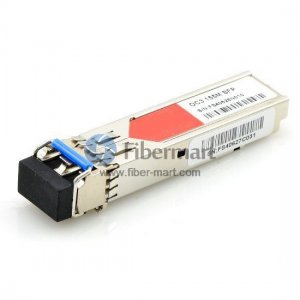
What’s CWDM XFP Transceiver

by http://www.fiber-mart.com

CWDM-XFP 10G-40 Transceiver

CWDM XFP Transceiver

10G CWDM XFP is designed for single mode fiber and operates at a nominal wavelength of CWDM wavelength. There are four center wavelengths available from 1270nm to 1330nm, with each step 20nm.

Key Features

    • The 10GB CWDM XFP 1270nm to 1330nm 40km optical transceiver
    • Average Output Power:-1.8~4.0dBm
    • Receiver Sensitivity:-15.8dBm
    • High Quality with ISO9001, TUV, CE, FCC, UL and RoHS certificates
    • Condition: Factory New
    • Supports 9.95Gb/s to 11.1Gb/s bit rates
    • Hot-Pluggable XFP footprint
    • Operating Case Temperature Standard: 0°C~+70°C
    • Duplex LC connector
    • Temperature-Stabilized CWDM Rated EML Transmitte
    • Build-in digital diagnostic functions


Applications

  • 10GBASE-LR/LW 10G Ethernet
  • 1200-SM-LL-L 10G Fiber Channel
  • 10GE over G.709 at 11.09Gbp
  • Other Optical Link
  • Packaging

      • Antistatic bag
      • Packed on pallets in a box(Default Customer Options)
      • Specific Labels as Request
      • Seperate white Box for each transceiver

    OEM and ODM

    Combining our extensive design and engineering capability in optical transceiver industry, with our competitive advantages from integrated manufacturing capability, internal supply chain, and cost competitive and scalable operation infrastructure, Fiber-Mart provides OEM, ODM, and contract manufacturing service to world leading customers with our manufacturing facilities in China.We are also mainly engaged in providing complete sets of optoelectronic device solutions to gain more brand extensions and influence for Fiber-Mart in the world.

    • OEM/ODM order is available
    • We can supply CWDM-XFP10G-40 according to your requirements, and design CWDM-XFP10G-40 label and packaging for your company. We welcome any inquiry for customized CWDM XFP optical transceiver.

    Order Procedure

    Please contact us with any special requirements you may have, we can help you create a custom solution to meet almost any application. Our engineer will review the project and provide a quotation within 1-2 business days.
    a. Email (sales@fiber-mart.com) us a rough sketch to a detailed drawing.
    b. Our engineer will review the project and provide a quotation within 24 hours.
    c. We can arrange production as low as 1 piece and as high as 1,000 pieces in 1~4 business days once an order is placed.

    Shipment

    International Express: Fedex, DHL, UPS, TNT and EMS.If you have another preferred carrier, please notify us in advance.
    FedEx Overnight: It will take 1-3 business days (weekends and holidays excepted) for delivery.
    DHL: It will take 2-4 business days (weekends and holidays excepted) for delivery. For Spain, Italy, Brazil and some other countries, items will take longer time to arrive due to customs clearance period.

    Save Cost By Buying CWDM XFP From Original Manufacturer Fiber-Mart Directly.

    Fiber-Mart is an professional manufacturer & supplier of CWDM XFP transceivers. All of our CWDM XFP transceivers are tested in-house prior to shipping to guarantee that they will arrive in perfect physical and working condition. We guarantee CWDM XFP transceivers to work in your system and all of our CWDM XFP transceivers come with a lifetime advance replacement warranty. If you have questions about CWDM XFP optics, please feel free to contact us at sales@fiber-mart.com.

How OTN used for High Speed Service

by http://www.fiber-mart.com

Nowadays, the SONET/SDH network is an universal network that combines with WDM (wavelength division multiplexing) technique to transmit multiple optical signals over a single fiber. In future networking, high speed transmission is no doubt the migration trend. Inspired by the SONET/SDH network, ITU-T (ITU Telecommunication Standardization Sector) has defined the optical transport network (OTN) to achieve a more cost-effective high speed network with the help of WDM technology.

 EPON ONU with 1-PON Port and 8 10/100M ports
Generally speaking, OTN is a network interface protocol put forward in ITU G.709. OTN adds OAM (operations, administration and maintenance) functionality to optical carriers. It allows network operators to converge networks through seamless transport of the numerous types of legacy protocols, while providing the flexibility required to support future client protocols. Unlike the previous SONET/SDH, OTN is a fully transparent network that provides support for optical networking on a WDM basis. Since multiple data frames have been wrapped together into a single entity in OTN, it is also known as the “digital wrapper”.
Working Principle of OTN
You may wonder how OTN works in practice. Actually, its working structure and format very resemble the SONET/SDH network. Six layers are included in the OTN network: OPU (optical payload unit), ODU (optical data unit), OTU (optical transport unit), OCh (optical channel), OMS (optical multiplex section) and OTS (optical transport section).
OPU, ODU and OTU are the three overhead areas of OTN frame. OPU is similar to the “path” layer of SONET/SDH, which provides information on the type of signal mapped into the payload and the mapping structure. ODU resembles the “line overhead” layer of SONET/SDH, which adds the optical path-level monitoring, alarm indication signals, automatic protection switching bytes and embedded data communications channels. OTU is like the “section overhead” in SONET/SDH, and it represents a physical optical port that adds performance monitoring and FEC (forward error correction). OCh is for the conversion of electrical signal to optical signal and modulates the DWDM wavelength carrier. OMS multiplexes several wavelengths in the section between OADMs (optical add drop multiplexer). OTS manages the fixed DWDM wavelengths between each of the in-line optical amplifier units.
OTN-structure
Advantages of OTN
There are many advantages of OTN. Firstly, it separates the network against uncertain service by providing transparent native transport of signals encapsulating all client-management information. Secondly, it performs multiplexing for optimum capacity utilization which enhances network efficiency. Thirdly, it improves maintenance capability for signals transmitting through multi-operator networks by providing multi-layer performance monitoring.
4GE+2POTS+WIFI HGU ONT
Migration to High Speed OTN
With the fast evolution of networking, OTN standard is able to reach a higher speed service. Its multiplexing hierarchy allows any OTN switch and any WDM platform to electronically groom and switch lower-rate services within 10 Gbps, 40 Gbps, or even 100 Gbps wavelengths. This eliminates the need for external wavelength demultiplexing and manual interconnects. OTN network is definitely the best solution for future high speed networking over long distance. The picture below shows the OTN mapping diagram for high speed transmission.
Conclusion
Over the years, OTN has never stopped improving itself. Driven by the needs for high speed transmission, OTN combined with WDM is obviously a better choice in networking. It is a cost-effective way to build an optical transport network accommodating high throughput broadband services. I believe more and more people will employ this standard in their own network in the near future.

Fiber Optic Polishing Machine

by http://www.fiber-mart.com

Optical Fiber Polisher, OP-2000C is corner pressure polshing machine for fiber connectors.

Key Features:

Can polish 24~40 connector at same time, very applicable to bulk production
Polish process using liquid crystal display, can display the time polish, polish speed and polish times, making the process easier to control quality
Polish fixture with square pressure, the pressure from the elastic cushion into the decision to ground the pressure volume, simple products with high precision and consistent
post comply with IEC standards can produce geometric face
planetary orbit by way of Research Mo.
IPC using the new fixture (each mortise, independent compression) technology allows a higher passing rate of industrial production, and is willing to either one or 24polish connector,polish effects the same operation and high flexbility
MU and LC connector maximum polish 24 connectors,SC,FC,ST up to 20~40
Treatment with high quality stainless steel had to make the machine to maintain a very high accuracy and usage

Application for high volume production, and the polishing jig is fixed with 4 points, the polishing pressure is determines by coil spring and elastic cushion.
Designed for polishing manner with planet tray.
Using a new I.P.C jig technology (every ferrule is pressed singly) and making the finished yield rate much higher.
Dual APC & PC polishing and Accommodating most styles of connectors
High efficiency to deal with all kinds of connectors. The maximum polishing quantity for MU and LC connectors is 24 pcs; And maximum polishing quantity for SC, FC andST connectors is 20 pcs.
The polisher was made by high quality stainless steel with heat treatment and it is high accuracy and durability.
Quick to change jigs,  Easy and flexible to operate.
APC return loss as low as -70 dB,  UPC return loss as low as -60 dB, Insertion loss 0.2 dB typical
Super centering accuracy
Excellent connector endface polishing quality

Specifications:

Type High Volume, Installation
Pressure Source Coil Spring
Polishing Capacity (max) 20 connectors for FC, SC and ST  / 24 connectors for MU/LC
Dimensions 230 x 255 x 230mm
Weight 23.5 kg
Input Voltage 100-120VAC, 50/60Hz or 220-240VAC, 50/60Hz
Application 2.5mm PC, APC  /  12.5mm PC, APC  /  MT, mini-MT


Video of OP-2000C Fiber Optic Polishing Machine:

https://youtu.be/SzS9oSuy5xs


Introduction of Some Common Fiber Optical Transceivers

by http://www.fiber-mart.com

Fiber optic transceiver including both transmitter and receiver in a single module is an important equipment transmitting and receiving data to support the normal operation of optical fiber data transmission system. The market currently offers a wide selection of fiber optic transceiver for use with different types of wire, fiber and wavelength and so on.

ADTRAN 1184543P1 Compatible OC3 LR1 SFP 1310nm 40km Transceiver
A group of companies joined together to agree on package standards also called multisource agreements (MSAs). The package standards help customers choose the best transceivers to their applications and make sure the they can use transceiver from multiple vendor without redesigning the board. In the following text, some common fiber optic transceivers according to package standards are introduced in details.
9-PIN&GBIC&SFF
9-Pin transceiver is also known as 1×9 optical transceiver. This transceiver has a single row of output pins at the rear of the device. The optical interface is usually ST or duplex SC receptacles. It is mainly used in fiber optic transceiver, optical switches, single/multi-mode converter as well as some industrial control applications.
GBIC transceiver, namely gigabit interface converter transceiver, is a plug-in interface designed to allow a pluggable interface for Gigabit Ethernet. It offers a standard, hot swappable electrical interface and can support a wide range of physical media from copper to long-wave single mode optical fiber, at lengths of hundreds of kilometers. However, this type of transceiver is gradually replaced by SFP transceiver which has more advantages.
Dell 1000BASE 1310nmTX/1490nmRX BiDi SFP 20km Compatible Transceiver
SFF (small form-factor) transceiver is a compact optical transceiver used in optical communications for both telecommunication and data communications applications. Compare to 9-pin and GBIC transceivers, SFF transceivers is smaller allowing more ports in a given area. SFF transceivers have 10 or 20 I/O (input/output) pins that solder to the board.
SFP&SFP+&XFPSFP transceiver, small form-factor pluggable, small hot-pluggable optical module is a pluggable version of SFF transceiver and an upgraded version of the early GBIC module, with 10 I/O connections at the rear of the package. With smaller volume and higher integration, it is currently the most popular fiber optic transceiver.
SFP+ transceiver, also called enhanced SFP or SFP plus, with a higher transmission rate usually up to 8.5 G or 10 G, is a kind of optical transceiver module specified for 8Gbps/10Gbps/16Gbps fiber channel and 10Gigabit Ethernet applications.
XFP transceiver, 10Gigabit small form-factor pluggable transceiver, is the next generation SFP transceiver for 10Gbps application. This type of transceiver is hot-swappable and protocol-independent and is usually used to 10Gbps SONET/SDH, fiber channel, Gigabit Ethernet and other applications, but also of CWDM DWDM link.
X2&XENPAKXENPAK transceiver is a pluggable transceiver for 10Gbps applications, specifically 10 Gigabit Ethernet. The electrical interface is called XAUI, which provides four 2.5Gbps signals to the transmitter, which multiplexes or serialize them into a single 10Gbps signal to drive the source. It uses a 70-pin electrical connector. The optical interface is usually a duplex SC.
X2 transceiver is based on the XENPAK transceiver standards. It is shorter than XENPAK transceiver but uses same 70-position electrical and duplex SC interfaces. Unlike XENPAK, X2 devices mount on top of the board and are low enough to allow boards to be stacked side by side.
If you are look for fiber optic transceiver, you can visit fiber-mart.com which provides a wide selection of fiber optic transceivers with high quality.

Comparison of Different Types of Optical Amplifiers

by http://www.fiber-mart.com

Optical amplifier is an important technology for optical communication networks. Without the need to first convert it to an electrical signal, the optical amplifiers are now used instead of repeaters. As we know, there are several types of optical amplifiers. Among them, the main amplifier technologies are Doped fiber amplifier (eg. EDFA), Semiconductor optical amplifier (SOA) and Fiber Raman amplifier. Today, we are going to study and compare different types of optical amplifiers in this paper.
Before the comparison of the different types of optical amplifiers, let’s take a closer look at fiber optic amplifier. In general, a repeater includes a receiver and transmitter combined in one package. The receiver converts the incoming optical energy into electrical energy. The electrical output of the receiver drives the electrical input of the transmitter. The optical output of the transmitter represents an amplified version of the optical input signal plus noise. Repeaters do not work for fiber-optic networks, where many transmitters send signals to many receivers at different bit rates and in different formats. However, unlike a repeater, an optical amplifier amplify optical signal directly without electric and electric optical transformation. In addition, an ideal optical amplifier could support multi-channel operation over as wide as possible a wavelength band, provide flat gain over a large dynamic gain range, have a high saturated output power, low noise, and effective transient suppression. Several benefits of optical amplifiers as the following:
Support any bit rate and signal format
Support the entire region of wavelengths
Increase the capacity of fiber-optic links by using WDM
Provide the capability of all-optical networks, not just point-to-point links
OK, after a brief introduction of the optical amplifiers, we formally begin today’s main topic. As we talk above, there are three main types of today’s amplifier technology. Each of them has their own working principle, features and applications. We will describe them one by one in the following paragraphs.
Doped fiber amplifier (The typical representative: EDFA)
Erbium-doped fiber amplifier (EDFA) is the most widely used fiber-optic amplifiers, mainly made of Erbium-doped fiber (EDF), pump light source, optical couplers, optical isolators, optical filters and other components. Among them, a trace impurity in the form of a trivalent erbium ion is inserted into the optical fiber’s silica core to alter its optical properties and permit signal amplification.
Working Principle
The working principle of the EDFA is to use the pump light sources, which most often has a wavelength around 980 nm and sometimes around 1450 nm, excites the erbium ions (Er3+) into the 4I13/2 state (in the case of 980-nm pumping via 4I11/2), from where they can amplify light in the 1.5-μm wavelength region via stimulated emission back to the ground-state manifold 4I15/2.
Advantages & Disadvantages of EDFA
Advantages
EDFA has high pump power utilization (>50%)
Directly and simultaneously amplify a wide wavelength band (>80nm) in the 1550nm region, with a relatively flat gain
Flatness can be improved by gain-flattening optical filters
Gain in excess of 50 dB
Low noise figure suitable for long haul applications
Disadvantages
Size of EDFA is not small
It can not be integrated with other semiconductor deviecs
Semiconductor optical amplifier (SOA)
Semiconductor optical amplifier is one type of optical amplifier which use a semiconductor to provide the gain medium. They have a similar structure to Fabry–Perot laser diodes but with anti-reflection design elements at the end faces. Unlike other optical amplifiers SOAs are pumped electronically (i.e. directly via an applied current), and a separate pump laser is not required.

Technology Of Fiber Optic Amplifiers

by http://www.fiber-mart.com

In fiber optic communication, the visible-light or infrared (IR) beams carried by a fiber are attenuated as they travel through the material. Then there comes to the fiber optic amplifier which is used to compensate for the wakening of information during the transmission.
Amplifiers are inserted at specific places to boost optical signals in a system where the signals are weak. This boost allows the signals to be successfully transmitted through the remaining cable length. In large networks, a long series of optical fiber amplifiers are placed in a sequence along the entire network link.
Common fiber optical amplifiers include Erbium-Doped Fiber Amplifier (or EDFA Optical Amplifier), Raman fiber amplifier, and silicon optical amplifier (SOA). Erbium doped fiber amplifier is the major type of the fiber amplifier used to boost the signal in the WDM fiber optic system, as we know it is WDM that increase the capacity of the fiber communications system and it is the erbium-doped fiber amplifier that makes WDM transmission possible. Fiber amplifiers are developed to support Dense Wavelength Division Multiplexing (DWDM) which is called DWDM EDFA amplifier and to expand to the other wavelength bands supported by fiber optics.
There are several different physical mechanisms that can be used to amplify a light signal, which correspond to the major types of optical amplifiers. In doped fibre amplifiers and bulk lasers, stimulated emission in the amplifier’s gain medium causes amplification of incoming light. In semiconductor optical amplifiers (SOAs), electron-hole recombination occurs. In Raman amplifiers, Raman scattering of incoming light with phonons in the lattice of the gain medium produces photons coherent with the incoming photons. Parametric amplifiers use parametric amplification.
When light is transmitted through matter, part of the light is scattered in random directions. A small part of the scattered light has frequencies removed from the frequency of the incident beam by quantities equal to the vibration frequencies of the material scattering system. Raman fiber optic amplifiers function within this small scattering range. If the initial beam is sufficiently intense and monochromatic, a threshold can be reached beyond which light at the Raman frequencies is amplified, builds up strongly, and generally exhibits the characteristics of stimulated emission. This is called the stimulated or coherent Raman effect.
EFDA fiber optic amplifier functions by adding erbium, rare earth ions, to the fiber core material as a dopant; typically in levels of a few hundred parts per million. The fiber is highly transparent at the erbium lasing wavelength of two to nine microns. When pumped by a laser diode, optical gain is created, and amplification occurs.
Silicon or semiconductor optical amplifier functions in a similar way to a basic laser. The structure is much the same, with two specially designed slabs of semiconductor material on top of each other, with another material in between them forming the “active layer”. An electrical current is set running through the device in order to excite electrons which can then fall back to the non-excited ground state and give out photons. Incoming optical signal stimulates emission of light at its own wavelength.
Fiber optic repeater also can re-amplify an attenuated signal but it can only function on a specific wavelength and is not suitable for WDM systems. That is the reason why fiber optic amplifier plays a much more important role in communication systems.