Fiber Optic Connectors ― an Essential Part of Fiber Patch Cords

by http://www.fiber-mart.com

Fiber optic patch cord is a fiber optic cable capped at both ends with fiber optic connectors to allow it to be rapidly and conveniently connected to telecommunication equipment and to achieve accurate and precise connections. Fiber optic connector is a very important part of the fiber patch cords. This article mainly talks about what fiber optic connector is, four common types of fiber optic connectors and its relationship with fiber patch cords.
This question can be answered in two ways. Functionally, a fiber optic connector terminates the end of an optical fiber, and provides a separable connection between two elements of an electronic system without unacceptable signal distortion or power loss. Structurally, every connector includes several parts, two permanent interfaces, the contact springs in each half of the connector, the separable interface and the connector housing which maintains the location of the contacts and isolates them from one another electrically. The connectors mechanically couple and align the cores of fibers so light can pass. To achieve less light loss, more and more better connectors are made to provide more accurate misalignment of the fibers.
Four Common Types of Fiber Optic Connectors
Connector types of the patch cable must match the patch panels and equipment so that the patch cable can function well. There are many different connectors in use for fiber optic patch cords. The text below is a brief overview of four common connector types. The following picture shows some common fiber optic connectors.
Fiber Optic Connector
LC connector is a small form factor plastic push/pull connector with a 1.25mm ferrule. LC was first developed by Lucent. LC connector has a locking tab and a plastic housing and provides accurate alignment via its ceramic ferrule. LC has been referred to as a miniature SC connector.
SC connector is a plastic push/pull connector with a 2.5mm ferrule. It requires less space in patch panels than screw on connectors. For its low cost, simplicity and durability, SC connector is the second most commonly used type for polarization maintaining (PM) connections. Like LC connector, SC connector also has a locking tab and provides accurate alignment via its ceramic ferrule.
FC connector is a metal screw on connector with a 2.5mm ferrule. It is extensively used at the interfaces of test equipment due to its ruggedness. FC connector is the most common connector used for PM connections. And it features a metal housing, a position locatable notch and a threaded receptacle. FC connectors are nickel-plated.
ST connector is a metal bayonet coupled connector with a 2.5mm ferrule. It can be inserted into and removed from a fiber optic cable both quickly and easily. ST connectors are nickel-plated, keyed, spring-loaded and constructed with a metal housing. It has push-in and twist types.
All these four types of fiber optic connectors have different constructions and their respective applications. And there are many other kinds of fiber optic connectors, such as MU, MTRJ, E2000, SMA, etc. One important criterion for choosing fiber patch cord is to choose one with the most appropriate connector type that meets your needs.
Fiber Optic Connectors and Fiber Patch Cords
Fiber optic connector is an essential part of fiber patch cords. Generally, many fiber optic connectors can be manufactured for both single mode and multi-mode, simplex and duplex fiber patch cables. And fiber patch cord can have the same or different connectors at its both ends. For example, LC-LC single mode simplex fiber patch cord is a single mode simplex fiber patch cable with a simplex LC connector on each end, or SC-LC multi-mode duplex fiber patch cord is a multi-mode duplex fiber patch cable with a duplex LC connector on one end and a duplex SC connector on the other end.
Everything you need to know about OM1 vs OM2 vs OM3 vs OM4 vs OM5

There are four commonly used OM (multimode) fibers: OM1, OM2, OM3 and OM4. Each type of them has different characteristics. The article will compare these four kinds of fibers from history,the side of core size, bandwidth, data rate, distance, color and optical source in details.

Fiber optic cable can be divided into several types. Usually we see single-mode and multimode fiber types available on the market. Multimode fibers are described by their core and cladding diameters. The diameter of the multi-mode fiber is either 50/125 µm or 62.5/125 µm. At present, there are four commonly used OM (multimode) fibers: OM1, OM2, OM3 and OM4. Each type of them has different characteristics. The article will compare these four kinds of fibers from history,the side of core size, bandwidth, data rate, distance, color and optical source in details.

1113

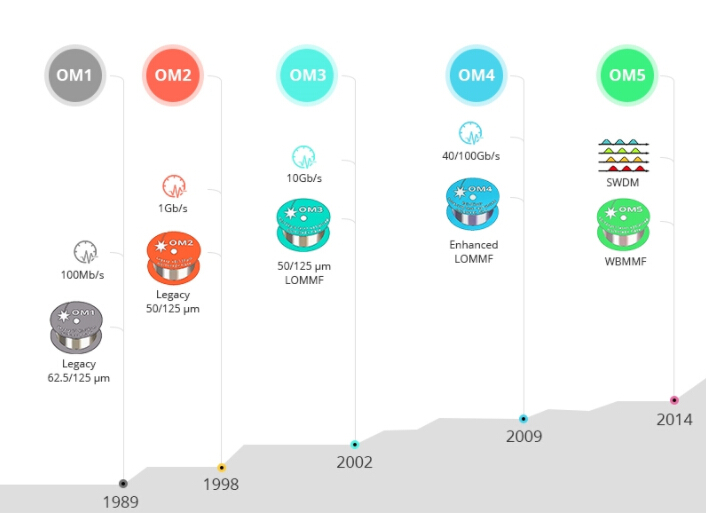
The picture above shows the development of OM multimode fibers. The Lime Green OM5 fibers are newly released and sure to be the mainstream transmission media in the near future.

specification of OM1, OM2, OM3 and OM4

Core Size

Multimode fiber is provided with the core diameter from 50 µm to 100 µm. Apart from OM1 with a core size of 62.5 µm, other three types are all using the 50 µm. The thick core size makes them able to carry different light waves along numerous paths without modal dispersion limitation. Nevertheless, in the long cable distance, multiple paths of light can cause signal distortion at the receiving end, resulting in an unclear and incomplete data transmission. And this is why all the types of multimode fiber can only be used for short distance.

11111

Bandwidth

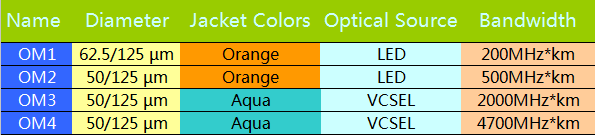
Bandwidth is the bit-rate of available or consumed information capacity expressed typically in metric multiples of bits per second. The higher bandwidth is, the faster transmission speed can be. According to overfilled launch (OFL) and effective modal bandwidth (EMB) measurements, OM1 and OM2 fibers can only support OFL, but OM3 and OM4 are able to support both measurements. At the wavelengths of 850/1300 nm under OFL, the respective bandwidth of OM1, OM2, OM3, OM4 is 200/500 MHz*km, 500/500 MHz*km, 1500/500 MHz*km and 3500/500 MHz*km. And at the wavelength of 850 nm under EMB, the bandwidth of OM3 is 2000 MHz*km and OM4 even reaches 4700 MHz*km.

Data Rate

Data rate is a technical term that describes how quickly information can be exchanged between electronic devices. With a higher data rate, the transmission can be more effective. OM1 and OM2 support the Ethernet standards from 100BASE to 10GBASE with a minimum data rate of 100 Mbps and a maximum data rate of 10 Gbps. Compare with OM1 and OM2, OM3 fibers and OM4 fibers are enhanced to support much higher data rates of 40 Gbps and 100Gbps in 40G and 100G Ethernet.

55

Distance

Multimode fiber is typically used for short distance transmission. But the maximum reaches are varied in different multimode fiber types. Also, on account of different data rates, the transmitting distances are different. However, the common feature is that OM1 always supports the shortest distance yet OM4 supports the longest. For instance, based on the same data rate of 10 Gbps, the maximum reach of OM1 is 33 m, OM2 is 82 m, OM3 is 300 m and OM4 is 550 m. Thus, if a medium-sized transmission is required, OM3 and OM4 fibers are the best choices.

Color & Optical Source

The outer jacket can also be a method to distinguish OM1, OM2 from OM3, OM4. The common jacket color of OM1 and OM2 is orange, and OM3, OM4 are in aqua. In addition, OM1 and OM2 are using a light-emitting diodes (LEDs) optical source but OM3 and OM4 adopt the vertical-cavity surface-emitting laser (VCSELs) optical source.

44

color and optical source of OM1, OM2, OM3 and OM4

Application

OM1 fibers and OM2 fibers are widely employed for short-haul networks, local area networks (LANs) and private networks. OM3 is applied to a larger private networks. Different from the previous multimode types, OM4 is more advanced to be used for high-speed networks in data centers, financial centers and corporate campuses.

Conclusion

It is very important to choose the right fiber type for your application. Future-proofing network design is crucial for network planning, but there is often a cost for that speed. With a higher performance, OM3 fibers and OM4 fibers are definitely more expensive than OM1 and OM2 fibers . So plan well and spend wisely.

Should you Buy OEM Optics or Third Party Optics?

by http://www.fiber-mart.com

Most IT networking professionals are well aware of the high cost of the OEM Optics (SFP, SFP+, XFP, QSFP, CFP, QSFP28 etc.) when sourced from Original Equipment Manufacturers like Cisco, HPE, Juniper, and Extreme. While the customers search the optics price by Google, you will quickly find the huge pricing disparity between OEM optics and many other third party optics suppliers, then you are confused? Why is there such a huge price difference?
OEM Optics vs Third Party Optics, What’s the difference?
First of all, we need to know the definition of “third party optics” (3rd party optics) and “OEM optics”.
OEM optics refers to a brand new optics supplied or manufactured by Original Equipment Manufacturers (OEM). So an original optics for a Cisco switch is branded by Cisco.
3rd party optics refers to the optical transceiver that is not supplied and branded by Original Equipment Manufacturers (OEM) but provided by another vendor (third party) who can offer or make the optics with same specifications. For example, Cisco really doesn’t manufacture transceivers by themselves, so they go to the people who do. In fact, they sourcing the item from optics manufacturers such as Finisar, Avago, and Lumentum under contract, rebranding the optics with their logo, and then sell them to end users by distributors with a quite high price. In this case, Cisco is the first party(OEM), the end user is the second party, but Finisar or another vendor is third party supplier.
Advantages of Buying OEM Optics?
OEM optics are manufactured to the highest quality and ensure working with their network equipment. These transceiver optics are ideal for providing the best quality and compatibility. They have a much lower failure rate and have no any compatibility issues with your switches.
This is why the switches manufacturers recommend that you use their original optics. Their guys also suggest that the life of the equipment is shortened by usage of unbranded third party optics. If you have enough budget but learn little of the third party optics and concern about any quality or incompatibility issues, just pay for the OEM brand optics.
However, when you search the SFP optics price by Google, you will quickly find the huge pricing disparity in optical transceiver pricing between OEMs and many third parties. For most customers, the savings from purchasing third party optics far exceeds what you expect. However, then most of the sales representative from network equipment manufacturer’s will treat the customer that if third-party optics installed in the system, this will void the system manufacturer’s warranty. In this way, the sales try to coerce customers into purchasing transceiver optics from the same system manufacturer, but all of that comes at a much higher price. Is it true?
Will use third party optics void the switches warranty?
The short answer is No. If the switch is defective, the vendors are obliged to fulfill the terms of the warranty per Magnuson-Moss Warranty Act that prohibits a manufacturer from revoking warranty support merely for the use of unapproved hardware.
7 Key Benefits of 3rd Party Optics
Price
The OEMs make their huge profit from selling optics, so they always charge exorbitant prices for their optics. Our 3rd party optics are much cheaper than original ones – sometimes even 10 times. It allows you to save much money especially when you’re working with a limited budget, buy a better quality of systems equipment, the huge savings make you make extra network upgrade in the future.
Quality
Most of factories in the world produce optics according strict standards of MSA (Multisource Agreement), and they make the optics for every end users. They even provide a quality part with a long time warrantty.
Availability
A professional 3rd party optics provider can offer a wide line of transceivers that even OEMs can not provide. If you need long reach 1G SFP ZX 160km optics for your fiber slot in Cisco switch, you won’t find original ones, but many 3rd party can meet your needs and deliver it within 1 week. Many 3rd party suppliers have a huge stock of optics and you can get most of the them with the same day shipping.
Streamline Your Support
By providing you with a single contact window, third party vendors can save you valuable time by providing support for multiple manufacturers all wrapped up in a single contract. As a result, you won’t have to juggle several service contracts from OEM manufacturers. You can also eliminate any disputes that would likely occur from dealing with multiple service providers. Depending on the issue you’re having with your network systems, 3rd party vendors are capable of delivering an array of customized optics to meet your special needs.
Experienced Technicians
If you have many brands of network equipment products, you won’t find OEM service offerings that will provide support for equipment other than their own. You have to face complicated service contracts through multiple providers. Third party optics suppliers should consist of one team of technical experts in a variety of networking equipment from a wide spectrum of manufacturers. Just like if you want to know if a Juniper SFP works with Cisco platform, the 3rd party will tell you based on their test and experience.
Long Time Warranty
Most of reputable third party optics supplier will provide great support service after you’ve bought their products. They are highly focused and specialize in the optical transceiver market, and they will offer even a lifetime warranty on their products. It is inevitable that at one point or another, even with name brand OEM optics, a few optics that you buy will fail. When the software switches or routers is updated, failures occurs such as incompatibility issues with existing optics. Most of the suppliers will be able to troubleshoot and replace the optics for you quickly and at minimal to no cost.
So which should you choose?
The choice is yours. If you demand the highest quality and compatibility 100% of the time, and it is within you. But saving money is always a good thing, if you are still using the overpriced OEM optics, just go ahead to test quality third party optics and you should love it.

Do you know the difference between optical fiber and optical fiber cable?

by http://www.fiber-mart.com

Now many cables use optical fiber cable, because of optical fiber cable stability, the price is much cheaper than ordinary cable. The optical fiber is the main medium for the transmission of information, so before the study of optical fiber communication, we need to know the optical fiber structure and classification, optical fiber transmission principle and optical fiber. Many people have doubts for optical fiber and optical fiber cable and don’t know the difference between optical fiber and optical fiber cable. Let us understand this point first from the optical fiber and optical fiber cable meaning then sees the difference between them.
What is optical fiber and optical fiber cable ?
The optical fiber is a thin, soft medium that transmits light beams. In the actual optical fiber communication line, in order to ensure that optical fiber can be used for a long time under various playing conditions and in a variety of environments, it must be formed to optical fiber cable, because optical Fiber must be covered by several layers of protective structure before use, the cable that is covered is called optical fiber cable. So optical fiber is the core part of optical fiber cable, optical fiber through some of the components of the protection of the subordinate protective layer constitutes an optical fiber cable.
The protective structure of the outer layer protects the optical fiber from the surrounding environment. Optical fiber cable includes optical fiber, buffer layer, and drape. optical fiber and coaxial cable are similar, but no mesh shield, the center is the glass core of light transmission.
The optical fiber is usually tied into a beam, outside with the shell protection. Fiber Core is usually made of quartz glass that cross-sectional area is a very small double concentric cylinder, it is crisp and easy to break, so need a protective layer. So their difference lies in this.
What are the advantages of optical fiber cable?
Optical fiber cable is a new generation of transmission media, compared with copper media, optical fiber security, reliability or network performance has been greatly improved. Optical fiber transmission bandwidth is much higher than the copper cable, and support the maximum distance of more than 2 kilometers. It has the advantages of good anti-electromagnetic interference, strong confidentiality, fast speed, large transmission capacity.
At present, there are two different types of optical fiber, namely Single-mode optical fiber and multimode optical fiber. Multimode optical fiber is generally used for network connections in the same office building or in areas with relatively close proximity. The single-mode optical fiber transmits data at higher quality, longer transmission distances and is often used to connect offices or geographically dispersed networks. If using optical fiber cable as network transmission medium, we also need to increase Ethernet to Fiber Media Converter and other equipment.
Optical fiber cable as the main transmission medium of optical fiber communication, we should pay attention to the quality of optical fiber cable, especially when ordering optical fiber cable, we should consider many factors comprehensively.

Application of MPO Cabling in High-Density Data Center

by http://www.fiber-mart.com

Fiber optic jumper applications in the data center are very extensive, and in recent years the data center fiber optic transmission system bandwidth demand shows a high growth trend, so the use of a new generation of fiber and optical modules can continue to explore the potential of fiber-optic network bandwidth growth. As the multimode fiber jumper in the cost of a great advantage, to promote its application in the data center.
With the continuous drive of the application and popularization of the network media in the cloud computing environment, the multimode fiber jumper is also developing, from OM1 to OM2, and from OM3 to OM4 to use the VCSEL laser optimization technology, the bandwidth demand is increasing. New OM4 Multi-mode jumper fiber standard EIA/TIA492AAAD is introduced, which provides a better transmission mode for multimode fiber in the future wide application. This article provides an ideal communication solution for your data center, servers, network switches, telecentres, and many other embedded applications that require high-speed data transmission.
In a transport port connection device in a 40G / 100G data transmission application, such as QSFP optical modules, regardless of Fiber Channel connections using several fiber connections, and regardless of the type of fiber connection, they are connected directly to the MTP / MPO connector. Because the 40G / 100G data transmission application channel and the device connection between the equipment need to form a special mode, so that the device’s transmitter and receiver channels corresponding to each other, which requires MTP / MPO connector to complete the connection.
The MPO/MTP fiber jumper can provide a wide range of applications for all networks and devices that require 100G modules. They use the high-density multimode fiber optic connector system MT series of casing design, MPO / MTP fiber jumper with UPC and APC polished end, and also supports multimode and single-mode applications. The 10G OM3 / OM4 MPO / MTP fiber jumpers provide 10 Gbps of data transfer rates in high-bandwidth applications, which are five times faster than the standard 50 μm fiber jumper.
At the same time, multi-mode MPO / MTP fiber jumpers are also the most economical choice for most of common optical fiber communication systems. Single-mode MPO / MTP fiber jumper is mainly used for long-distance data transmission system. The MPO / MTP trunk cable is designed for data center applications. Typically, single-mode and multi-mode MPO / MTP fiber jumpers are designed to be 3mm or 4.5mm round cable, and connectors at both ends of the cable are also referred to as MPO / MTP connectors.
The MPO / MTP high-density push-pull fiber jumpers are currently used in three areas: high-density cabling data centers, fiber-to-the-home, and connection applications with a splitter, 40G QSFP+ / 100G QSFP28, 10G SFP+ and other optical modules. Today, there are already a series of high-density parallel optical interconnect products that can accommodate optical fiber transmission in modern data centers, such as custom MPO / MTP fiber jumpers, multimode fiber loopers, and QSFP+ high-speed cable assemblies.
Server virtualization and the development of cloud computing, as well as the development trend of network convergence, bringing a faster and more efficient data center network development needs. At present, 48x 10G channel composed of 10G switches, mainly limited to the use of SFP+ module to achieve the connection. In order to meet the higher bandwidth requirements, users can use a high-density QSFP+ high-speed cable to complete the connection, by increasing the data transmission rate of each channel and increase the port density to meet customer’s high bandwidth requirements.

A Preferable Interconnect Solution for SFP+ Applications–SFP+ AOC Assemblies

by http://www.fiber-mart.com

Dramatically reducing 10G interconnectivity costs, the 10G SFP+ cables can provide inexpensive and reliable 10G speed connections using either SFP+ copper cables or SFP+ active optical cables (AOCs). SFP+ AOC is a cabling technology that accepts the same electrical inputs as a traditional copper cable. It uses optical fiber and electrical-optical conversion on the cable ends to improve speed and data transmission distance of the cable while not sacrificing compatibility with standard electrical interfaces. Nowadays, SFP+ AOC has been a preferable interconnect solution for SFP+ applications. Before choosing it for your applications, you need to have a basic understanding about it.
Description
AOC consists of multimode optical fiber, fiber optic transceivers, control chip and modules. SFP+ to SFP+ active optical cable is composed of SFP+ optical transceivers in both ends and fiber optic cable in between. This integrated optical module solution removes the complicated optical fiber interface and brings friendly and intuitive electrical-to-electrical interface to users. SFP+ AOC is designed to meet the requirements of high speed, high density and low power consumption for applications in today’s data centers via optical fiber wire. SFP+ AOC is compliant to industrial standard SFP MSA and provides high performance SFP+ interfaces, supporting 10Gb/s bi-directional operation. The demand for more bandwidth for data center is challenging interconnect technologies like Ethernet, Infiniband, and Fibre Channel. SFP+ AOC is one of the best solutions to solve this problem. The image below shows a Cisco SFP-10G-AOC10M compatible SFP+ to SFP+ AOC. It is a 10Gb/s, hot pluggable active optical cable for Ethernet data transmission.
Advantages
Compared to SFP+ copper cables for data transmission, SFP+ AOCs provide more advantages, as shown below:
Longer reach
Lower weight and tighter bend radius enable simpler cable management
Thinner cables allows better airflow for cooling
Lower power consumption
No need for power-hungry conditioning ICs on the host board
Application
SFP+ active optical cable is a 10Gbps and cost effective solution for 10G Ethernet (10GbE) applications. With industry-leading VCSEL technology and an advanced new light engine design, the SFP+ AOC assemblies are ideal for high-performance computing clusters, 10G Ethernet applications (10GbE), 4G and 8G Fiber Channel applications (4GFC/8GFC), 1x InfiniBand QDR, DDR, SDR, servers, switches, storage and network interfacing applications.
Conclusion
fiber-mart.com is a leading provider of optical and copper network equipment. We do provide a good selection of 10G SFP+ copper cables, both passive and active and options for SFP+ active optical cables. For example, IBM 95Y0326 compatible SFP+ to SFP+ active copper cable, HP J9285B and HP JG081C compatible SFP+ to SFP+ passive copper cables, and SFP+ AOC cables with various length choices like 1m, 3m, 5m, 7m, 10m, etc., all our SFP+ cables are 100% compatible with major brands like Cisco, HP, Juniper, Enterasys, Extreme, H3C and so on. If you would like to order high quality compatible SFP+ cables and get worldwide delivery. With a wide range of copper and optical networking equipment on offer, fiber-mart.com is sure to have the network equipment to fit your requirements.