Category: Fiber Optic Cables
SELECTING A FIBER OPTIC PATCH CORD
Know All about the DWDM and its Utilization and Significance
Basic knowledge of Fiber Optic Cable Jacket & Fire Rating
Fiber optic cable is constructed from the inside core, cladding, coating, strengthen member to the outside cable jacket. As the bare fiber is easily broken, fiber optic cable jacket is needed to provide protection for the shielding and conductors within the cable. The cable jacket is the first line of moisture, mechanical, flame and chemical defense for a fiber cable.
Fiber Optic
Fiber optic cable is constructed from the inside core, cladding, coating, strengthen member to the outside cable jacket. As the bare fiber is easily broken, fiber optic cable jacket is needed to provide protection for the shielding and conductors within the cable. The cable jacket is the first line of moisture, mechanical, flame and chemical defense for a fiber cable.
Fiber Optic Cable Jacket Material
Fiber cable jacket is made of various types of materials. It’s important to consider the jacket type when selecting the compatibility with the application’s connectors and environment. The table below contains some of the most common fiber cable jacket material types used both indoor and outdoor cables.
Fiber Optic Cable Jacket Color Code
According to EIA/TIA-598, the fiber optic cable color code defines the jacket color codes for different fiber types (SMF or MMF). For single mode fiber, the jacket color is typically yellow. While for multimode cable, the jacket color can be orange (OM1 & OM2 cable), aqua (OM3 cable) and purple (OM4 cable). For outside plant cables, the standard jacket color is black. For more information about fiber optic cable color code, please refer to How to Identify the Fiber Optic Cable Color Code?
Fiber Optic Cable Fire Rating
Typically, there are eight levels of fire resistance for both non-conductive and conductive cables specified by NEC (National Electrical Code). All indoor fiber optic cables must be marked and installed properly for its intended use: plenums, risers and general purpose areas.
Note:
(1) A Plenum area is a building space used for air flow or air distribution system (drop ceiling and raised floors).
(2) A Riser area is a floor opening, shaft or duct that runs vertically through one or more floors.
(3) A general purpose area is all other area that is not plenum or riser and on the same floor.
OFNP vs. OFNR
As mentioned above, OFNP and OFNR are two types of fiber optic cables that are used in buildings. OFNP cables have fire-resistance and low smoke production characteristics. This is the highest fire rating fiber cable and no other cable types can be used as substitutes. So these cables are mostly installed in plenum areas. Whereas, the fiber-resistance and low smoke of OFNR cables are not good as OFNP. OFNP plenum cables can be used as substitutes for OFNR cables. Through OFNR vs. OFNP, it is worth noticing that OFNR fiber optic cable cannot be used in plenum areas to replace OFNP cables, however, the latter can be used in the riser areas. Both OFNP and OFNR can be used in general purpose areas.
Fiber-Mart Plenum/Riser Fiber Optic Cable Solutions
In the nutshell, plenum rated and riser rated cables are generally deployed within the buildings. Choosing the right type of rated cables can effectively reduce loss when the cables are burning. If your cabling application requires materials that are flame-retardant or compliant with strict safety standards, please always opt for plenum-rated cables. Fiber-mart provides a full line of plenum and riser fiber optic cables, including MTP plenum trunk cables, MTP-LC plenum harness cables, tight-buffered distribution plenum cables, armored tight-buffered plenum cables, and tight-buffered distribution / breakout riser cables. If you have any questions or requirement of Optical Fiber,welcome to contact us: product@fiber-mart.com.
Very Effective Method of Fiber Optic Cables Selection
After the distribution network plan is developed, the next step we have to do is the selection of the right fiber optic cable. Remember the bulk of the Fiber Optic Cable installed today is for either telephone or office applications. Industrial sites bring some challenges that are not address by many of the common fiber optic cable installation design. Just due to the local telephone company would rather a particular type of fiber optic cable does not mean it is the right one for a facility.
The common rule of thumb for selection optical cable in industrial setting is to use 62.5/125 μm or 50/125 μm Multi-mode fiber cable. The cable should be rated for both indoor and outdoor use and must have an FT-4 flame rating if it is used for indoors. Aluminum interlock armor is preferred over steel tape for all but long, buried runs. Fiber counts should be a minimum of 12, with 24 fibers as the standard for main backbones. More specific selection details depend on the area where the cable will be installed.
Indoor Office Installation
Fiber selection for office applications is relatively simple. The fiber must be flame-rated for either FT-4 general use or FT-6 for plenum. Typically, tight-buffered cable with Kevlar strength members and a light jacket is used. There is little reason to use loose tube as it is more difficult to install and usually does not meet the flame rating standards. As well, fiber optic cables in these environments do not require armor as the chance of crush or pull damage is relatively low. Because jacketed fiber optic cable is more rugged than most coaxial and twisted-pair cables, plan to armor fiber only in the places where coaxial cables would be Armored Fiber Cable.
Indoor Industrial Installations
If fiber optic cable is being installed in plant-floor conditions. It is possible to be installed in existing cable trays and be subjects to more stresses than office cable systems. Thus, some form of armor is recommended, usually aluminum interlocked (TEC style) armor. This armor must be electrically bonded to ground at all distribution cabinets.
Inter-building Installation
Industrial sites often need a combination of indoor and outdoor fiber routing. Telecommunication industry guidelines recommended switching between indoor and outdoor fiber cable types at each transition, a solution than is not practical for most industrial sites. On a typical site, this would require numerous patch boxes or splices and is not worked for both cost and attenuation(signal loss) reasons. Instead, FT-4 flame-rated, tight-buffered cable should be used so that the cable can transmit both indoor and outdoor environment.
Long-Run Outdoor Installations
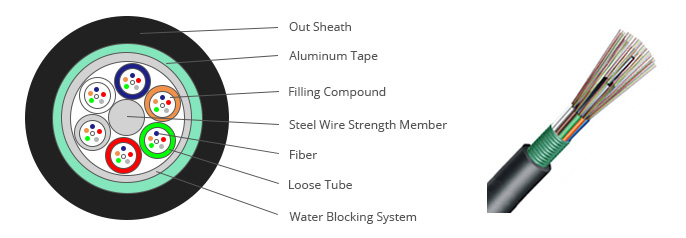
Outdoor fiber cable generally falls into three categories, direct burial, underground conduit, and aerial. These cables are manufactured specifically for outdoor applications and are recommended for any long outdoor cable runs, especially in region subject to cold weather. Most are loose tube designs with high tensile strength, to withstand environmental conditions, and gel filling, to prevent water migration. The jacket materials are specially selected to be abrasion and ultraviolet resistant. If a facility is planning to install long outdoor runs it will need to work closely with the manufacturer ti determine the right cable for its application.
Indoor and Outdoor fiber optic cable delivers outstanding audio, video, telephony and data signal performance for educational, corporate and government campus applications. With a low bending radius and lightweight feature, this cable is suitable for both indoor and outdoor installations. Typical indoor and outdoor cables are loose tube and tight buffer designs, and we also supply ribbon cables, drop cables, distribution cables and breakout cables. These are available in a variety of configurations and jacket types to cover riser and plenum requirements for indoor cables and the ability to be run in duct, direct buried, or aerial/lashed in the outside plant. In addition, Fiber-Mart can supply Indoor and Outdoor fiber optic cable. If you have any questions or requirement of Indoor and Outdoor fiber optic cable,welcome to contact us: product@fiber-mart.com.
Difference Between Tight-Buffered Breakout and Distribution Cables
There are two basic styles of fiber optic cable construction: loose tube and tight buffered. Tight buffered cables provide improved reliability and quick termination for today’s cable installation systems.
There are two basic styles of fiber optic cable construction: loose tube and tight buffered. Tight buffered cables provide improved reliability and quick termination for today’s cable installation systems. Tight-buffered breakout cables and distribution cables are two main types of the tight-buffered cables.loose tube cables hold more than one optical fiber, each individually sleeved core is bundled loosely within an all-encompassing outer jacket. However, in tight buffered cables, there are not so many cables as loose tube cables.
Cable Structures
Breakout Cable Structure
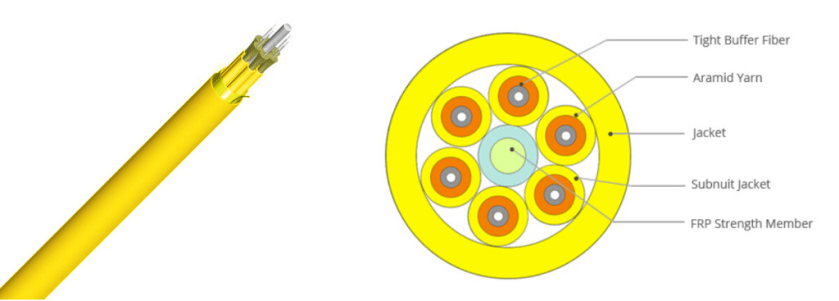
Breakout cable is also known as fan-out cable. As the following picture shows, breakout cable consists two or more simplex cables bundled around a central strength member. Each fiber has its own jacket and all of the fibers are packaged together inside the same outer jacket. Thus, breakout cable can also be broken out into individual simplex cables for separate use when running through walls of a building. Breakout cable is usually designed with tight buffer and the fiber counts are varied from 2 to 24 fibers.

Distribution Cable Structure
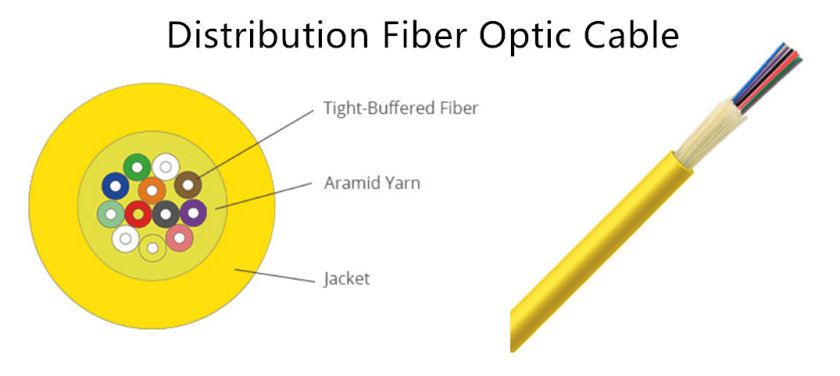
Unlike the breakout cable, distribution cable is smaller in size and lighter in weight. Fiber counts of distribution cable can be more intensive than the breakout cable for up to 144 fibers. Many fibers may not be used immediately but can be left for future expansion. Although the distribution cable has a more compact design, the tight-buffered fibers inside the cable are only bundled in a single outer jacket for protection, as shown in the picture below. Yet this has made the distribution cable to be easily handled and stripped for field termination.

Conclusion
Tight-buffered cables are optimal for indoor applications. With the design of armored layer, they are also used for indoor/outdoor applications. Fiber-Mart provides a wide range of quality optical fiber cables with detailed specifications displayed for your convenient selecting. Per foot price of each fiber cable is flexible depending on the quantities of your order, making your cost of large order unexpected lower. Customers can also have the flexibility to custom the cable plant to best fit their needs.any question pls feel free to contact me at service@fiber-mart.com