Category: Connector & Adapter
All kinds of Fiber Optic Connectors and Adapters, LC, ST, FC, SC, E2000, MPO, MTP, SMA905, MU, DIN etc.
The best way to Install CWDM MUX/DEMUX System?
How Multiplexing Techniques Deliver Higher Speeds on Fiber Optic Cabling
Picking the right fiber connector – PC, UPC or APC
I wrote a blog post some days ago on the different types of connectors available, which sparked a great deal of feedback and discussion, demonstrating how important the whole topic is to both fiber installers and network planners alike. Thanks again to everyone around the world that contributed, both directly on the PPC’s blog and through various social groups.
To recap, I covered SC, LC, FC, ST and MTP/MPO connectors, and looking through the comments I thought it would be beneficial to focus on one area that the original post deliberately didn’t cover – the differences between Angled Physical Contact (APC) and Ultra Physical Contact (UPC) connectors. Beside one having a green body and the other being colored blue, the different ways they both treat light is crucial in planning a network, as several readers pointed out.
To help us understand all this jargon, let’s look back at why the original Flat Fiber Connector evolved into the Physical Contact (PC) connector and then onto UPC and APC.
The primary issue with Flat Fiber connectors is that when two of them are mated it naturally leaves a small air gap between the two ferrules; this is partly because the relatively large end-face of the connector allows for numerous slight but significant imperfections to gather on the surface. This is not much use for single mode fiber cables with a core size of just 8-9 µm, hence the necessary evolution to Physical Contact (PC) Connectors.
The PC is similar to the Flat Fiber connector but is polished with a slight spherical (cone) design to reduce the overall size of the end-face. This helps to decrease the air gap issue faced by regular Flat Fiber connectors, resulting in lower Optical Return Loss (ORL), with less light being sent back towards the power source.
Building on the convex end-face attributes of the PC, but utilizing an extended polishing method creates an even finer fiber surface finish: bringing us the Ultra Physical Contact (UPC) connector. This results in a lower back reflection (ORL) than a standard PC connector, allowing more reliable signals in digital TV, telephony and data systems, where UPC today dominates the market. Most engineers and installers believe that any poor performance attributed to UPC connectors is not caused by the design, but rather poor cleaving and polishing techniques. UPC connectors do have a low insertion loss, but the back reflection (ORL) will depend on the quality of the fiber surface and, following repeat matings/unmatings, it will begin to deteriorate.
So what the industry needed was a connector with low back reflection, that could sustain repeated matings/unmatings without ORL degradation. Step forward the Angled Physical Contact (APC) connector.
Although PC and UPC connectors have a wide range of applications, some instances require return losses in the region of one-in-a-million (60dB). Only APC connectors can consistently achieve such performance. This is because adding a small 8° angle to the end-face allows for even tighter connections and smaller end-face radii. Combined with that, any light that is redirected back towards the source is actually reflected out into the fiber cladding, again by virtue of the 8° angled end-face.
It is true that this slight angle on each connector brings with it rotation issues that Flat, PC and UPC connectors simply don’t have. It is also the case that the three aforementioned connectors are all inter-mateable, whereas the APC isn’t. So, why then is the APC connector so important in fiber optics?
The uses of APC connectors
The best feedback examples from my previous blog came from people experienced with Fttxand Radio Frequency (RF) applications. The advance in analogue fiber optic technology has driven demand for it to replace more traditional coaxial cable (copper). Unlike digital signals (which are either ON or OFF), the analogue equipment used in applications such as DAS, FTTH and CCTV is highly sensitive to changes in signal, and therefore requires minimal back reflection (ORL).
APC ferrules offer return losses of -65dB. In comparison a UPC ferrule is typically not more than -55dB. This may not sound like a major difference, but you have to remember that the decibel scale is not linear. To put that into context a -20dB loss equates to 1% of the light being reflected back, -50dB leads to nominal reflectance of 0.001%, and -60dB (typical of an APC ferrule) equates to just 0.0001% being reflected back. This means that whilst a UPC polished connector will be okay for a variety of optical fiber applications, only an APC will cope with the demands of complex and multi-play services.
The choice is even more important where connector ports in the distribution network might be left unused, as is often the case in FTTx PON network architectures. Here, optical splitters are used to connect multiple subscriber Optical Network Units (ONUs) or Optical Network Terminals (ONTs). This is not a problem with unmated APC connections where the signal is reflected into the fiber cladding, resulting in typical reflectance loss of -65dB or less. The signal from an unmated UPC connector however, will be sent straight back towards the light source, resulting in disastrously high loss (more than 14dB), massively impeding the splitter module performance.
Picking the right physical contact connector
Looking at current technology, it’s clear that all of the connector end-face options mentioned in this blog post have a place in the market. Indeed, if we take a sidestep across to Plastic Optical Fiber (POF) applications, this can be terminated with a sharp craft knife and performance is still deemed good enough for use in the high-end automotive industry. When your specification also needs to consider cost and simplicity, not just optical performance, it’s hard to claim that one connector beats the others. Therefore whether you choose UPC or APC will depend on your particular need. With those applications that call for high precision optical fiber signaling, APC should be the first consideration, but less sensitive digital systems will perform equally well using UPC. Fiber-Mart can supply many kinds fiber connectors. If you have any questions or requirement of fiber connectors,welcome to contact us: product@fiber-mart.com.
INTRODUCTION OF ODC CONNECTOR
What is ODC Connector?
ODC connectors are designed for the fiber to antenna (FTTA) applications. The ODC product range incorporates precision-machined rugged brass housings with two or four optical terminations in both singlemode and multimode fibers. The environmentally sealed, fixed and free connectors are supported by a range of highly crush resistant, high tensile strength “tactical” style cables.ODC fiber optic connector can with stand harsh environmental conditions when being used in outdoor applications. They are used for data and telecommunications in mobile radio, process, utility and traffic automation.
What is ODC Connector?
ODC connectors are designed for the fiber to antenna (FTTA) applications. The ODC product range incorporates precision-machined rugged brass housings with two or four optical terminations in both singlemode and multimode fibers. The environmentally sealed, fixed and free connectors are supported by a range of highly crush resistant, high tensile strength “tactical” style cables.ODC fiber optic connector can with stand harsh environmental conditions when being used in outdoor applications. They are used for data and telecommunications in mobile radio, process, utility and traffic automation.
ODC Fiber Optic Cable System
The ODC connectors, together with the support optical cable, are becoming the standard interface specified in 3G, 4G and WiMax Base Station remote radios and Fiber-to-the-Antenna applications.ODC fiber optic patch cables with extremely robust outdoor connector are designed to withstand harsh environment such as mechanical loads, high thermal exposure, and demanding environments like rain, salt and splash water. It is known for their ease of installation and highest operation safety due to the robust and ruggedized design. ODC military grade cables are installation-friendly for fixed or mobile applications and transmit reliably data over long distances under severe environmental conditions.
The ODC cable assembly is based on the N Type RF Coax connector. The product, however, is not limited to the above applications. It is also in the oil, wind power, rail transport and heavy machinery of digital information transmission and other areas play a strong role.The ODC cable assemblies have passed tests like salt mist, vibration and shock and meet protection class IP67. They are well suited for industrial and Aero-space and Defense applications.
Sum
We believe there is no country in the world in which ODC assemblieshave not been installed yet. There is no other RRH interface which is used more often and which was chosen by more system vendors. The success comes from the fact that ODC is an extremely robust outdoor connector which withstands all installation hazards – and most importantly – does not permit handling errors. ODC makes mobile networks more reliable and guarantees 100 % performance.
Fiber-Mart provides all types of outdoor fiber connectors. These connectors meet the highest quality and robustness standards, and they offer reliability and flexibility for outdoor applications.For purchasing more high quality fiber optical connectors with low cost or for more products’ information, please contact us: product@fiber-mart.com
Basic Knowledge of Fiber Connector
Remateable connections are made possible by Fiber Connectors. Fiber Connectors are therefore generally used where flexibility is needed at termination points when an optical signal is routed. Examples would include connections from receivers to equipment pigtails, or normal termination, or when re-configuring systems. Remateable connections make it easy to meet changing customer requirements by simplifying system reconfigurations.
Application
Optical fiber connectors are used to join optical fibers where a connect/disconnect capability is required. Due to the polishing and tuning procedures that may be incorporated into optical connector manufacturing, connectors are often assembled onto optical fiber in a supplier’s manufacturing facility. However, the assembly and polishing operations involved can be performed in the field, for example, to terminate long runs at a patch panel.
Optical fiber connectors are used in telephone exchanges, for customer premises wiring, and in outside plant applications to connect equipment and cables, or to cross-connect cables.

Most optical fiber connectors are spring-loaded, so the fiber faces are pressed together when the connectors are mated. The resulting glass-to-glass or plastic-to-plastic contact eliminates signal losses that would be caused by an air gap between the joined fibers.
Performance of optical fiber connectors can be quantified by insertion loss and return loss. Measurements of these parameters are now defined in IEC standard 61753-1. The standard gives five grades for insertion loss from A (best) to D (worst), and M for multimode. The other parameter is return loss, with grades from 1 (best) to 5 (worst).
A variety of optical fiber connectors are available, but SC and LC connectors are the most common types of connectors on the market. Typical connectors are rated for 500–1,000 mating cycles.The main differences among types of connectors are dimensions and methods of mechanical coupling. Generally, organizations will standardize on one kind of connector, depending on what equipment they commonly use.
In many data center applications, small (e.g., LC) and multi-fiber (e.g., MTP/MPO) connectors have replaced larger, older styles (e.g., SC), allowing more fiber ports per unit of rack space and higher data rate application such as 100 Gigabit Ethernet.
Features of good connector design:
- Low insertion loss
- High return loss (low amounts of reflection at the interface)
- Ease of installation
- Low cost
- Reliability
- Low environmental sensitivity
- Ease of use
Outside plant applications may require connectors be located underground, or on outdoor walls or utility poles. In such settings, protective enclosures are often used, and fall into two broad categories: hermetic (sealed) and free-breathing. Hermetic cases prevent entry of moisture and air but, lacking ventilation, can become hot if exposed to sunlight or other sources of heat. Free-breathing enclosures, on the other hand, allow ventilation, but can also admit moisture, insects and airborne contaminants. Selection of the correct housing depends on the cable and connector type, the location, and environmental factors. Careful assembly is required to ensure good protection against the elements.
Depending on user requirements, housings for outside plant applications may be tested by the manufacturer under various environmental simulations, which could include physical shock and vibration, water spray, water immersion, dust, etc. to ensure the integrity of optical fiber connections and housing seals.
what’s the difference of Fiber Connectors?
Given the variety of splice options available to fiber network planners today identifying the best connector for FTTH can be overwhelming. Consequently often not much thought is given to connector selection with choice driven by cost, availability or what’s been used before. However each connector has its own unique design and therefore, pros and cons. Over time or depending on project size this can have a dramatic impact on deployment speeds and costs.

So what are the differences and what do they mean to your implementation? This table of common connectors gives an overview of strengths and weaknesses, with more detail in the accompanying descriptions:
1.Standard Connector (SC)
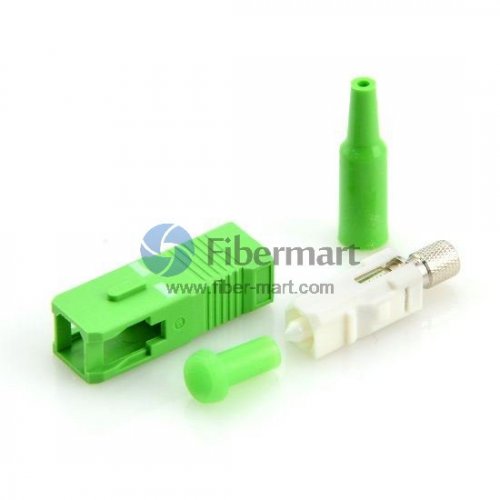
Simple, rugged and low cost, SC connectors use a ceramic ferrule to deliver accurate alignment of the SMF. The SC connector comes with a locking tab that enables push on / pull off operation.
At the time of writing the most popular choice for such equipment like Fiber Multiplexers, GPON and EPON ONU’s, Fiber Media Converters and more.

Figure 3: SC connector
2.Ferrule Core Connector (FC)
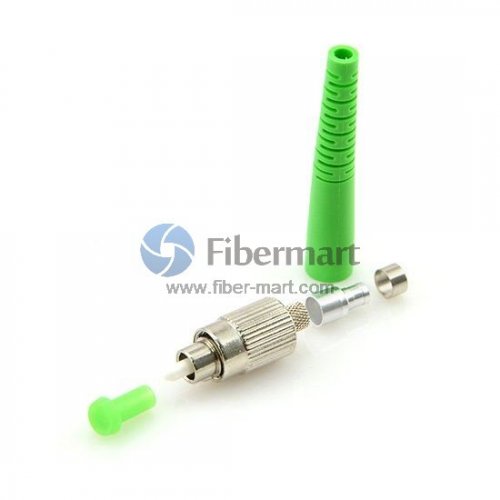
Although the FC connector was widely used in fiber optic networks until of late, its use is dwindling fast. This connector uses a threaded container and a position locatable notch to achieve exact locating of the SMF in relation to the receiver and the optical source. Once the connector is installed, its position is maintained with total precision.
FC connector is pretty common choice for example in Video over Fiber Transmission Equipment.

Figure 4: FC connector
3.Lucent Connector (LC)
The Lucent Connector, sometimes referred to as the Little Connector, is a small form factor FOC that uses a 1.25 mm ferrule. There are 3 different types of LC connectors:
- Single Mode LC APC
- Single Mode LC UPC
- Multi-Mode LC UPC
If you had used any SFP module, you have sure seen this connector.

Figure 5: LC connector
LC connector is always present on SFP’s, and if some equipment uses SFP as transmitter, like for example our USB over fiber transmitters, then you can recognize it easily.
4. ST Connector
The ST connector’s keyed bayonet design is similar to that of a BNC (Bayonet Nut Connector or Bayonet Neill-Concelman) connector. The connector is used widely for MMF and SMF FOC and is extremely easy to use. The ST connector is manufactured in two versions – the ST and the ST-II. Both types are keyed and spring loaded, and use a “push-in and twist” mechanism.

Figure 6: ST connector
In some cases, if Multimode type cable is required, some of our customers order RCA audio over fiber converter, with ST connectors:
5. MTP/MPO connector
The MT ferrule connector is another of NTT’s inventions and has been around since the 1980s, although the technology has only recently become popular under branded versions of the Multiple Fiber Push-On/Pull-Off connector, such as MTP and MPO. It is larger than the other connectors but for good reason – it can support up to 24 fibers in a single ferrule.
Multi-fiber connectors are not currently designed for field-fit applications so must be lab terminated. In high density patch environments such as datacenters they are used extensively, both at single mode and multi-mode wavelengths. On a ‘per-fiber’ basis the costs are relatively inexpensive. However as might be expected, the attenuation loss can be higher than a single ceramic ferrule connector. That being said, it is possible to order ‘low loss’ MTP/MPO connectors which have comparable insertion loss performances. These are more costly however.
Network planners should also consider that whilst still using a uniter/adaptor much like other connectors, the MTP/MPO must also be mated to an opposing male or female connector. This may require more than one connector specification or type within inventory, adding to cost and complexity.
Because the sequence of the fibers cannot physically be changed after termination, the connector is often supplied with a fan-out assembly at the opposing end (such as LC, SC FC etc.). This allows the operator to change channels simply by re-patching the fanned-out side of the cable. The consequence of this is that the small form high density design of the MTP/MPO will only benefit one side of the assembly.
Fiber-Mart can supply many kinds fiber connectors. If you have any questions or requirement of fiber connectors,welcome to contact us: product@fiber-mart.com.