EPON VS GPON

As the infrastructure for access networks, fiber is making rapid headway in the world’s leading technology markets.

As the infrastructure for access networks, fiber is making rapid headway in the world’s leading technology markets. With passive optical networking (PON) technology gaining popularity, Ethernet passive optical networking (EPON) and igabit passive optical network (GPON) are both in active deployment.

What’s the EPON?

EPON (Ethernet PON) generally delivers 1 Gbit/s symmetrical bandwidth.And its Gigabit Ethernet service actually constitutes 1 Gbit/s of bandwidth for data and 250 Mbit/s of bandwidth for encoding.Employs a single Layer 2 network that uses Internet Protocol (IP) to carry data, voice, and video, generally delivers 1 Gbit/s symmetrical bandwidth.

EPON is a device which serves as the service provider endpoint of apassive optical network. to perform conversion between the electrical signals used by the service provider’s equipment and the fiber optic passive component signals used by the passive optical network. To coordinate the multiplexing between the conversion devices on the other end of that network (called either optical network terminals or optical network units).

What’s the GPON?

GPON, FSAN and ITU have standardized it. Its technical feature is to use ITU-T-defined GFP (General framing procedure) to encapsulate and map multiple services such as Ethernet, TDM and ATM at the second layer, which can provide 1.25Gbps and 2.5Gbps downlink rate, and 155M, 622M, 1.25Gbps, 2.5Gbps several uplink rates, and has a strong OAM function. If you don’t consider EPON, you will see that it will increase to 10Gbps (10G Ethernet is mature). Currently, GPON has advantages in high-speed and multi-service support, but the complexity and cost of technology are currently higher than EPON.


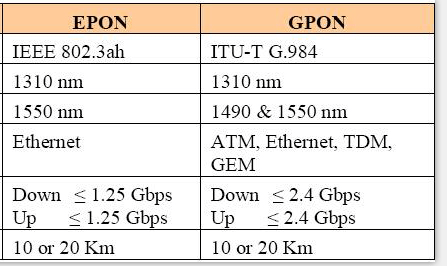
Comparison of EPON and GPON


GPON and EPON Differences

Perhaps the most dramatic distinction between the two protocols is a marked difference in architectural approach. GPON provides three Layer 2 networks: ATM for voice, Ethernet for data, and proprietary encapsulation for voice. EPON, on the other hand, employs a single Layer 2 network that uses IP to carry data, voice, and video.
图片1.png

GPON vs EPON: Data Rate

EPON, based on a 10-Gbit/s Ethernet version designated 802.3av. The actual line rate is 10.3125 Gbits/s. The primary mode is 10 Gbits/s upstream as well as downstream. A variation uses 10 Gbits/s downstream and 1 Gbit/s upstream. The 10-Gbit/s versions use different optical wavelengths on the fiber, 1575 to 1580 nm downstream and 1260 to 1280 nm upstream so the 10-Gbit/s system can be wavelength multiplexed on the same fiber as a standard 1-Gbit/s system.

GPON, based on the GPON packets can handle ATM packets directly. Recall that ATM packages everything in 53-byte packets with 48 for data and 5 for overhead. GPON also uses a generic encapsulation method to carry other protocols. It can encapsulate Ethernet, IP, TCP, UDP, T1/E1, video, VoIP, or other protocols as called for by the data transmission. Minimum packet size is 53 bytes, and the maximum is 1518. AES encryption is used downstream only.

Conclusion: GPON is better than EPON


Technology Comparison

EPON, based on Ethernet is the best carrier for carrying IP services; it is easy to maintain, easy to expand, easy to upgrade; EPON equipment is mature and available, EPON has already laid millions of lines in Asia, third-generation commercial chips have been introduced, related optical modules, chip prices Both have dropped significantly, reached the scale of commercial level, and can meet the requirements of recent broadband services; EPON protocol is simple and low in implementation cost, equipment cost is low, and the most suitable technology is needed in the metro access network, not the best technology.

GPON, based on Access network for telecom operation; high bandwidth: line rate, downlink 2.488Gb/s, uplink 1.244Gb/s; high transmission efficiency: 94% (actual bandwidth up to 2.4G) behavior 93% (actual bandwidth up to 1.1) G); business support: G.984.X standard strictly defines the support of carrier-class full service (voice, data and video); strong management capabilities: rich in features, reserved sufficient OAM domain in the frame structure, and The OMCI standard has been developed; the service quality is high: multiple QoS levels can strictly guarantee the bandwidth and delay requirements of the service; the comprehensive cost is low: the transmission distance is long, the split ratio is high, the OLT cost is effectively allocated, and the user access cost is reduced.

Conclusion: As the parts of PON, they have something in common. For example, they both can be accepted as international standards, cover the same network topology methods and FTTx applications, and use WDM (wavelength-division multiplexing) with the same optical frequencies as each other with a third party wavelength; and provide triple-play, Internet Protocol TV (IPTV) and cable TV (CATV) video services

Costs Comparison

PON, as a FTTH technology, is an ideal solution to deliver last-mile broadband access. The optical line terminal (OLT), optical network unit (ONU) and optical distribution network (ODN), which comprise a PON system, decide the costs of GPON and EPON deployments.

The cost of OLT and ONT is influenced by the ASIC (application specific integrated circuit) and optic module. Recently, the chipsets of GPON are mostly based on FPGA (field-programmable gate array), which is more expensive than the EPON MAC layer ASIC. On the other hand, the optic module’s price of GPON is also higher than EPON’s. When GPON reaches deployment stage, the estimated cost of a GPON OLT is 1.5 to 2 times higher than an EPON OLT, and the estimated cost of a GPON ONT will be 1.2 to 1.5 times higher than an EPON ONT.

Conclusion: the cost of EPON and GPON would be the same.


Summary

Currently, we are still unclear whether EPON or GPON will prevail. EPON and GPON have their own advantages and disadvantages. But one thing is clear: PON system is undoubtedly one of the best, EPON and GPON, both technologies have their own advantages, whether it is EPON technology or GPON technology, its application is largely determined by the rapid reduction of fiber access costs and business needs. For more information,welcome to visit www.fiber-mart.com or contact us service@fiber-mart.com
Should you Buy OEM Optics or Third Party Optics?

by http://www.fiber-mart.com

Most IT networking professionals are well aware of the high cost of the OEM Optics (SFP, SFP+, XFP, QSFP, CFP, QSFP28 etc.) when sourced from Original Equipment Manufacturers like Cisco, HPE, Juniper, and Extreme. While the customers search the optics price by Google, you will quickly find the huge pricing disparity between OEM optics and many other third party optics suppliers, then you are confused? Why is there such a huge price difference?
OEM Optics vs Third Party Optics, What’s the difference?
First of all, we need to know the definition of “third party optics” (3rd party optics) and “OEM optics”.
OEM optics refers to a brand new optics supplied or manufactured by Original Equipment Manufacturers (OEM). So an original optics for a Cisco switch is branded by Cisco.
3rd party optics refers to the optical transceiver that is not supplied and branded by Original Equipment Manufacturers (OEM) but provided by another vendor (third party) who can offer or make the optics with same specifications. For example, Cisco really doesn’t manufacture transceivers by themselves, so they go to the people who do. In fact, they sourcing the item from optics manufacturers such as Finisar, Avago, and Lumentum under contract, rebranding the optics with their logo, and then sell them to end users by distributors with a quite high price. In this case, Cisco is the first party(OEM), the end user is the second party, but Finisar or another vendor is third party supplier.
Advantages of Buying OEM Optics?
OEM optics are manufactured to the highest quality and ensure working with their network equipment. These transceiver optics are ideal for providing the best quality and compatibility. They have a much lower failure rate and have no any compatibility issues with your switches.
This is why the switches manufacturers recommend that you use their original optics. Their guys also suggest that the life of the equipment is shortened by usage of unbranded third party optics. If you have enough budget but learn little of the third party optics and concern about any quality or incompatibility issues, just pay for the OEM brand optics.
However, when you search the SFP optics price by Google, you will quickly find the huge pricing disparity in optical transceiver pricing between OEMs and many third parties. For most customers, the savings from purchasing third party optics far exceeds what you expect. However, then most of the sales representative from network equipment manufacturer’s will treat the customer that if third-party optics installed in the system, this will void the system manufacturer’s warranty. In this way, the sales try to coerce customers into purchasing transceiver optics from the same system manufacturer, but all of that comes at a much higher price. Is it true?
Will use third party optics void the switches warranty?
The short answer is No. If the switch is defective, the vendors are obliged to fulfill the terms of the warranty per Magnuson-Moss Warranty Act that prohibits a manufacturer from revoking warranty support merely for the use of unapproved hardware.
7 Key Benefits of 3rd Party Optics
Price
The OEMs make their huge profit from selling optics, so they always charge exorbitant prices for their optics. Our 3rd party optics are much cheaper than original ones – sometimes even 10 times. It allows you to save much money especially when you’re working with a limited budget, buy a better quality of systems equipment, the huge savings make you make extra network upgrade in the future.
Quality
Most of factories in the world produce optics according strict standards of MSA (Multisource Agreement), and they make the optics for every end users. They even provide a quality part with a long time warrantty.
Availability
A professional 3rd party optics provider can offer a wide line of transceivers that even OEMs can not provide. If you need long reach 1G SFP ZX 160km optics for your fiber slot in Cisco switch, you won’t find original ones, but many 3rd party can meet your needs and deliver it within 1 week. Many 3rd party suppliers have a huge stock of optics and you can get most of the them with the same day shipping.
Streamline Your Support
By providing you with a single contact window, third party vendors can save you valuable time by providing support for multiple manufacturers all wrapped up in a single contract. As a result, you won’t have to juggle several service contracts from OEM manufacturers. You can also eliminate any disputes that would likely occur from dealing with multiple service providers. Depending on the issue you’re having with your network systems, 3rd party vendors are capable of delivering an array of customized optics to meet your special needs.
Experienced Technicians
If you have many brands of network equipment products, you won’t find OEM service offerings that will provide support for equipment other than their own. You have to face complicated service contracts through multiple providers. Third party optics suppliers should consist of one team of technical experts in a variety of networking equipment from a wide spectrum of manufacturers. Just like if you want to know if a Juniper SFP works with Cisco platform, the 3rd party will tell you based on their test and experience.
Long Time Warranty
Most of reputable third party optics supplier will provide great support service after you’ve bought their products. They are highly focused and specialize in the optical transceiver market, and they will offer even a lifetime warranty on their products. It is inevitable that at one point or another, even with name brand OEM optics, a few optics that you buy will fail. When the software switches or routers is updated, failures occurs such as incompatibility issues with existing optics. Most of the suppliers will be able to troubleshoot and replace the optics for you quickly and at minimal to no cost.
So which should you choose?
The choice is yours. If you demand the highest quality and compatibility 100% of the time, and it is within you. But saving money is always a good thing, if you are still using the overpriced OEM optics, just go ahead to test quality third party optics and you should love it.

Do you know the difference between optical fiber and optical fiber cable?

by http://www.fiber-mart.com

Now many cables use optical fiber cable, because of optical fiber cable stability, the price is much cheaper than ordinary cable. The optical fiber is the main medium for the transmission of information, so before the study of optical fiber communication, we need to know the optical fiber structure and classification, optical fiber transmission principle and optical fiber. Many people have doubts for optical fiber and optical fiber cable and don’t know the difference between optical fiber and optical fiber cable. Let us understand this point first from the optical fiber and optical fiber cable meaning then sees the difference between them.
What is optical fiber and optical fiber cable ?
The optical fiber is a thin, soft medium that transmits light beams. In the actual optical fiber communication line, in order to ensure that optical fiber can be used for a long time under various playing conditions and in a variety of environments, it must be formed to optical fiber cable, because optical Fiber must be covered by several layers of protective structure before use, the cable that is covered is called optical fiber cable. So optical fiber is the core part of optical fiber cable, optical fiber through some of the components of the protection of the subordinate protective layer constitutes an optical fiber cable.
The protective structure of the outer layer protects the optical fiber from the surrounding environment. Optical fiber cable includes optical fiber, buffer layer, and drape. optical fiber and coaxial cable are similar, but no mesh shield, the center is the glass core of light transmission.
The optical fiber is usually tied into a beam, outside with the shell protection. Fiber Core is usually made of quartz glass that cross-sectional area is a very small double concentric cylinder, it is crisp and easy to break, so need a protective layer. So their difference lies in this.
What are the advantages of optical fiber cable?
Optical fiber cable is a new generation of transmission media, compared with copper media, optical fiber security, reliability or network performance has been greatly improved. Optical fiber transmission bandwidth is much higher than the copper cable, and support the maximum distance of more than 2 kilometers. It has the advantages of good anti-electromagnetic interference, strong confidentiality, fast speed, large transmission capacity.
At present, there are two different types of optical fiber, namely Single-mode optical fiber and multimode optical fiber. Multimode optical fiber is generally used for network connections in the same office building or in areas with relatively close proximity. The single-mode optical fiber transmits data at higher quality, longer transmission distances and is often used to connect offices or geographically dispersed networks. If using optical fiber cable as network transmission medium, we also need to increase Ethernet to Fiber Media Converter and other equipment.
Optical fiber cable as the main transmission medium of optical fiber communication, we should pay attention to the quality of optical fiber cable, especially when ordering optical fiber cable, we should consider many factors comprehensively.

Knowledge about fiber media converter that you should know

by http://www.fiber-mart.com

Fiber media converters include three basic functional modules: optical media conversion chip, optical signal interface (optical media converter module) and electrical interface (RJ45), if equipped with network management functions, including network management information processing unit. It is an Ethernet transmission Media conversion module that converts short distance twisted-pair signals and long distance optical signals to each other and is also called a fiber converter or Ethernet media converter. It generally applies to Ethernet cables that cannot be covered, it is necessary to use optical fiber to extend the actual network environment of transmission distance, and it is usually positioned in the access layer of broadband Metropolitan Area Network, and it also plays an important role in helping to connect the last kilometre of fiber line to the metropolitan area Network.
In some large-scale enterprises, the network construction directly using fiber for the transmission medium to establish the backbone network, and the internal LAN transmission medium is generally copper, how to achieve LAN connected with the fiber backbone network? This requires different ports, different Linear, different fiber between the conversion and to ensure the quality of the link.  The emergence of fiber-optic media converter, allows the twisted pair of electrical signals and optical signals to each other to ensure the smooth transmission of packets between the two networks while extending the network transmission distance from the copper wire from 100 meters to more than 160 kilometers (Single-mode fiber).
What are the basic features of a fiber media converter?
Fully transparent to the network protocol.
Provide ultra low delay data transmission.
Supports Ultra wide working temperature range.
Using ASIC chip to achieve data line speed forwarding. The programmable ASIC centralizes many functions on a chip, which has the advantages of simple design, high reliability, and low power consumption so that the equipment can get higher performance and lower cost.
Provide network management equipment to diagnose, upgrade, status report, abnormal Situation Report, and control function, can provide complete operation log and alarm log.
Rack-type equipment can provide hot-swappable functions for easy maintenance and uninterrupted upgrades.
Supports a variety of transmission distances (0~160 km).
The Media Converter Rack adopts the dual power supply design, supports the ultra wide power supply voltage, realizes the power protection.
What kinds of fiber media converters are available?
There is a wide range of fiber optic media converters that can be categorized in different ways.
According to the properties of an optical fiber can be divided into Multimode fiber media converter and Single-mode fiber media converter. Because of the use of different fiber, media converter can transmit the distance is not the same, Multimode fiber media converter general transmit distance between 0.5 km to 2 kilometers, and the single mode fiber media converter coverage can range from 20 km to 120 kilometers;
According to the number of optical fiber required can be divided into Single fiber (WDM) optic media converter, receiving data sent in a single strand fiber transmission; Dual Fiber optic media converter, receiving sent data on a pair of optical fiber transmission.
According to the work level/rate, can be divided into single 10M, 100M fiber media converter, 10/100M adaptive Fiber media converter, and 1000M fiber media converter.
According to the structure, can be divided into desktop (stand-alone) fiber media converter and card-type optical media converter. Stand-alone fiber media converter Suitable for a single user, such as a single switch in the corridor to meet the upper allied. Card-type (modular) optical media converter suitable for multi-user convergence, such as the central room of the community must meet all the switches in the upper allied.
According to network management can be divided into management type optical media converter and non-network management type Optical media converter.
According to the power type can be divided into: internal power optical media converter, the built-in switching power supply for the telecommunications application; external power supply Optical media converter, External transformer power is used in civilian equipment. The former advantage lies in the ability to support the ultra wide power supply voltage, to better achieve voltage regulator, filter, and equipment power protection, reduce the mechanical contact caused by external fault points; the latter has the advantage that the equipment is small and inexpensive.
Divided by the way of work: Full-duplex refers to when data is sent and received streaming, by two different transmission lines, respectively, the communication between the two sides can be sent and received at the same time operation, such a transmission is full duplex system, Full-duplex mode without the direction of the switch, therefore, there is no switching operation caused by the time delay; Half-duplex refers to the use of the same transmission line both as a receiving and sending, although the data can be transmitted in two directions, the communication between the two sides can not send and receive data, such a transmission is half duplex system. In a Half-duplex mode, the transmitter and receiver of each end of the communication system are transferred to the communication line by the receiving/sending switch, and the direction is switched, thus the time delay is generated.
These are some of the basic knowledge of optical media converter, we should have a basic understanding of fiber media converter in the application before fiber cabling to avoid any trouble.

WHAT IS OPTICAL CIRCULATOR ?

With the development of advanced optical networks, applications of optical circulators are expanding rapidly and new functionality and applications are emerging quickly.

With the development of advanced optical networks, applications of optical circulators are expanding rapidly and new functionality and applications are emerging quickly. Because of its high isolation of the input and reflected optical powers and its low insertion loss, optical circulators are widely used in advanced communication systems and fiber-optic sensor applications.

What is Optical Circulator?

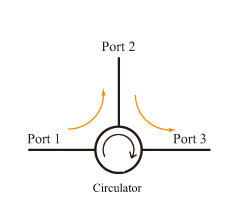
An optical Circulator is a non reciprocal device allowing for the Routing of Light from one Fiberto another based upon the direction of the light propagation.

Optical circulators enable the routing of light from one Optical Fiber or Waveguide to another based upon the direction of light propagation. A circulator has at least three optical ports. These ports can be accessed in such order that when a light beam is caused to enter into an optical port, this light-beam after passing through the circulator to exit from a next optical port. The light enters the circulator through a first Port and exits through a second port. Another light that enters the second port exits through a third port and so on. Since the optical circulator is an inherently non-reciprocal device, the light never goes to other ports. Optical Circulator is a passive optical component that can be used to achieve bi-directional transmission over a single fiber in WDM optical networks. It is widely implemented in equipment such as Dispersion Compensation Modules (DCMs), Optical Add-Drop Multiplexers (OADMs), Optical Time-Domain Reflectometers (OTDRs), optical amplifiers, and fiber optic sensors.


Principle of Optical Circulator

Fiber optic circulators are non-reciprocal optics, which means that changes in the properties of light passing through the device are not reversed when the light passes through in the opposite direction.a special fiber-optic component that can be used to separate optical signals that travel in opposite directions in an optical fiber, analogous to the operation of an electronic circulator. An optical circulator is a three-port device designed such that light entering any port exits from the next. This means that if light enters port 1 it is emitted from port 2, but if some of the emitted light is reflected back to the circulator, it does not come out of port 1, but instead exits from port 3.

22.png

Applications of Optical Circulator

Optical circulator can be utilized to achieve bi-directional optical signal transmission over a single fiber. It is a very important optical component which is commonly used in passive optical network, (wavelength division multiplexing) WDM network, polarization mode dispersion, chromatic dispersion compensation, optical add-drop modules (OADM), optical amplifiers, optical time domain reflectometry (OTDR) and fiber sensing applications. Fiber-Mart provides both polarization insensitive and polarization maintaining optical circulators. These optical circulators feature with high isolation, low insertion loss, and excellent environmental stability etc. Customers can buy these circulators directly in this category or Make Customized Orders.


Main Features of Optical Circulator

  • High isolation
  • Low insertion loss
  • Low polarization dependent loss
  • Low polarization mode dispersion
  • Excellent environmental stability


From this article,you may have a certain understanding of the optical circulator. for more detailed information about optical circulator, welcome to visit www.fiber-mart.com or contact us :Service@fiber-mart.com

40G & 100G Optical Transceivers Basics

by http://www.fiber-mart.com

40G and 100G have two main types in the data center. Short reach (SR4) for ~100 meters transmission on multimode fiber and Long Reach (LR4) for 100 meters to 10km using single-mode fiber. We can use SR/LR transceivers to connect compute clusters and various switches layers in data centers. 40G transceivers are typically deployed as four 10G lanes in QSFP or CFP MSAs. 40G SR transceiver uses 8 multi-mode fibers, VCSEL lasers, and the QSFP MSA. Using edge-emitting lasers and multiplexes the four 10G lanes onto two single-mode fibers, 40G LR4 reach a 10km distance per CFP MSA, CFP/2 or QSFP28 MSAs. The 40G SR4 and LR4 transceivers can be used in the same QSFP switch port without any issues.
A recent report from market research company LightCounting talks about the 40G & 100G optical transceivers basics, here are the details.
100G SR10 transceivers use 20 multi-mode fibers, VCSELs and the CXP MSA, the 100G LR4 transceivers uses CFP form and 2 single-mode fibers. The 100G SR10 CXP transceivers and AOCs are typically designed for the link of large aggregation and core switches at <50 meters. Since 2008, 40G QSFP transceivers and AOCs have been available, but until 2012, several transceiver companies announced CXP 100G SR transceivers.