
What Fiber Attenuator Do You Use? LC Attenuator or SC?

Fiber optic attenuator is an essential passive component in the optical communication system. With the advancement of DWDM technology, as well as the potential to flexibly upgrade the reconfigurable optical add-drop multiplexer (ROADM), the demand for optical attenuator is sure to soar, especially for optical variable attenuator.

Fiber optic attenuator is an essential passive component in the optical communication system. With the advancement of DWDM technology, as well as the potential to flexibly upgrade the reconfigurable optical add-drop multiplexer (ROADM), the demand for optical attenuator is sure to soar, especially for optical variable attenuator.


Types of Fiber Optic Attenuators


Optical attenuator takes a number of different forms. They are typically grouped as fixed optical attenuator and optical variable attenuator.


Fixed Optical Attenuator

Fixed attenuator, as the name of which has indicated clearly, is designed to have an unchanging level of attenuation, expressed in dB, such as 1dB, 5dB, 10dB, etc. Fixed value attenuators consist of in-line type and connector type. In-line type looks like a plain fiber patch cable. It has a fiber cable terminated with two connectors which you can specify types. Connector type attenuator looks like a bulk head fiber connector, with a male connector interface on one end and a female interface connector on the opposite end. It mates to regular connectors of the same type such as FC, ST, SC and LC. Their applications include telecommunication networks, optical fiber test facility, Local Area Network (LAN) and CATV systems.

Optical Variable Attenuator

Optical variable attenuator, or variable optical attenuator, generally uses a variable neutral density filter. It has advantages of being stable, wavelength insensitive, mode insensitive, and offering a large dynamic range. Variable optical attenuator is generally used for testing and measurement, but it is also widely adopted in EDFAs (Erbium-Doped Fiber Amplifier) for equalizing the light power among different channels. Basically, there are two types of optical variable attenuator: stepwise variable attenuator and continuously variable attenuator. Stepwise variable attenuator can change the attenuation of the signal in known steps such as 0.1 dB, 0.5 dB or 1 dB. Continuously variable optical attenuator produces precise level of attenuation with flexible adjustment. Thus, operators are able to adjust the attenuator to accommodate the changes required quickly and precisely without any interruption to the circuit.


How to Use Fixed Fiber Attenuator?


As shown in the figure below, fixed fiber optic attenuators should be always installed at the receiver end of the link (X in the drawing). This is because it’s more convenient to test the receiver power before and after attenuation or while adjusting it with your power meter at the receiver, plus any reflectance will be attenuated on its path back to the source.

For female to male fixed fiber optic attenuators, we can plug the patch cord to the female fiber optic adapter of the attenuator. And then plug the male plug connector of the attenuator to the equipment directly. For female to female fixed fiber optic attenuators, we should plug the two patch cords to the two female fiber optic adapter of the attenuator (shown in the figure below).


Conclusion

Fiber optic attenuator is a passive device used to reduce the power level of an optical signal because too much light can overload a fiber optic receiver and degrade the bit error ratio (BER). To achieve the best BER, the light power must be reduced by using fiber optic attenuator. Fiber-MART provides optical attenuators with various connector types, such as FC/SC/ST/LC/E2000, available with APC or UPC polish. Any question pls feel free to contact me at service@fiber-mart.com

Fiber Optic Splitter Termination Box for FTTH Applications

Fiber optic splitter termination box provides a cost-effective solution for FTTH applications. Nowadays some manufacturers provide this type of box with pre-installed fiber splitters, adapters, splice trays or pre-terminated pigtail assemblies, which help to reduce installation time and cost and satisfy different requirements of customers. Today, this post mainly focuses on the basics of splitter termination box .


Fiber Optic Splitter Termination Box Overview

Fiber optic termination box generally refer to the box shape fiber optic management products used to protect and distribute the optical fiber links in FTTH Network. Usually the fiber optic box includes the fiber optical patch panels and fiber optic terminal box. Fiber optic patch panel is bigger size, fiber optic termination box is smaller. Actually there are too many fiber optic boxes and fiber management devices, they are hard to count the types, many manufacturers will make the fiber optic boxes according to their own design and they may give the fiber optic boxes different names and model numbers.

The fiber optic boxes panels can be pre-installed with various kinds of fiber optic adapters, these adapters are the interface via which the fiber box will connect the external devices. Smaller size fiber optic box, the terminal box, is also used for fiber optic distribution and organization. Our typical fiber terminal box are with 12 ports or 24 ports, with a size of 270mm*137mm*45mm. the fiber optic box are made of cold rolling steel and the surface of the box use the technique of dim blowing plastic. This type fiber optic box is typically installed with FC or ST adapters on the panel. This fiber terminal box could be installed on the wall or put in horizontal line.

fb97020c071ce33ec245b43263e0ee6c.image.500x500.jpg

Fiber Terminal Boxes

Besides fiber patch panels, one can also count on fiber terminal boxes for fiber distribution and organization. While typical fiber terminal boxes are with 12 ports or 24 ports, 8 ports, 36 ports, 48 ports and 96 ports fiber are available in the markets now. They are often installed with FC or ST adapters on the panel, either on the wall or put in horizontal line.

According to the design, FTB can be further divided into wall mount type and rack mount type.

The wall mount fiber termination boxes are designed for either pre-connectorized cables, field installation of connectors, or field splicing of pigtails. They offer an ideal solution for building entrance terminals, telecommunication closets, main cross-connects, computer rooms and other controlled environments.


Fiber Terminal Boxes

Besides fiber patch panels, one can also count on fiber terminal boxes for fiber distribution and organization. While typical fiber terminal boxes are with 12 ports or 24 ports, 8 ports, 36 ports, 48 ports and 96 ports fiber are available in the markets now. They are often installed with FC or ST adapters on the panel, either on the wall or put in horizontal line.

According to the design, FTB can be further divided into wall mount type and rack mount type.The wall mount fiber termination boxes are designed for either pre-connectorized cables, field installation of connectors, or field splicing of pigtails. They offer an ideal solution for building entrance terminals, telecommunication closets, main cross-connects, computer rooms and other controlled environments.

Moreover, in terms of installation environment, there are indoor FTB and outdoor FTB.

Indoor fiber termination box acts as the transition point between the risen cable and the horizontal cable, in this way, it provides operators much more flexibility when managing cables. Besides, indoor FTB makes it possible to leave space for overlength and terminated fibers, as well as for fiber splicing.

The outdoor fiber terminal boxes are environmentally sealed enclosures to distribute fibers for FTTX networks. They are also designed for fiber splicing, termination, and cable management.

Features and Benefits

Fiber optic splitter termination box enables service providers to accelerate their deployments more effectively and is an ideal solution when deploying networks in FTTH applications. And it offers increased efficiency within distinct FTTX network applications. Featuring a compact solution for wall mounting, these termination boxes provide a significant space savings while maintaining hand access to connectors. Following are the features and benefits of deploying fiber optic splitter termination box.

  • Provide a small footprint for splitting, splicing and terminating and are environmentally rated for indoor or outdoor use.
  • Available in several types, each box can equip with splice tray allowing for an input splicing option.
  • Accept standard splitters and splitters can be easily added after the termination box has been installed. And it can accommodate 1×4, 1×8, 1×16, 1×32 fibers, up to 64 fibers.
  • Its small size and flexible mounting options offer easy integration into cell sites and huts, providing on-demand capacity for wireless back haul applications.
  • Offer an economical solution for applications where larger sized FDHs (fiber distribution hubs) may be unfeasible.

Conclusion

Fiber termination box nowadays plays an indispensable role in the field of communication network with greater reliability and flexibility. The continual expansion of broadband networks and the resulting set up of fiber to the home (FTTH) infrastructures make network organizers adopt powerful management and planning systems. Fiber optic splitter termination box is a small part of this system. Fiber -MART can provides comprehensive solutions, any question pls do not hesitate to contact me at service@fiber-mart.com

Passive CWDM VS DWDM – Which to choose?

With current industry advancements trend that has equalized costs of transceivers, in technical battle of CWDM vs DWDM more advancements are in DWDM.

With current industry advancements trend that has equalized costs of transceivers, in technical battle of CWDM vs DWDM more advancements are in DWDM.


Lets compare passive CWDM vs DWDM from pure technical application viewpoint:


CWDM vs DWDM – Channel Uniformity:

As CWDM spectrum for 18 channels spans from 1260nm up to 1620nm compared to DWDM C-band 1530 – 1565 nm, CWDM has weakness from channel uniformity aspect. Attenuation in wide spectrum is different based on wavelength – for example, typical attenuation of G.652.C optical fiber is 0.38 dB/km at 1310nm wavelength and 0.22 dB/km at 1550nm. So in CWDM system You can get quite great disparity of channel optical performance using different CWDM wavelength. Uniformity of optical channels across whole 1260-1620nm spectrum depends on fiber cable specification. – we suggest checking carefully if You plan using passive CWDM. Especially it is very important for old G.652 specification fiber – it has so called “water-peak” phenomena in range of 1390 and 1490 nm that are not usable for CWDM connections at all. DWDM is clear winner here – due it’s narrow spectrum channel properties on same fiber will be almost identical.


CWDM vs DWDM – Capacity:

It’s clear winner here – while maximum capacity of CWDM system is 18 wavelengths all spectrum, DWDM using traditional C-Band 1530 – 1565 nm allow to have 45 100GHz spaced DWDM channels, but with introduction of 50 GHz spaced transceivers we can double number of channels up to 90. In future, we can expect to have 25 GHz and even 12.5 GHz frequency offset even multiplying number of possible channels to 180 or 360. If that is not enough – there is S-band (1460-1530 nm) and L-band (1565-1625 nm) which can be used with DWDM as well, just is not mainstream yet.


CWDM vs DWDM – Distance:

Maximum distance of xWDM connection depends on two main factors – maximum budget of optical transceivers and attenuation of all passive elements – fiber itself, number of joints and splices, attenuation of passive filters (Chromatic dispersion as well, but we don’t consider it much a factor up to 80km). If looking on 10G connection data rate, with both, CWDM and DWDM, passive technologies You can have up to 23 dB guaranteed budget using popular SFP+ transceivers (With XFP You can have 26dB budget), what is enough to have 80km WDM link with both technologies. But big advantage of DWDM is, that due it’s narrow spectral width it’s possible to use cost efficient and widely available EDFA (Erbium Doped Fiber Amplifier) boosters, which is one very cost efficient way allowing extension of DWDM reach.


CWDM vs DWDM – Spare Parts:

Even optical transceivers are mature elements and failure-rates are very uncommon, introducing WDM technology You would like to have backup stock of all active elements. If You are planning to have just small scale deployment and connect just two or few network nodes, it could mean that You basically need to back up everything – resulting on doubling up of your investment. DWDM is a winner here as well, due availability of Tunable DWDM transceivers, with can replace all Your different wavelength DWDM transceivers with one or two units.


Conclusion

CWDM still has price advantages for connection rates below 10G and for short distances with low data rates it’s currently most feasible technology. For more information,welcome to visit www.fiber-mart.com, pls feel free to contact me at service@fiber-mart.com
2 Ports QSFP to QSFP 40G WDM Transponder OEO Converter w/full 3R Support Standalone

FM SKU#:SKU000001G2
Model#:2P-40G-3R-Q-FMOEO
MFG PART#:

QSFP to QSFP 40G WDM Transponder OEO Converter comes with two QSFP ports, are Standalone device that can support the “Three Rs” to Retime,Regenerate and Reshape the optical signal.

Transponders are fiber-to-fiber media converters that convert wavelengths for Wavelength Division Multiplexing (WDM) applications.

Fiber-Mart transponders are protocol and rate-transparent fiber media converters that support SFP, SFP+ and XFP transceivers with data rates up to 11.32 Gpbs, and our transponders provide seamless integration of different fiber types by converting multi-mode fiber to single-mode fiber, and dual fiber to single-fiber.

Fiber-to-Fiber media converters extend network distance by converting wavelengths (1310 to 1550), amplifying optical power. Fiber-MART.Com transponders as re-generators are also an optical – electrical – optical (O-E-O) converter with electrical amplification of the signal by FEC to realize long distances fiber transmission.

Features

    • Support 2U Rack(16 Slots) and independent use.
    • Support network management (Web SNMP, Console).
    • 3R function.
    • Support Jumbo Frame.
    • Transparent Transpor and very low delay.
    • Support DMI function for QSFP fiber module.
    • Support 1*40G Mode and 4*10G Mode.
    • Support Loopback test function.
    • Support hot plugging.
    • Full State Led display.
    • Easy installation.


OEO Converter Standalone

OEO Card for 2U Unified Platefrom Chassis

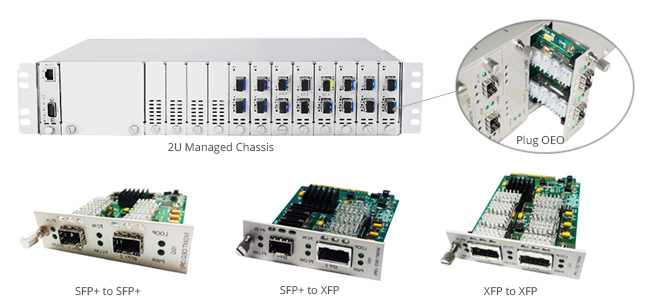
The 2ports OEO card is compatible with 2U Unified Platefrom Chassis. Each card ( SFP+ to SFP+, XFP to SFP+,XFP to XFP,SFP to SFP ) can coexist together in this 2U 17-slot Managed chassis.

Specifications

Performance Data Technical Indexes
Equipment function 3R Repeater
Protocols Multiple functions in one module:
–40G converter/repeater
–Quad 10G optical multiplexer
40G link interface
–Ethernet/IEEE: 802.3ba 40GE-LR4 /SR4
10G interfaces:
–9.95 – 11.35 Gbps
Access Type 40G Ethernet/td>
Interface Type QSFP To/From QSFP
Transmission Distance Up to QSFP module ( Max 10Km )
Maximum Packet Forwarding Rate 14,880,950/S
Network management information: • Card type information
• QSFP fiber module DMI function ( Temperature , Voltage , Optical power)
• Link status detector
• Enable/Disabled Loopback test function
• Enable/Disable PRBS Generator and checker function
power requirement Rack-mountable: AC 85 ~ 220V OR DC -48V
Standalone: AC 220V OR DC -48V
Power consumption: ≤6W
Work Environment Operating Temp: 0~ 50 ℃
Storage Temp: -10~ 70 ℃
Humidity: 5%~90% ( non-condensing )
Dimension Card: 11.5mm ( W ) × 78mm ( D )
Standalone: 156mm ( W ) × 128mm ( D ) × 32mm (H )


OEO Transponder Application in WDM Network

by http://www.fiber-mart.com

Anyone who has experiences of deploying WDM networks, either DWDM or CWDM networks, may be familiar with OEO transponder. Since in WDM network deployment, especially for long haul transmission, OEO transponder plays an important role. OEO transponder, also known as WDM transponder, means optical-to-electrical-to-optical. That is to say, it converts an optical signal to an electrical signal, and then recovers it to an optical signal. In some cases, OEO transponder serves as fiber mode converter or repeater for long distance transmission.
Functions of OEO Transponder
Wavelength Conversion
As we all know, when add a CWDM Mux/Demux or DWDM Mux/Demux into a WDM network, there is a requirement to convert the optical wavelengths like 850nm, 1310nm and 1550nm to CWDM or DWDM wavelengths. Then the OEO transponder comes to assist. The OEO transponder receives, amplifies and re-transmits the signal on a different wavelength without changing the signal content.
Fiber Mode Conversion
It’s know to us that multimode fiber optic cables (MMF) are often used in short distance transmission, while single mode fiber optic cables (SMF) are applied in long optical transmission. Therefore, in some network deployment, considering the transmission distances, MMF to SMF or SMF to MMF conversions are needed.
Signal Repeating
In long haul fiber optic transmission, OEO transponder also can work as repeater to extend network distance by converting wavelengths (1310nm to 1550nm) and amplifying optical power. The OEO converter converts the weak optical signals from the fiber into electrical signals, and regenerates or amplifies, then recovers them into strong optical signals for continuous transmission.
Analysis of OEO Transponder Application Case
Having known about the function of OEO transponder, here let me take some application cases as examples to illustrate its applications clearly.
Case One
The distance between site A and site B is about 165km, and there is a repeater station C. The distance between A and C is 90km. The client needs to build connection between A and B. Just like the following picture shows.
In this solution, three OEO transponders are used in this links according to the requirements of the client. The use of the first OEO converter at site A is to convert the signals from MMF to SMF, achieving the long distance transmission between site A and C. The second OEO transponder re-generates and amplifies the optical signal, then convert the it from dual fiber to single fiber. At site B, the OEO transponder re-amplifies the optical signal and recovers it to multimode transmission.
Advantages of this solution: use OEO transponder to achieve fiber mode conversion and long distance transmission; make full use of the OEO transponder (retime, regenerate and reshape) to realize high quality connections; save cost by using the OEO transponder.
Case Two
This solution is more complicated than the first one. There are three sites with fiber links between them. The distance between site A and B is 84km, and site B and C is 1km. Site A and C is 84km too. All the 10G connections are dual fiber transmission. Here is a simple picture of this solution.
As we can see in the figure, to build DWDM networks between these three sites, six OEO transponders are deployed. Each site uses two OEO transponders. The OEO transponder at site A converts the 10G-LR signals into 10G DWDM wavelengths, then the wavelengths are multiplexed by the DWDM Mux. At site B, the separated wavelengths are recovered to 10G-LR signals through the OEO transponder. The transmission between site B and C, site A and C are similar to the transmission between site A and B. In addition, there are two EDFAs in each two long distance transmissions.
Advantages of this solution: using OEO transponder for wavelength conversion. Converting common 10G signals into DWDM wavelengths and transmitting them with DWDM MUX/DEMUX increase the network capacity easily. At the same time, it also reduces the damage of optical transceivers.
Summary
OEO transponder is an important components in optical networks. This post gives a simple analysis of OEO transponder application case. Hope it’s useful for you. fiber-mart.COM supplies high quality 10G OEO converters like SFP+ to SPF+ and XFP to XFP, and 40G WDM transponder like QSFP+ to QSFP+. If you want to know more detailed information, please contact us via sales@fiber-mart.com.

How Much Do You Know About WDM Transponder?

by http://www.fiber-mart.com

In optical fiber communications, a WDM transponder is a common element that sends and receives the optical signal from a fiber. Maybe you have seen and used it many times. But do you really know it clearly? How much do you know? Today, this article is going to talk about something about WDM (Wavelength Division Multiplexing) transponder.
What’s WDM Transponder?
WDM transponder, also named as fiber optic transponder, is an optical-electrical-optical (OEO) wavelength converter which is designed to perform an O-E-O operation to convert wavelengths of light. It plays a key role in WDM system, especially in DWDM (Dense Wavelength Division Multiplexing) system. Its name “transponder” is short for transmitter and responder, which clearly show its purpose. They are protocol and rate-transparent fiber media converters that support SFP, SFP+, XFP and QSFP transceivers with data rates up to 11.32 Gpbs. WDM transponders extend network distance by converting wavelengths (1310 to 1550nm), amplifying optical power and can support the “Three Rs” to Retime, Regenerate and Reshape the optical signals. In general, there is an O-E-O (optical-electrical-optical) function with this device. Fiber optic transponders and optical multiplexers are usually present in the terminal multiplexer.
How does the WDM Transponder work?
The most distinguished characteristic of WDM transponder is that it can automatically receive, amplify, and then retransmit a signal on a different wavelength without altering the data/signal content. In today’s commercial networks, wavelength conversion is only realized with optical to electronic to optical (O-E-O) transponders. OEO Transponder works as a regenerator which converts an optical input signal into electrical form, generates a logical copy of an input signal with a new amplitude and shape of its electrical pulses and uses this signal to drive a transmitter to generate an optical signal at the new wavelength. Here is a picture showing how a transponder works. From left to right, the transponder receives an optical bit stream operating at one particular wavelength (1310 nm). And then it converts the operating wavelength of the incoming bitstream to an ITU-compliant wavelength and transmits its output into a DWDM system. On the receive side (right to left), the process is reversed. The transponder receives an ITU-compliant bit stream and converts the signals back to the wavelength used by the client device.
What’s the Major Functions of WDM Transponder?
WDM transponder is a vital element in optical communication. Usually, its major function includes:
Conversions between electrical and optical signals
Serialization and deserialization
Control and monitoring
Why WDM Transponder Is Needed in WDM System?
There are several reasons that we need wavelength-converting transponder. The first reason is that they can connect incompatible equipment. Such an example is the conversion of 1300nm carrying wavelength of optic networks. Another one is because we have different fiber optic networks with different providers and different criteria. Therefore, we need WDM transponder to traverse from one fiber network to another. WDM transponder helps us to reduce the number of wavelengths required.
How Many Applications of WDM Transponder Do You Know?
WDM transponders are widely used in a number of networks and applications. The following are their major applications.
Convert Multimode to Single-Mode Fiber
It’s known to us that multimode fiber is often used for short distance transmission while single-mode fiber is used for long distance transmission. In order to exceed the limitation of multimode fibers, mode conversion is needed in networks. As the following figure showing, two switches are connected by the WDM transponder which convert the multimode fibers to single-mode fibers.
Convert Dual Fiber to Single-Fiber
In this case, two dual fiber switches are connected with a single-fiber via two transponders. The single fiber uses 1310nm and 1550nm wavelengths over the same fiber strand in opposite directions. As the following figure showing.
Wavelengths Conversion
The most common application of WDM transponder is wavelengths conversion. Fiber optic communications equipment with fixed fiber interfaces (ST, SC, LC or MTRJ connectors) operating over legacy wavelengths (850nm, 1310nm, 1550nm) must be converted to CWDM wavelengths with a transponder. In this application, the transponder is called WDM transponder or wavelength-converting transponder.
wavelength-conversion
In addition, WDM transponder also can be used to extend 10G OTN network distances, SONET ring distances and provide a standard line interface for multiple protocols through replaceable 10G small form-factor pluggable (XFP) client-side optics.
Conclusion
With its own special features, WDM transponder facilitates a wide application in optical networks. Fiberstore provides a number of choices for OEO WDM transponder which have high performance and good quality. Here you can find different transmission rates of this products such as 2.5G, 4.25G, 8G, 10G and 40G, and different ports of OEO converters such as SFP+ to SFP+, SFP+ to XFP, XFP to XFP, etc. If you want to know more, please visit fiber-mart.COM.