Things You Should Know Before Choosing an OTDR

by http://www.fiber-mart.com

OTDR that is short for optical time domain reflectometry, is a fiber optic tester for the characterization of optical networks that support telecommunications. It can be used to measure loss, optical return loss (ORL) and optical distance on a fiber optic link. Besides, by providing pictorial trace signatures of the fibers under test, an OTDR can offer a graphical representation of the entire fiber optic link. However, there are so many OTDR brands in the market. Choosing the right OTDR for your application can be challenging. So this post is intended for giving some reminders when choosing an OTDR. Hope it may help you.
Why You Need an OTDR?
As we all know, fiber testing is an essential procedure to make sure that the network is optimized to deliver reliable and robust services without fault. So here are two reasons for why an OTDR is needed.
First, service providers and network operators want to insure that their investments into fiber networks are protected. Installers need to use OTDR performing bi-directional tests and providing accurate cable documentation to certify their work. Of course, OTDRs can be used for troubleshooting problems such as break locations due to dig-ups.
Second, premises fiber networks have tight loss budgets and less room for error. Therefore installers have to test the overall loss budget with a light source and power meter, which is a big task. While OTDR can easily pinpoint the causes for excess loss and verify that splices and connections are within appropriate tolerances, which saves lots of time. Besides, it is also the only way to know the exact location of a fault or a break.
What and Where Will You Test?
Before choosing a suitable OTDR, ask yourself the following two questions.
Loss, reflectance, splicing alignment and distance, which one are you going to test? Make sure the OTDR you choose can do what you want easily, quickly and accurately. If you need to make “live” test (like during a “hot cut”—splicing of fibers in a working cable), you need an OTDR that can do an active splice loss measurement in “real time”.
Where are you going to do testing? A good understanding of the applications of an OTDR will help you make the right choice for specific needs. For example, what kind of networks will you test? LAN (local area network), metro or long haul? What is the maximum distance you might have to test? 700 m, 25 km, 150 km?
What Should Be Focused on When Choosing an OTDR?
Many people may be familiar with OTDR but not know how to choose a real right one. Except for the quality that we must focus on, the following three factors also should be attached great importance to.
A Simplified and Task-focused User Interface
Maintaining fiber health is just as challenging and makes fast troubleshooting critical. Almost every OTDR on the market today is designed to cover carrier applications. As a result, many OTDR have very complex user interfaces which require the user to make sense numerous buttons and controls and navigate cumbersome multi-level menus. It’s bad for users improving operating efficiency. So a simplified and task-focused user interface test equipment is important.
Precision Fiber Channel Information
With the wide use of short patch fibers and various types of fiber connectors, details on network link—loss, connector and reflectance—are critical to ensuring performance. However, OTDR with an attenuation dead zone of more than 3m are no longer applicable for testing data center fiber. But when problems arise, an OTDR with precision fiber channel information can help users with various skill levels efficiently perform troubleshooting and accelerate network recovery.
Effective Planning and Documentation
As data centers grow and change, it’s challenging to ensure all fibers are installed with certificated quality. Therefore, integrated project management capabilities with cable-by-cable granularity can save time and planning effort. An OTDR with built-in project management capability that allows users plan day-to-day activities without using a personal computer or laptop.

 

Why should I calibrate fiber optic test and splicing equipment?

Would you drive a car with a speedometer that gives you faulty readings? How can you tell how fast you were driving? Optical testing equipment that is out of calibration will also cause faulty test readings. A fusion splicer that is out of calibration will produce inferior splices. False readings from an OTDR and a poor connector splice joining cable will cost you time and money. Not to mention customers and network owners who would question your fiber optic installation work. How do you expect to evaluate your installation or repair with equipment that has not been calibrated?

As demand keeps growing, more and more of today’s fiber optic network owners are demanding that their networks handle the increased speed needed to keep up with those demands. This means that your splice equipment and cleaver need to be up to the job. With this increased need for speed, today’s loss budgets are lower than ever. These budgets need to be met. Test equipment must be more accurate than ever.

Items that need to be calibrated

You need to remember your OTDR is an important piece of diagnostic equipment. It must be calibrated at specific intervals to ensure correct diagnostics. A power meter & light source is another important piece of testing equipment in your arsenal. This tool consists of transmitter and receiver. It measures the power of an optical signal that is passed through the fiber cable. When two ends of optical fiber are permanently welded together by an electrical arc, this is known as a fusion splice. Arc calibration is a must for the proper splice to take place. Do not forget the optical fiber cleaver. Cleaving is the process of breaking or cutting of the fiber. A fusion splice requires the use of a highly accurate cleaver. As you can see the each piece of equipment mentioned has a specific job. Not calibrating a cleaver or a fusion splicer can mean a poor splice. Without calibration, optic test equipment such as the OTDR and power meter & light source are somewhat useless in determining things like the quality of connectors and splices.

What is a loss budget?

This calculation is the total optical power loss that the system is allowed to have. This amount is determined by the power losses resulting from the total amount of equipment that the system has. A loss budget for fiber optic networks is derived from installation of items such as patch cords; couplers, adaptors, splices, cable and any additional optical components installed in the system. This is determined when the network is designed. After it is installed this loss must be tested to see if the budget has been met. Is the splice that has been made to extend the cable acceptable? How about a connector? Was it installed properly? Another equally important reason for OTDR testing, is once the system is active, later on if a problem presents itself, you can go back to the original test. You could then compare the new test to the original test and determine the problem quickly and easily. This is why accurate OTDR testing equipment must be maintained. In order for that piece of equipment to be accurate it must be calibrated on a regular basis.

Calibration is not an option. It is a must.

Put calibration off and it could cost you more than the cost of the calibration itself. Incorrect readings could have technicians thinking the installation is better than it really is or just the opposite. Your company name depends on quality and accuracy. It is not worth saving a few bucks on calibration. During the year your equipment such as splicing equipment is subjected to all sorts of events that can cause it to go out of calibration. If you are in the south heat can be your enemy. Up north freezing temperatures are not your friend. Have you left your equipment in your truck only to be bounced around? All those bumps, drops and bangs add up to inaccurate readings. Dirty conditions are no help either. In many instances in order to get paid you need up to date certified testing equipment. If you are certified for ISO 9001 you need your equipment calibrated. ISO clause 7/6 reads in part as; Control of monitoring and measuring equipment. The organization shall determine the monitoring and measurement to be undertaken and the monitoring and measuring equipment needed to provide evidence of conformity of product to determined requirements. The organization shall establish processes to ensure that monitoring and measurement can be carried out and are carried out in a manner that is consistent with the monitoring and measurement requirements. Remember, calibration is always a must when the measurements from your equipment are critical – It’s that simple.

What exactly is calibration?

When you calibrate any piece of equipment the unit to be calibrated is compared to a unit of a known value. This known value comes from another similar device of known accuracy and precision. Equipment that has a laser which is being calibrated means that laser must fall within a specific acceptable range. Should the equipment being tested be found to be “out of calibration” and produces faulty readings, the equipment must be repaired or adjusted so it falls within the acceptable specified range of measurement.

What is NIST Calibration?

NIST stands for National Institute of Standards and Technology. They provide services to make sure the equipment being calibrated is measured up to a particular piece of equipment similar to that of the equipment being calibrated. NIST certifies that that the lab testing to equipment uses a method that meets the standards of the NIST and must match the NIST measurement standard for a particular piece of equipment. For fiber optic purposes, that would be equipment such as an OTDR, a fusion splicer, cleavers, power meters and lights sources.

In simple terms when using the NIST method you need an unbroken chain of documents; your piece of equipment and components are compared to our piece of equipment which in turn was compared to a piece of equipment from the NIST which is within a stated tolerance. NIST sets the tolerance and it is correct. Our equipment was compared to the NIST equipment so we know ours is correct. Finally yours is compared to ours and found to be correct. That is an unbroken chain. This unbroken chain which is traced back to NIST standards for accurate measurement is how uniformity is maintained. Once your equipment has been tested and meets NIST standards you will receive a calibration certificate paper work stating the results and the date. This means your equipment has met the highest test standards. A big plus would be getting that certification from an ISO compliant calibration company.

What is ISO?

The International Organization for Standardization (ISO) is the world’s largest non-governmental organization developer of standards. ISO 9001 is the most sought-after and internationally acclaimed management system standard. They have created over 22,808 International standards and goals. Their standards are voluntary. Companies who seek out this standard are ensuring that their customer requirements are met accurately and consistently. When it comes to calibration a company is working to meet a set of regulatory requirements which in turn will improve company performance, which will improve product and service quality. This method in the end will benefit the customer by assuring them that the ISO certified company has met the exacting ISO standards to bring them a better product.

Conclusion

Over time even a well cared for piece of test equipment can lose its’ accuracy. You must have your equipment calibrated as suggested by the manufacturer. However, in many instances you may need to get it done sooner, as many conditions that the equipment is subjected to may alter or falsify your test results. As networks need to increase their efficiencies loss budgets are becoming smaller and smaller. Only calibrated equipment can assure you are correctly within that budget. Calibration is not really an option. It is a must. Always use a lab that will test to NIST standards and if possible use an ISO certified test lab. Accurate results will always save you time, money and your company reputation.

Understanding Loss in Fiber Optic & How to Reduce It ?

Fiber optic cable, which is lighter, smaller and more flexible than copper, can transmit signals with faster speed over longer distance. However, many factors can influence the performance of fiber optic transmission. Losses in optical fiber are negligible issues among them, and it has been a top priority for every engineer to work with and figure out solutions for.

Fiber optic cable, which is lighter, smaller and more flexible than copper, can transmit signals with faster speed over longer distance. However, many factors can influence the performance of fiber optic transmission. Losses in optical fiber are negligible issues among them, and it has been a top priority for every engineer to work with and figure out solutions for.

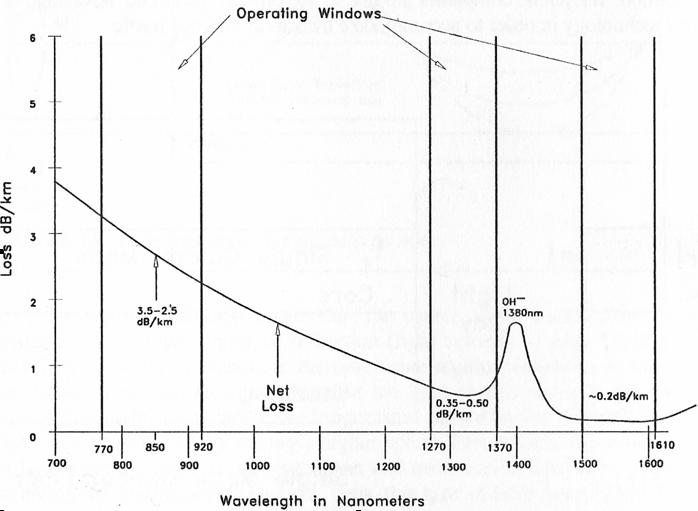
Light traveling in an optical fiber loses power over distance. The loss of power depends on the wavelength of the light and on the propagating material. For silica glass, the shorter wavelengths are attenuated the most (see Fig. 1). The lowest loss occurs at the 1550-nm wavelength, which is commonly used for long-distance transmissions.

44

Transmission of light by fibre optics is not 100% efficient. There are several reasons for this including absorption by the core and cladding (caused by the presence of impurities) and the leaking of light from of the cladding. When light reflects off the cladding /core interface it actually travels for a short distance within the cladding before being reflected back. This leads to attenuation (signal reduction) by up to 2db/Km for a multi-mode fibre. For example, with this level of attenuation, if light travelled over 10kM of cable only 10% of the signal would arrive at the following end.

The amount of attenuation for a given cable is also wavelength dependent. Figure 1 shows the attenuation profile for the two main types of fibre; multi-mode and single-mode cable (described in detail below). The absorption peak at 1000nm is caused by the peculiarities of single mode fibre while the peak at 1400nm is caused by traces of water remaining in the fibre as an impurity. Due to this water absorption peak there are two standard single-mode wavelengths in use, 1310nm and 1550nm. 1310nm has been a standard for many years, only now is there a trend towards using 1550nm brought about by the need to extend the distances between repeaters.

The loss of power in light in an optical fiber is measured in decibels (dB). Fiber optic cable specifications express cable loss as attenuation per 1-km length as dB/km. This value is multiplied by the total length of the optical fiber in kilometers to determine the fiber’s total loss in dB.

Optical fiber light loss is caused by a number of factors that can be categorized into extrinsic and intrinsic losses:

  • Extrinsic
  • Bending loss
  • Splice and connector loss
  • Intrinsic
  • Loss inherent to fiber
  • Loss resulting from fiber fabrication

1

Figure 1. Optical fiber operating wavelengths.

  • Fresnel reflection

Bend Loss. Bend loss occurs at fiber cable bends that are tighter than the cable’s minimum bend radius. Bending loss can also occur on a smaller scale from such factors as:

  • Sharp curves of thefiber core
  • Displacements of a few millimeters or less, caused by buffer or jacket imperfections
  • Poor installation practice

This light power loss, called microbending, can add up to a significant amount over a long distance.

Splice and Connector Loss. Splice loss occurs at all splice locations. Mechanical splices usually have the highest loss, commonly ranging from 0.2 to over 1.0 dB, depending on the type of splice. Fusion splices have lower losses, usually less than 0.1 dB. A loss of 0.05 dB or less is usually achieved with good equipment and an experienced splicing crew. High loss can be attributed to a number of factors, including:

  • Poor cleave
  • Misalignment of fiber cores
  • An air gap
  • Contamination
  • Index-of-refraction mismatch
  • Core diameter mismatch to name just a few.

Losses at fiber optic connectors commonly range from 0.25 to over 1.5 dB and depend greatly on the type of connector used. Other factors that contribute to the connection loss include:

  • Dirt or contaminants on the connector (very common)
  • Improper connector installation
  • A damaged connector face
  • Poor scribe (cleave)
  • Mismatched fiber cores
  • Misaligned fiber cores
  • Index-of-refraction mismatch

Loss Inherent to Fiber. Light loss in a fiber that cannot be eliminated during the fabrication process is due to impurities in the glass and the absorption of light at the molecular level. Loss of light due to variations in optical density, composition, and molecular structure is called Rayleigh scattering. Rays of light encountering these variations and impurities are scattered in many directions and lost.

The absorption of light at the molecular level in a fiber is mainly due to contaminants in glass such as water molecules (OH-). The ingress of OUT molecules into an optical fiber is one of the main factors contributing to the fiber’s increased attenuation in aging. Silica glass’s (Si02) molecular resonance absorption also contributes to some light loss.

Figure 1 shows the net attenuation of a silica glass fiber and the three fiber operating windows at 850, 1310, and 1550 nm. For long-distance transmissions, 1310- or 1550-nm windows are used. The 1550-nm window has slightly less attenuation than 1310 nm. The 850-nm communication is common in shorter-distance, lower-cost installations.

Loss Resulting from Fiber Fabrication. Irregularities during the manufacturing process can result in the loss of light rays. For example, a 0.1 percent change in the core diameter can result in a 10-dB loss per kilometer. Precision tolerance must be maintained throughout the manufacturing of the fiber to minimize losses.

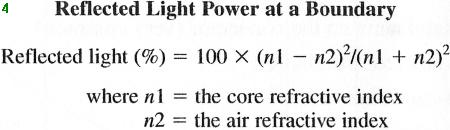
Fresnel Reflection. Fresnel reflection occurs at any medium boundary where the refractive index changes, causing a portion of the incident light ray to be reflected back into the first medium. The fiber end is a good example of this occurrence. Light, traveling from air to the fiber core, is refracted into the core. However, some of the light, about 4 percent, is reflected back into the air. The amount being reflected can be estimated using the following formula:

2

At a fiber connector, the light reflected back can easily be seen with an optical time domain reflectometer (OTDR) trace. It appears as a large upward spike in the trace. This reflected light can cause problems if a laser is used and should be kept to a minimum.

The reflected light power can be reduced by using better connectors. Connectors with the “PC” (Physical Contact) or “APC” (Angle Physical Contact) designations are designed to minimize this reflection.

How to Reduce Losses in Optical Fiber?

In order to ensure the output power can be within the sensitivity of the receiver and leave enough margin for the performance degradation with the time, it is an essential issue to reduce the losses in optical fiber. Here are some common approaches in fiber link design and installation.

  • Make sure to adapt the high-quality cables with same properties as much as possible.
  • Choose qualified connectors as much as possible. Make sure that the insertion loss should be lower than 0.3dB and the additional loss should be lower than 0.2dB.
  • Try to use the entire disc to configure (single disc more than 500 meters) in order to minimize the number of joints.
  • During splicing, strictly follow the processing and environment requirements.
  • The connecting joints must have excellent patch and closed coupling so that can prevent the light leakage.
  • Make sure of the cleanliness of the connectors.
  • Choose the best route and methods to lay the fiber cables during design the construction.
  • 3
  • Select and form a qualified construction team to guarantee the quality of the construction.
  • Strengthen the protection work, especially lightning protection, electrical protection, anti-corrosion and anti mechanical damage.
  • Use high quality heat-shrinkable tube.

Summary

When it comes to high-quality fiber patch cables that help in reducing losses in optical fiber, Fiber-Mart offers bend insensitive fiber (BIF) patch cables with ultra low insertion loss (IL) and bend radius, ensuring high performance of data transmission.I believe you can find a suitable fiber optic patch cable for your devices in Fiber-Mart.please contact us: product@fiber-mart.com.


Basics of OTDR (Optical Time-Domain Reflectometer)

OTDR, short for optical time-domain reflectometer, is an optoelectronic instrument used to characterize an optical fiber. It injects a series of optical pulses into the fiber under test and extracts, from the same end of the fiber, light that is scattered (Rayleigh backscatter) or reflected back from points along the fiber.

OTDR, short for optical time-domain reflectometer, is an optoelectronic instrument used to characterize an optical fiber. It injects a series of optical pulses into the fiber under test and extracts, from the same end of the fiber, light that is scattered (Rayleigh backscatter) or reflected back from points along the fiber.  It can offer you an overview of the whole system you test and can be used for estimating the fiber length and overall attenuation, including splice and mated-connector losses. It can also be used to locate faults, such as breaks, and to measure optical return loss.

How does an OTDR work?

OTDR is used to test the performance of newly installed fiber links and detect problems that may exist in them. Its purpose is to detect, locate, and measure elements at any location on a fiber optic link. OTDR works like radar—it sends pulse down the fiber and looks for a return signal, creating a display called a “trace”or “signature” from the measurement of the fiber.

the OTDR uses a unique optical phenomena “backscattered light” to make measurements along with reflected light from connectors or cleaved fiber ends, thus to measure loss indirectly.Unlike sources and power meters, which measure the loss of the fibre optic cable plant directly, the OTDR works indirectly. The source and meter duplicate the transmitter and receiver of the fibre optic transmission link, so the measurement correlates well with actual system loss.

During the process of OTDR testing, the instrument injects a higher power laser or fiber optic light source pulse into a fiber from one end of the fiber cable, with the OTDR port to receive the returning information. As the optical pulse is transmitted through the fiber, part of the scattered reflection will return to the OTDR. Only useful information returned could be measured by the OTDR detector which acts as the time or curve segments of fibers at different positions. By recording the time for signals from transmission to returning and the speed of transmission in fibers, the distance thus can be calculated.

When do you need an OTDR? 

You can use an OTDR to locate a break or similar problem in a cable run, or to take a snapshot of fibers before turning an installation over to a customer. This snapshot, which is a paper copy of the ODTR trace, gives you a permanent record of the state of that fiber at any point in time. This can help installers when fibers have been damaged or altered after installation, proving where responsibility for the damage lies. In fact, some customers will demand OTDR testing as a condition for system acceptance.

Although OTDRs are not especially accurate for loss testing, they can be used to conduct loss testing on long, outdoor runs of singlemode fiber where access to both ends of the cable isn’t practical. It can also be helpful for preventive maintenance procedures, such as routine checkups on a facility’s fibers.

Characteristics of OTDR

Rayleigh scattering refers to the irregular scattering generated when the optical signals transmitting in the fiber. OTDR only measure the scattered light back on the OTDR port. The backscatter signal show the attenuation degree (loss/distance) of the optical fiber, and will be tracked as a downward curve, illustrating the power of backscatter is decreasing, this is because that both transmission signal and backscatter loss are attenuated.given the optical parameters, Rayleigh scattering power can be marked, if the wavelength is know, it is proportional with the pulse width of the signal: the longer the pulse width, the stronger backscatter power. Rayleigh scattering power is also related to the wavelength of transmitted signal: the shorter the wavelength, the power is stronger. That is to say, the backscatter loose generated by the trajectory of 1310nm will higher than that of 1550nm signals.

In the higher wavelength region (more than 1500nm), the Rayleigh scattering will continue to decrease, and the other one phenomenon which called infrared attenuation (or absorption) will appear to increase and cause an increase the overall attenuation values. Therefore, 1550nm wavelength is the lowest attenuation, this also explains why it is a long distance communication wavelength. Naturally, these phenomena will return to affect the OTDR. OTDR of 1550nm wavelength is also have low attenuation, so it can be used for long distance testing. While as the high attenuation wavelength 1310nm or 1625nm, OTDR testing distance is bound to be limited, because the test equipment need to test a sharp front in the OTDR trace, and the end of the spikes will quickly fall into the noise area.

Fresnel reflection falls into the category of discrete reflection that is caused by the individual point of the whole fibers. These points are the result of changes in reverse coefficient elements such as glass and air gap. At these points, a strong backscatter light will be reflected back. Therefore, OTDR uses the information of Fresnel reflection to locate the connection point, fiber optic terminal and breakpoints.

Conclusion

OTDRs are invaluable test instruments that can illuminate problems in your optical fiber before they bring your system to its knees. Once you’re familiar with its limitations and how to overcome them, you’ll be prepared to detect and eliminate your optical fiber events. Fiber-MART can offer OTDRs are available with a variety of fiber types and wavelengths, including single mode fiber, multimode fiber, 1310nm, 1550 nm, 1625 nm, etc.. And we also supply OTDRs of famous brands, such as AFL Noyes OFL & FLX series, JDSU MTS series, EXFO FTB series, YOKOGAWA AQ series and so on. OEM portable and handheld OTDRs (manufactured by Fiber-Mart) are also available.Pls not hesitate to contact us for any question, for more information, welcome to visit www.fiber-mart.com or E-mail: service@fiber-mart.com