To get good fiber optic splices or terminations, especially when using the pre-polished connectors with internal splices, it is extremely important to cleave the fiber properly. Imprecisely cleaving of the fiber ends, therefore, will result in improper matching. So, the end of the fiber must be cleaved to a 90 degree flat end when it is prepared for a connector or splice. However, technicians often encountered the problem that the end of the fiber strand is so small, making it is impossible to tell whether the strand has a flat end. To ensure smooth and precise fiber cleaving, a fiber optic cleaver is much needed. And in this article, we will offer you some useful information about fiber optic cleaver.

What is Cleaving or Fiber Cleaver?
Cleaving is the process by which an optical fiber is “cut” or precisely broken for termination or splicing. Just like cutting glass plate, fiber is cut by scoring or scratching the surface and applying stress so the glass breaks in a smooth manner along the stress lines created by the scratch. Properly done, the fiber will cleave with a clean surface perpendicular to the length of the fiber, with no protruding glass on either end.
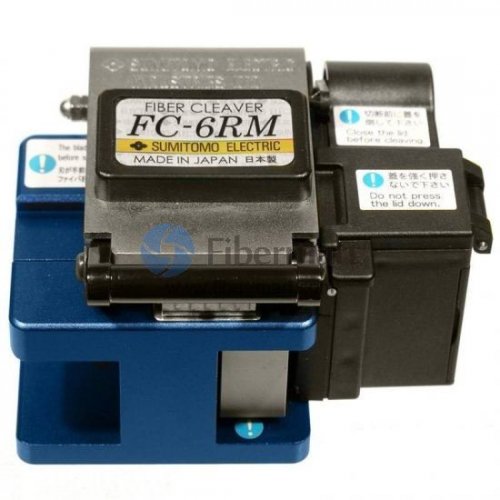
A fiber cleaver is a tool that holds the fiber under low tension, scores the surface at the proper location, then applies greater tension until the fiber breaks. Good cleavers are automatic and produce consistent results, irrespective of the operator. With good fiber cleavers, you only need to clamp the fiber into the cleaver and operate its controls, then fiberglass is cleaved automatically. However, some cleavers are less automated and require operators to exert force manually to cut the fiber cable, which makes it difficult to predict and control the force. The good cleavers are called as precision cleavers, while the less automated ones are called as cheap or scribe cleavers, which will be introduced in the next part.

Two Types of Fiber Optic Cleavers
We know that the closer to 90 degrees the cleave is, the greater chance you will have to match it with another cleaved fiber, then be spliced or mated by a connector. Thus, a proper tool with good technique is demanded for consistently achieving a 90 degree flat end. Good cleavers are automatic and can produce consistent results, irrespective of the operator. The user only needs to clamp the fiber into the cleaver and operate its controls. Some cleavers are less automated, making them more dependent on operator technique and therefore less predictable. There are basically two broad categories of fiber optic cleavers: scribe cleavers and precision cleavers.
Scribe Cleavers
This type is based on a traditional cleaving method. It is typically used to remove excess fiber from the end of a connector before polishing, simply by using a hand tool called scribe. Scribe cleavers are usually shaped like ballpoint pens with diamond tipped wedges or come in the form of tile squares. The scribe has a hard, sharp tip, generally carbide or diamond, which is used to scratch the fiber manually. Then the operator pulls the fiber to break it. Since both the scribing and breaking process are under manual control, this method varies greatly in repeatability. Most field and lab technicians shy away from these cleavers as they are not accurate. However, if used in skilled hands, this scribe cleaver reduces the cost significantly for repairs, installation, and training classes.
Precision Cleavers
Precision cleavers are the most commonly used cleavers in the industry. They use a diamond or tungsten wheel/blade to provide the nick in the fiber. Tension is then applied to the fiber to create the cleaved end face. The advantage of these cleavers is that they can produce repeatable results through thousands of cleaves by simply rotating the wheel/blade accordingly. Although more costly than scribe cleavers, precision cleavers can cut multiple fibers at one time with increased speed, efficiency, and accuracy. While in the past, scribe cleavers were widely used for fiber cleaving, precision cleavers are now developed to support various applications and multiple fiber cleaving. Precision cleavers contribute to better cleave, which ensures low splice loss and precision cleavers, besides, its blades have a much longer life span.

Operation method
1.Verify that the device has the blade sliding plate in front of one end, open the size platen;
2.Stripped fiber coating stripping fiber clamp reserve bare fiber length of 30-40mm, to wrap fiber, cotton wool or tissue dipped in alcohol then clean fiber. Rub with cotton wool or tissue paper, do not use the same cotton wool or tissue paper to rub the second (Note: Please use plain Greater than 99% alcohol).
3.Visual edge alignment of the fiber coating cutter ruler (12-20cm) appropriate scale, the left hand placed in the optical fiber oriented pressure tank the bare fiber placed straight on the left and right rubber mat.
4.Together on a small plate, large platen to promote devices blade slider the blade dicing fiber under surface, and is free to slide to the other side, cut fiber;
5.The left hand held onto the cutter, the right hand to open a large pressure plate and remove fiber debris into fixed container.
6.Pinch the optical fiber with the left hand while the right hand to open the small pressure plate, carefully remove the fiber cut end face, attention: the neat fiber cross-section do not touch it matter.
The advantages of fiber optic cleaver
1.Excellent beam quality of a smaller of focal diameter and high working efficiency, high quality;
2.High cutting speed: cutting speed greater than 10m/min;
3.Stable operation: the world’s top import fiber optic lasers, stable performance, key parts can reach 100,000 hours;
4.The high efficiency of photoelectric conversion: Compare with CO2 laser cutting machine, fiber optic laser cutting machine have three times photoelectric conversion efficiency;
5.Low cost: to save energy and protect the environment Photoelectric conversion rate as high as 25-30%. The low power consumption, which is the traditional CO2 laser cutting machine is only about 20% -30%;
6.Low maintenance costs: fiber line transmission, no need reflect lens, save maintenance costs;
7.Simple operation: optical fiber transmission lines, there is no adjustment of the optical path;
8.Super flexible optical effects: compact design, compact and easy to flexible manufacturing requirements.

Tips on Choosing Fiber Cleavers
1. Select fiber cleavers according to your application requirements. Fiber cleavers, designed for fusion splicing, need a low average angle that is one degree or less, whereas cleavers appropriate for mechanical connectors require angles below three degrees. So determine whether you require a single-fiber or multi-fiber cleaver before you cleave the fibers at one time.
2.Think twice before purchasing a cleaver built into a splicer. If you intend to purchase the built-in cleavers, you must check whether the cleaver or splicer requires maintenance. It may cause inconvenience to technician if they loses valuable tools, which can hold up the job at hand.
3.Purchase a cleaver with the latest automation features that can save a lot of labour and time. Fiber cleavers are always continuing to evolve with new and improved features, such as automated fiber scrap collection, automated scoring mechanisms, and the latest automatic blade rotation technology.
Conclusion
Precise cleaving is the premise of successful fusion splicing. Thus the quality of the fiber cleavers directly determines the quality of fiber optic splices or terminations. If the fiber ends were not cleaved perfectly, fiber loss would occur which would in turn affect the transmission of signals. To buy reliable and high precision fiber cleavers, please visit Fiber-Mart or contact us via product@fiber-mart.com.


 Fiber Optic Blog