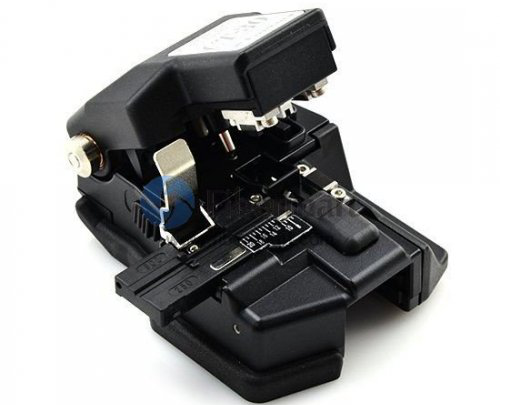
Why A Good Fiber Optic Cleaver Helps Cut Out Costly Mistakes?

What Is Fiber Optic Cleaver?

A cleave in an optical fiber is a deliberate, controlled break, intended to create a perfectly flat end face, perpendicular to the longitudinal axis of the fiber. A fiber optic cleaver is a tool that holds the fiber under low tension, scores the surface at the proper location, then applies greater tension until the fiber breaks. Usually, after the fiber has been scored, the technician will use a cleaver either bend or pull the fiber end, stressing the fiber. This stress will cause the fiber to break at the score mark, leaving a 90-degree flat end if all goes well. So the cleaver doesn’t cut the fiber. In fact, it just breaks the fiber at a specific length.

Two Types of Fiber Optic Cleavers

We know that the closer to 90 degrees the cleave is, the more success you will have with matching it to another cleaved fiber to be spliced or mated by a connector. So it’s important to use the proper tool with good technique to consistently achieve a 90-degree flat end. Good cleavers are automatic and produce consistent results, irrespective of the operator. The user need only clamp the fiber into the cleaver and operate its controls. Some cleavers are less automated, making them more dependent on operator technique and therefore less predictable. There are two broad categories of fiber optic cleavers, scribe cleavers and precision cleavers.

Scribe Cleavers

A traditional cleaving method, typically used to remove excess fiber from the end of a connector before polishing, uses a simple hand tool called a scribe. Scribe cleavers are usually shaped like ballpoint pens with diamond tipped wedges or come in the form of tile squares. The scribe has a hard, sharp tip, generally carbide or diamond, that is used to scratch the fiber manually. Then the operator pulls the fiber to break it. Since both the scribing and breaking process are under manual control, this method varies greatly in repeatability. Most field and lab technicians shy away from these cleavers as they are not accurate. However, if in skilled hands, this scribe cleaver offer significantly less investment for repairs, installation, and training classes.

Precision Cleavers

Precision cleavers are the most commonly used cleavers in the industry. They use a diamond or tungsten wheel/blade to provide the nick in the fiber. Tension is then applied to the fiber to create the cleaved end face. The advantage to these cleavers is that they can produce repeatable results through thousands of cleaves by simply just rotating the wheel/blade accordingly. Although more costly than scribe cleavers, precision cleavers can cut multiple fibers while increasing speed, efficiency, and accuracy. In the past, many cleavers were scribes, but over time, as fusion splicers became available and a good cleave is the key to low splice loss, precision cleavers were developed to support various applications and multiple fiber cleaving with blades that have a much longer life span.

Which One to Use: Scribe Cleaver or Precision Cleaver?

While both types perform the functions above, the difference between the two categories of cleavers is the percentage yield of good cleaves. An experienced fiber optic technician will achieve approximately 90% good cleaves with a scribe cleaver, while the precision cleaver will produce 99% good cleaves. The difference doesn’t seem like much so you may hardly to make a specific decision. My suggestion is to buy precision cleavers if you plan to use a lot of mechanical splices or pre-polished splice/connectors. It will pay for itself in no time. If you decide to use the inexpensive scribe cleavers, you must learn how to use it properly. Follow directions, but also do what comes naturally to you when using the device, as they are sensitive to individual technique. Inspect the fibers you cleave to see how good they are and keep practicing until you can make consistently good cleaves.

To find pricing, information and more information on the different fiber optic cleavers currently available, please visit http://www.fiber-mart.com.

Choosing a Fiber Optic Cleaver

The old adage, “You get what you pay for” applies to most purchases that you make in life. Fiber optic cleavers are no exception!

When choosing a fiber optic cleaver there are two types of devices to consider:
• Precision Cleavers – These are used to prepare fiber for fusion splicing. This is a process in which a separate tool called a fusion splicer or fusion splicing machine uses a powerful electric arc to fuse (or splice) two fibers together. Precision cleavers also provide superior results when used to prepare fibers for mechanical splicing.
• Mechanical Cleavers – A mechanical cleaver is used to prepare fiber for mechanical splicing only. Instead of fusing, mechanical splices rely on mechanical gripping mechanisms to hold the two fibers together. Mechanical cleavers are not considered accurate enough to prepare fibers for fusion splicing. That being said, even low cost mechanical cleavers have their place.
This blog will help you decide which type of cleaver is best suited to your needs and budget.
Precision Cleavers Vs. Mechanical Cleavers
A Closer Look
Before an optical fiber can be spliced to another fiber, the end of the fiber must be prepared prior to splicing. The fiber endface must be cleaved, which means breaking (cleaving) the fiber in a precise manner that produces a cleaved surface with the proper geometry and smoothness to ensure optimum signal throughput after the splice is completed. The goal is to minimize light scattering and back reflection at the juncture of the two fibers.
The degree to which such accuracy can be achieved depends on whether you are using a cleaver meant for fusion splicing (precision cleaver) or mechanical splicing (mechanical cleaver).
Precision Cleavers
Precision cleavers are capable of producing a near perfect cleave in which the cleaved endface of the fiber is at a 90 degree angle relative to the length of the fiber, in other words after cleaving the fiber endface is perpendicular relative to the length of the fiber. Generally, this is the ideal angle at which to fuse two fibers together. Some precision cleavers are designed to produce cleave angles other than 90 degrees, such as may be required for specialized applications involved in the manufacture of semiconductors and laser diodes. Angled cleavers are also sometimes used with mechanical splices to minimize back reflectance.
In either case, the goal is to achieve consistent cleave angles within 1 degree of accuracy, this can only be achieved using a Precision Cleaver.
Operation
When using a precision cleaver, the technician simply places the fiber in the device and clamps it down in the correct position. The tool then completes the cleaving operation automatically. There is no chance that the operator will apply the wrong amount of pressure to score and snap the fiber. The precision cleaver does it all, with accuracy, repeatability and reliability.
Applications
• Single mode and Multimode Networks
• Telecom and Datacom
• Component Assembly
• High Strength Splicing Applications
• Splice-On Connectors
Advantages
• Cleaves both single mode and multimode fiber
• Produces high precision cleaves that mitigate signal loss
• Provides reliability and repeatability
• Ribbon splicing option
Disadvantages
• Cost – Relatively high cost compared to mechanical cleavers. Typical prices range from $500 to $1,000 or more.
Mechanical Cleavers
If your application allows splicing fibers by mechanical means (as opposed to fusing them together) you can probably get by with a relatively inexpensive mechanical cleaver. Mechanical cleavers are used to prepare fibers for mechanical splices, which employ mechanical gripping mechanisms to hold the two fibers together. Mechanical splices may also use Index Matching Gel between adjoining fibers to help reduce back reflection and signal loss due to irregularities in the fiber endfaces. Mechanical cleavers are also known as pocket cleavers, field cleavers, beaver cleavers and staple-type cleavers.
Operation
A notable characteristic of a mechanical cleaver is its long leaf spring. Typically. the fiber is held in position on the spring by a retainer while a blade is brought into contact with the fiber to scratch (score) the fiber. The technician then bends the leaf spring, causing the fiber to break along the score line. A skilled technician can achieve a cleave angle within 2 degrees of accuracy.
Applications
• Mechanical Splices
• Mechanical Connectors
• Multimode Networks
• Premise and Campus Installations
• Local Datacom Multimode Networks
• Other multimode applications not subject to tight loss budgets
Advantages
• Cost – Affordable enough to put one in every tool box. Prices range from $100 to $200.
• Low Maintenance – Simple mechanical design
Disadvantages
• Less Accurate – Provides less precision and repeatability when compared to a precision cleaver. Not suitable for preparing fiber for fusion splicing.
• Multimode Only – Not suitable for cleaving single mode fiber.
Summary
If you are required to do fusion splicing, there is no question about it – you need a precision cleaver. If you are doing mechanical splicing only, you can likely get by with a lower cost mechanical cleaver.
Be aware that a precision cleaver can perform both types of cleaving, allowing you to minimize signal loss in both single mode and multimode networks. Although purchasing a precision cleaver involves a higher upfront cost, it may prove to be the best value in the long term.
Cleaver Specifications (Typical)
Precision Cleavers – Models are available for use with 250-µm to 900-µm coated fibers. V-groove alignment and adjustable cleave lengths can provide consistent cleave angles of 90 Degrees +/- 0.5 Degrees. Precision cleavers are available with diamond blades, with 16 or more blade positions that provide up to 3,000 cleaves per position. Precision cleavers can be purchased with fixtures that enable the cleaving of ribbon fibers and can accommodate 2 to 24 fibers.
Mechanical Cleavers – Models are available for use with 80µm to 200µm fibers or 900µm buffer or 250µm coated fiber. Mechanical cleavers provide cleave lengths of 2 to 20mm. These cleavers are available with ceramic blades that offer 1,000 cleaves or more, or carbide blades that can provide 5,000 cleaves or more. Mechanical cleavers typically include a graduated scale to indicate various cleave lengths.

The advantage of A Good Fiber Optic Cleaver

by http://www.fiber-mart.com

To get good fiber optic splices or terminations, especially when using the pre-polished connectors with internal splices, it is extremely important to cleave the fiber properly. If the fiber ends are not precisely cleaved, the ends will not mate properly. To prepare a fiber end for a connector or splice, the end of the fiber must be cleaved to a 90 degree flat end. For technicians the problem is that the end of the fiber strand is so small that it is impossible to tell with the naked eye whether the strand has a flat end. So in order for this to happen, you must use a cleaving tool called fiber optic cleaver. Some knowledge of fiber optic cleaves will be provided in this article.
good and bad fiber cleave
Fujikura CT-30 High Precision Fiber Cleaver
What Is Fiber Optic Cleaver?
A cleave in an optical fiber is a deliberate, controlled break, intended to create a perfectly flat end face, perpendicular to the longitudinal axis of the fiber. A fiber optic cleaver is a tool that holds the fiber under low tension, scores the surface at the proper location, then applies greater tension until the fiber breaks. Usually, after the fiber has been scored, the technician will use a cleaver either bend or pull the fiber end, stressing the fiber. This stress will cause the fiber to break at the score mark, leaving a 90 degree flat end if all goes well. So the cleaver doesn’t cut the fiber. In fact, it just breaks the fiber at a specific length.
Two Types of Fiber Optic Cleavers
We know that the closer to 90 degrees the cleave is, the more success you will have with matching it to another cleaved fiber to be spliced or mated by a connector. So it’s important to use the proper tool with good technique to consistently achieve a 90 degree flat end. Good cleavers are automatic and produce consistent results, irrespective of the operator. The user need only clamp the fiber into the cleaver and operate its controls. Some cleavers are less automated, making them more dependent on operator technique and therefore less predictable. There are two broad categories of fiber optic cleavers, scribe cleavers and precision cleavers.
A traditional cleaving method, typically used to remove excess fiber from the end of a connector before polishing, uses a simple hand tool called a scribe. Scribe cleavers are usually shaped like ballpoint pens with diamond tipped wedges or come in the form of tile squares. The scribe has a hard, sharp tip, generally carbide or diamond, that is used to scratch the fiber manually. Then the operator pulls the fiber to break it. Since both the scribing and breaking process are under manual control, this method varies greatly in repeatability. Most field and lab technicians shy away from these cleavers as they are not accurate. However, if in skilled hands, this scribe cleaver offer significantly less investment for repairs, installation, and training classes.
Scribe
Precision cleavers are the most commonly used cleavers in the industry. They use a diamond or tungsten wheel/blade to provide the nick in the fiber. Tension is then applied to the fiber to create the cleaved end face. The advantage to these cleavers is that they can produce repeatable results through thousands of cleaves by simply just rotating the wheel/blade accordingly. Although more costly than scribe cleavers, precision cleavers can cut multiple fibers while increasing speed, efficiency, and accuracy. In the past, many cleavers were scribes, but over time, as fusion splicers became available and a good cleave is the key to low splice loss, precision cleavers were developed to support various applications and multiple fiber cleaving with blades that have a much longer life span.
Precision Cleaver
Which One to Use: Scribe Cleaver or Precision Cleaver?
ST-105 Fiber Optic Cleaver
While both types perform the functions above, the difference between the two categories of cleavers is the percentage yield of good cleaves. An experienced fiber optic technician will achieve approximately 90% good cleaves with a scribe cleaver, while the precision cleaver will produce 99% good cleaves. The difference doesn’t seem like much so you may hardly to make a specific decision. My suggestion is to buy precision cleavers if you plan to use a lot of mechanical splices or pre-polished splice/connectors. It will pay for itself in no time. If you decide to use the inexpensive scribe cleavers, you must learn how to use it properly. Follow directions, but also do what comes naturally to you when using the device, as they are sensitive to individual technique. Inspect the fibers you cleave to see how good they are and keep practicing until you can make consistently good cleaves.
To find pricing, information and more information on the different fiber optic cleavers currently available, please visit http://www.fiber-mart.com. Sign up to get informative news, posts and deals in regards to current products in the fiber optic field. Or you also can contact our friendly staff members at sales@fiber-mart.com to learn more about all the fiber optic cleavers with the best value that are present in the industry today.
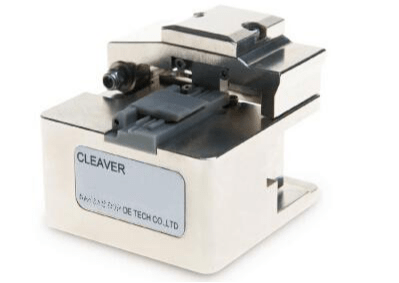
Introduction of Fiber Optic Cleaving

As we know, in most cases, when a fiber is used or spliced, it is essential to prepare clean ends. Stripping, cleaving, polishing are the basic steps to ensure fiber ends clean and smooth. Cleaving, an essential step of making fiber ends clean, though it’s a simple mean, but it works surprisingly well, at least for standard glass fibers. Thus, I want to share something about the cleaving in this paper today.

As we know, in most cases, when a fiber is used or spliced, it is essential to prepare clean ends. Stripping, cleaving, polishing are the basic steps to ensure fiber ends clean and smooth. Cleaving, an essential step of making fiber ends clean, though it’s a simple mean, but it works surprisingly well, at least for standard glass fibers. Thus, I want to share something about the cleaving in this paper today.

图片1

Basics of Fiber Optic Cleaving

Fiber optic cleaving is one of the several processes in the preparation for a fiber splice operation. The purpose of cleaving is to prepare the end of the fiber so that it makes a very nearly perfect right angle with the body of the fiber and that this end face is nearly perfectly smooth. With a well-performed cleaving operation, a clean and flat endface was created perpendicular to the length of the fiber, with no protruding glass on either end. Besides it can also help to achieve a successful low loss splice of an optical fiber.


The technique of Fiber Optic Cleaving

A general strategy involved in the technique of fiber optic cleaving is known as the scribe-and-tension or scribe-and-break strategy. With the use of cutting tool made from materials such as diamond, sapphire or tungsten carbide, this process involves the introduction of a crack in the fiber, then followed by the application of tensile stress in the vicinity of the crack.

However, the specific implementations of the cleaving can be various thus lead to cleaves of different qualities. Some implementations may apply the tensile force uniformly across the cross section of the fiber while others might bend the fiber around a curved surface, causing excessive tensile stress on the outside of the bend. Besides, the crack in the fiber may also be generated in different ways: the crack may be introduced at a single point on the circumference or it may be generated all along the circumference of the fiber prior to the application of the tensile force. The circumferential introduction of the crack often allows fibers of considerably large diameters to be cleaved while maintaining high quality of the cleave.

图片2

Two Types of Fiber Optic Cleavers

As mentioned before, fiber optic cleavers can be classified into precision cleavers and cheap or scribe cleavers.

Scribe Cleavers—The scribe or manual cleaver, which is cheaper than the precision cleaver, is the most original type of fiber optic cleaver. Scribe cleavers are usually shaped like ballpoint pens with diamond tipped wedges or come in the form of tile squares. The scribe has a hard and sharp tip, generally made of carbide or diamond, to scratch the fiber manually. Then the operator pulls the fiber to break it. Since the breaking process is under manual control, it is hard to control the force, which makes the cleaving less accurate and precise. That’s why most technicians shy away from these cheap cleavers.

Precision Cleavers—As the name implies, precision cleavers can do a preciser cleaving job compared to the scribe cleavers. A precision cleaver uses a diamond or tungsten wheel/blade to provide the nick in the fiber. Tension is then applied to the fiber to create the cleaved end face. The advantage of the precision cleavers is that they can produce repeatable results through thousands of cleaves by simply just rotating the wheel/blade accordingly. Although they are more costly than scribe cleavers, precision cleavers can cut multiple fibers with increasing speed, efficiency, and accuracy. As the fusion splicers became popular, precision cleavers were developed to support various splicing works. Precision cleavers are deal for fusion splicing standard 125/250um & 125/900um fibers and preparing fiber for various pre-polished connectors.

3

Operation Procedure for Fiber Cleavers

A fiber cleaver utilizes an automatic anvil drop for fewer required steps and better cleaving consistency. The automated anvil design can save time and significantly improve the quality of the cleave by eliminating human error and subpar cleaves associated with scribes and manual cleavers. To perfectly cleave optical fibers, perform the following steps:

Step 1: Open the body cover and put the stripped fiber on the v-groove.

Step 2: Close the holder cover.

Step 3: Close the cover and move the slider forward to cleave the fiber.

Step 4: Open the cover and check the cleaved fiber.

Step 5: Open the holder cover and take out the cleaved fiber.

Step 6: Remove the chip of cleaved fiber with a pair of tweezers.

6

Tips on Choosing Fiber Cleavers

1.Select fiber cleavers according to your application requirements. Fiber cleavers, designed for fusion splicing, need a low average angle that is one degree or less, whereas cleavers appropriate for mechanical connectors require angles below three degrees. So determine whether you require a single-fiber or multi-fiber cleaver before you cleave the fibers at one time.

2.Think twice before purchasing a cleaver built into a splicer. If you intend to purchase the built-in cleavers, you must check whether the cleaver or splicer requires maintenance. It may cause inconvenience to technician if they loses valuable tools, which can hold up the job at hand.

3.Purchase a cleaver with the latest automation features that can save a lot of labour and time. Fiber cleavers are always continuing to evolve with new and improved features, such as automated fiber scrap collection, automated scoring mechanisms, and the latest automatic blade rotation technology.


Conclusion

To get good fiber optic splices or terminations, especially when using the pre-polished connectors with internal splices, it is extremely important to cleave the fiber properly. As we know, fiber splicing requires mating two fiber ends. Any defect of the ends would impact the performance of fiber splicing.To buy reliable and high precision fiber cleavers, please visit www.fiber-mart.com or contact us product@fiber-mart.com.