How Much Do You Know About Fiber Connector Cleaning?

by http://www.fiber-mart.com

With the widespread use of optical fiber in high-speed communications, reliable and efficient fiber installations and maintenance are critical to the high-performance network. According to NTT-Advanced Technology, 98% of installers and 80% of network owners reported that issues with fiber connector contamination were the greatest cause of network failure. Contaminated or dirty fiber connectors can often lead to degraded signal performance or link failure, so a properly maintained and cleaned fiber optic cable will help to reduce the contamination on fiber interface. Admittedly, fiber cleaning kits play an important role in the maintenance of fiber optic system, which keeps the effective connections between all fiber optic equipment.
Different Fiber Connector Types
As we all know, fiber connector is a component to terminate the end of fiber optic cable, which has an important impact on the fiber optic transmission reliability and the performance of the system. In general term, about 100 fiber optic connectors have been introduced to the market. But the most commonly used fiber connector types include LC, SC, MU, ST, FC, MTRJ, NID, E2000 and MTP/MPO connector. Therefore, choosing the right fiber cleaning tools depends on the types of the fiber connector.
General Fiber Cleaning Procedures
Before cleaning the fiber optic connectors, it is essential to know the general connector cleaning process. Generally, there are two methods to clean fiber connectors: dry cleaning and wet cleaning. Dry cleaning is to use a reel-type cassette cleaner or push-type fiber cleaner to wipe the connector end face against a dry cleaning cloth in one direction. It can remove airborne contamination and should be attempted at first. As for wet cleaning, first wipe the end face against the wet area and then onto a dry area to clean potential residue from the end face. Wet cleaning is more aggressive than dry cleaning, but it can remove both airborne contamination and light oil residue. After dry cleaning, the connector is still dirty, a wet cleaning is followed immediately in order to ensure no residue is left on the end face.
How Many Fiber Connector Cleaning Solutions Are There?
Reel-type Fiber Cleaners
The reel-type cleaner is designed for effective cleaning of almost all fiber optic connectors with an accessible ferrule including LC, MU, SC, FC, ST, MPO/MTP, MTRJ and so on. If you only need to clean the accessible connector with a wide range of connector styles, it is an ideal choice for you.
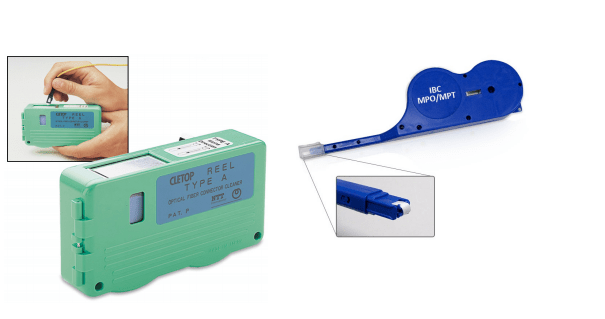
CLE-BOX cassette cleaner is an essential non-alcohol cleaner to maintain and guarantee good quality of fiber optic connection. It supports removing dust, oil, and other debris for LC/SC/FC/ST/MU/D4/DIN connectors. You don’t have to carry any other tools to clean the dust and grease on optical fiber interface. Cassette tapes are available for replacement after 500+ cleaning operations to ensure low cleaning cost. When using cassette cleaner, please always remember that don’t reverse cleaning direction so as to avoid back wiping contaminants.
Fiber Cleaning Wipes
Fiber optic cleaning wipes are designed to be used dry or with fiber optic cleaning alcohol for effectively removing common contaminants from optical jumpers and patch cords. These fiber wipes are lint-free and non-abrasive, thus they can provide superior cleaning of fiber optic connector ferrules without risk of scratching or lint residue. FS can provide Wipexperts M-3 cleanroom wipes, cleanroom wipes, and Kimtech wipes. Among them, Kimtech science wipes have been a favorite choice of labs, medical offices and delicate manufacturing for more than 60 years. Kimwipes delicate task wipers are specifically designed to gently clean liquid and dust and are great for instrumentation, surface, parts and lens cleaning.
Foam Swabs
Fiber optic lint-free foam swabs are ideally suited for cleaning contamination from 1.25mm or 2.5mm fiber adapters and connectors. 1.25mm and 2.5mm foam swabs are all made of polyester and polyurethane. These small foam swabs have excellent performance for cleaning the end face of adapter or connector, and they can also be used in other equipment, such as a printer, computer, optical instrument camera lens, etc.

Introduction of Fiber Connector Cleaning

With the widespread use of optical fiber in high-speed communications, reliable and efficient fiber installations and maintenance are critical to the high-performance network.With the deployment of 40G and 100G systems in the data center reliable and efficient,fiber installations are critical to the high performance network.Contaminated fiber optic connectors can often lead to degraded performance and costly, but preventable failures. In industry studies the #1 cause of link failure is a contaminated or dirty connector or fiber.

With the widespread use of optical fiber in high-speed communications, reliable and efficient fiber installations and maintenance are critical to the high-performance network.With the deployment of 40G and 100G systems in the data center reliable and efficient,fiber installations are critical to the high performance network.Contaminated fiber optic connectors can often lead to degraded performance and costly, but preventable failures. In industry studies the #1 cause of link failure is a contaminated or dirty connector or fiber. To ensure proper performance and reliability care must be taken with the installation and maintenance of removable fiber connectors. Ideally, a properly maintained and cleaned fiber optic cable will help reduce contaminant transfer to a removable or non-removable optical interface, lessening or removing the need to clean expensive and delicate gear. Cabling industry best practices recommend that both field and pre-terminated connections should be inspected and cleaned prior to mating to other connectors or equipment.

11

Preparation for the Cleaning Process

  • Always inspect your connectors or adapters before you begin the cleaning process.
  • Use the connector housing to plug or unplug a fiber.
  • Turn off any laser sources before you inspect and clean fiber connectors.
  • Disconnect the cables at both ends and remove the pluggable receiver from the chassis.
  • Store unused protective caps in a resealable container to prevent any transfer of dust to the fiber.
  • Discard any used tissues or swabs.

Fiber Optic Connector Cleaning Procedure

Step 1: Inspect the fiber optic connector, component, or bulkhead with a fiberscope.

Step 2: If the connector is dirty, clean it with a dry cleaning technique.

22

Dry cleaning: Using a reel-based cassette cleaner (see the picture below) with medium pressure, wipe the connector end face against a dry cleaning cloth (single swipe per exposure) in one direction. For angled physical contact (APC) polished connectors, ensure that the entire end face surface mates with the cleaning cloth. Dry cleaning will generally remove airborne contamination and should be attempted first. Inspect the connector end face for contamination after cleaning.

Step 3: Inspect the connector.

Step 4: If the connector is still dirty, repeat the dry cleaning technique.

Step 5: Inspect the connector.

Step 6: If the connector is still dirty, clean it with a wet cleaning technique followed immediately with a dry cleaning in order to ensure no residue is left on the end face.

33

Wet cleaning: Lightly moisten a portion of a lint free wipe with fiber optic cleaning solution (or > 91% Isopropyl Alcohol) and applying medium pressure, first wipe the end face against the wet area and then onto a dry area to clean potential residue from the end face. For APC polished connectors, ensure that the entire end face surface mates with the cleaning wipes. Wet cleaning is more aggressive than dry cleaning, and will remove airborne contamination as well as light oil residue and films.

44

Step 7: Inspect the connector again.

Step 8: If the contaminate still cannot be removed, repeat the cleaning procedure until the end face is clean.

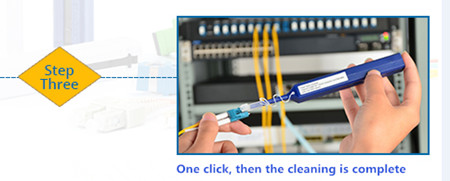
Note: Never use alcohol or wet cleaning without a way to ensure that it does not leave residue on the end face. Or it will cause equipment damage. The following images shows how to use fiber optic cleaner, just three steps will help you out.

111

222

333

Avoid These Common Mistakes

  • Do not use a cleaning process that will leave a residue on the end-face.Alcohol or wet cleaning processes are the most common procedures that will leave residue on the surface of the devices.
  • Do not touch the products without being properly grounded.
  • Do not connect the end face of the fiber connectors.
  • Do not twist or pull on the fiber cable forcefully.
  • Do not connect fiber to a fiberscope while system lasers are still on.
  • Do not touch the cleaned area with a swab, tissue, or cleaning fabric.
  • Do not reuse any tissues or swabs.
  • Do not touch a portion of the tissue or swab.
  • Do not use alcohol around an open flame or spark.
  • Extend the Life of Your Fiber Optic Connectors With Proper Cleaning Methods
  • Always extend the life of your fiber optic connectors by using one of these popular cleaning methods. They are safe to use and will prevent premature failure of your devices. Follow the instructions for more stability in your systems.

Summary

The following context has briefly introduced the procedures of cleaning fiber optic connectors. Note that if you are not sure how to proceed this, you’d better ask an expert for help. Besides this, choose the suitable cleaning tools would also be significant. Fiber-Mart has various fiber optic cleaning tools, such as pen cleaner, cassette cleaner, etc. All of these cleaning tools are provided with high quality and reasonable price. Moreover, we also supply a full range of fiber optic cables like LC to ST fiber cable, SC fiber cable, SC FC patch cord, etc. If you have any requirement of our products, please contact us: product@fiber-mart.com.