What splitter structure you should have in FTTH network centralized or cascading

by http://www.fiber-mart.com

FTTH currently developed very fast in South America and Africa, however, many new comers are curioused about how many splitters should i have in FTTH network.
PON is the basic structure for FTTH network, PON is short for Passive Optical Network. It consists of OLT, ODN (Splitter) and ONT. From the structure, splitter placement in ODN is very crucial. there are generally two types of splitter placement in ODN network, centralized splitting and cascading splitting. The centralized splitter uses single-stage splitter located in a central office in a star topology. The cascading splitter approach uses multi-layer splitters in a point to multi point topology.
The centrlized splitting structure generally uses a 1×32 splitters in the central office. . The central office CO may be located anywhere in the network. The splitter input port is directly connected via a single fiber to a GPON/GEPON optical line terminal (OLT) in the central office. On the other side of the splitter, 32 fibers are routed through distribution panels, splice ports and/or access point connectors to 32 customers’ homes, where it is connected to an optical network terminal (ONT). Thus, the PON network connects one OLT port to 32 ONTs.
A cascading splitting structure approach may use a 1×4/1×8 splitter residing in an outside plant enclosure/terminal box. This is directly connected to an OLT port in the central office. Each of the four fibers leaving this stage 1 splitter is routed to an access terminal that houses a 1×8/1×4, stage 2 splitter. In this scenario, there would be a total of 32 fibers (4×8) reaching 32 homes. It is possible to have more than two splitting stages in a cascaded system, and the overall split ratio may vary (1×16 = 4 x 4,  1×32 = 4 x 8, 1×64 = 4 x 16, 1×64 = 8 x 8).
A centralized architecture typically offers greater flexibility, lower operational costs and easier access for technicians. A cascaded approach may yield a faster return-on-investment with lower first-in and fiber costs. When deciding on the best approach, it’s important to understand these architectures in detail and weigh the trade-offs. The cascading type of splitting is the most commonly used in the FTTH ODN structures.

Comparing Passive Optical Networks and Passive Optical LANs

by http://www.fiber-mart.com

The Basics of Passive Optical Networks (PONs)
A PON is a point-to-multipoint network using optical splitters and loose tube singlemode fiber for outdoor network deployments.
Passive optical network technology has been around for a long time. Outside plant carrier networks (fiber-to-the-home, or FTTH) providers have been using passive optical network technology for over a decade.
PONs work well because their providers have lots of experience with passive optical networks; they know how much bandwidth a customer (one home, or one dwelling unit) typically consumes, so they can set up their split ratios very efficiently. There is a demonstrated blueprint for where to locate splitters, and what ratios are needed. This has been developed through trial and error over time.
The Basics of Passive Optical LANs
A traditional LAN manages signal distribution with numerous routers and switch aggregators. Passive optical LANs use passive optical splitters, just like PONs, but are adapted to indoor network architectures. As an alternative to traditional LAN, passive optical LAN is also a point-to-multipoint network that sends its signals on a strand of singlemode fiber. POLAN (or POL) utilizes the optical splitters to divide the high bandwidth signal for multiple users, and makes use of wavelength division multiplexing (WDM) technology to allow for bi-directional upstream and downstream communication. A passive optical LAN consists of an optical line terminal (OLT) in the main equipment room and optical network terminals (ONTs) located near end-users.
Because of this setup, passive optical LAN can decrease the amount of cable and equipment required to deploy a network. Compared to traditional copper cabling systems and active optical systems, passive optical LAN streamlines the amount of cabling required within a network. Also, because the splitters are passive (requiring no power and emitting no heat), the power and cooling requirements for traditional intermediate distribution frames (IDFs) or telecommunications rooms (TRs) is drastically reduced or eliminated.
Passive Optical LAN Offers Many Benefits
The waters are a bit uncharted when it comes to passive optical LAN, however – especially compared to outdoor PON. As of right now, there are no established POLAN standards; each vendor works from its own platform (ONTs from one vendor are not compatible with the OLTs of another, for example). Also, there is a much shorter history for POLAN deployments; split ratios are generally not as well understood (how much bandwidth does your engineering department really need?). In the past, passive optical LAN deployments were also completed without following a structured approach, so they often lacked interconnection points for future moves, adds and changes (MACs) and repairs.

How Multiplexing Techniques Enable Higher Speeds on Fiber Optic Cabling

by http://www.fiber-mart.com

Different multiplexing technologies are enabling the evolution of network speeds on fiber optic cabling. Such technologies include time division, space division and wavelength division multiplexing.
Wavelength Division Multiplexing
Wavelength division multiplexing is signaling simultaneously across multiple lanes segregated by different wavelengths (colors) of light that are multiplexed into and out of a single fiber. As the name implies, the wavelength band available for transmission is divided into segments each of which can be used as a channel for communication. It is possible to squeeze many channels into a small spectrum. The common versions used for long haul, single mode systems are called dense wave division multiplexing or coarse wave division multiplexing. In multimode systems, short wavelength division multiplexing techniques are appearing.
Space Division Multiplexing
Space division multiplexing, more commonly known as parallel optics or parallel fibers, is a way of adding one or more lanes simply by adding one or more optical fibers into the composite link. A lane in this scenario is physically another fiber strand. It’s an alternative to time division multiplexing lanes described above, where signals merged each in time on the same fiber. There are a number of examples of this technique being used in the industry. For example, 40G SR4 delivers 40Gbps over multi-mode fiber using four lanes or fibers. That’s four lanes in one direction and four lanes in the other direction. That’s also what the four on the end of ‘SR4’ means, four lanes of 10Gbps each.
Time Division Multiplexing
Time division multiplexing is simply a way of transmitting more data by using smaller and smaller increments of time, and multiplexing lower data rate signals into a higher speed composite signal. With time division multiplexing, lower speed electrical signals are interleaved in time and transmitted out on a faster composite lane. So, the higher resultant data rate would be multiple times the individual rates going in.
There are examples used today where Ethernet rates are achieved using such parallel electrical signals, combined in a multiplexer and serialized over fiber. For instance, 10Gbps Ethernet has four lane options where each of the lanes is at a quarter rate of 2.5Gbps.
Today’s top speed per lane is 25Gbps for Ethernet. If we look into the future, 50Gbps lane rates are being developed.
With the higher rates, more complex multi-level code schemes are used to get more bits through with each symbol. This is an indication that maximum speed limits are being reached and so alternative techniques are used to increase the composite lane speed.
Space Division Multiplexing
The standard for the 100Gbps solution uses 10 lanes of 10Gbps called SR10. There is also a second generation of 100G that has increased the lane rate to 25Gbps and that delivers 100G using four lanes, so mixing the improvements in time division multiplexing and parallel optic techniques to achieve the goal of higher speeds.
Taking this further from four lanes in each direction up to 16 or 24 lanes, speeds of 200Gbps, 400Gbps and beyond are made possible; however there are pragmatic limits. If you can get away with it, then clearly a four lane solution is more practical than a 24 lane solution. Going above 16 or 24 lanes is a diminishing return because it drives more cost into the cabling system. That’s where the third multiplexing technique, wave division multiplexing, comes in.
With short wavelength division multiplexing, wavelengths are used in the lower cost short wavelength range around 850nm to add lanes within a single strand of optical fiber. An example of this on the market today is Cisco’s 40G BD, or Bi-Di. Bi-Di stands for bidirectional and the signals are transmitting in both directions in each optical fiber strand, using two different wavelengths to discriminate between the reflections that might happen. This technique uses 20Gbps per wavelength in each of two fibers and that way they can get 40Gbps through the 2 core fiber channel using a duplex LC connector.
for more details about optical fiber cables, pls visit http://www.fiber-mart.com

What is SFP+ Direct Attach Copper Cable(DAC)?

In today’s market, Direct Attach Cables (DAC)provide an excellent pre-terminated and factory assembled & tested solution for both copper and fiber optic cabling in data centers.


In today’s market, Direct Attach Cables (DAC)provide an excellent pre-terminated and factory assembled & tested solution for both copper and fiber optic cabling in data centers. It is a kind of optical transceiver assembly widely applied in storage area network, data center, and high-performance computing connectivity etc. The DAC cables are used to connect one mobility access switch with another when forming a stack.


Direct-Attach Cables (DAC) are cost efficient close-range interconnection media widely used in telecom operator equipment rooms, data centers and corporate networks for connecting LAN and SAN equipment in same or neighboring racks. Our multi-vendor compatible Direct-Attach Cables portfolio support full range of transmission speeds from 10 Gbps up to 100 Gbps applications, customizable length of cables and current most popular interface assembly form factors – QSFP and SFP. Our multi-vendor compatible Direct-Attach Cables portfolio is compatible with 80% of networking equipment, where is not implemented a special algorithm for protection against third party modules. However – we can provide Direct-Attach Cables with custom-encoded firmware in order to make it work almost in any equipment and we can support encoding of each end to support different vendor equipment, allowing using Direct-Attach Cables as cross-platform interconnection medium.


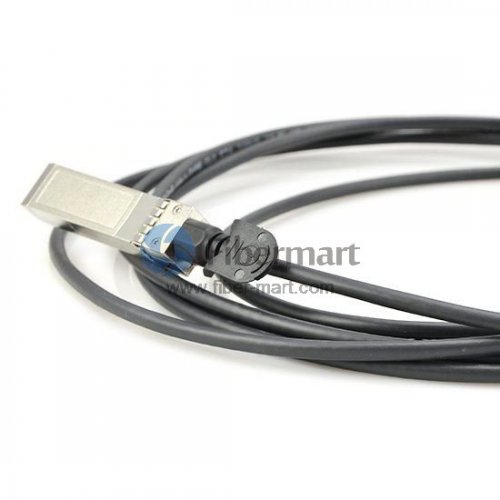
SFP+ direct attach cable (DAC) is a fixed assembly that is purchased at a given length, with the SFP+ connector modules permanently attached to each end of the cable. SFP+ DAC provides high performance in 10 Gigabit Ethernet network applications, using an enhanced SFP+ connector to send 10 Gbps data through one paired transmitters and receivers over a thin twinax cable or fiber optic cable. The 10G SFP+ Cable is designed to use the same port as an optical transceiver, but compared with optical transceivers, the connector modules attached to the cable leave out the expensive optical lasers and other electronic components, thus achieving significant cost savings and power savings in short reach applications.


SFP+ DAC is a low cost alternative to traditional fiber and twisted-pair copper cabling in data center deployments. SFP+ DAC provides better cable management for high-density deployments and enhanced electrical characteristics for the most reliable signal transmission

DDAC

Passive and Active 10G SFP+ Direct Attach Cable (DAC)

SFP+ Direct Attach is known as the successor technology to 10GBASE-CX4. SFP+ Direct Attach, as implied in the name, uses SFP+ MSA and by using the inexpensive copper twinaxial cable with SFP+ connectors on both sides, provides 10 Gigabit Ethernet connectivity between devices with SFP+ interfaces. SFP+ Direct Attach has a 10 meter distance limitation, thus the target application is interconnection of top-of-rack switches with application servers and storage devices in a rack.

Passive cables are much less expensive but require the host to do the work of driving it properly.

Benefits:

  • Lower Costs
  • Higher Reliability
  • Lower Power Consumption
  • Plug and Play Simplicity

Fewer Components (No Active Tx /Rx Components)

Only Capacitors, Resistors, EEPROM, Cable


Tradeoffs:

  • Reduced Cable Flexibility
  • Reduced Modularity
  • Limited Distance
  • No LOS
  • No TX Disable
  • No Interrupts
  • Limited Management Interface
  • Host must drive Cu cable


Active cables offer the benefit of optical-module.

Benefits:

  • Enhanced Signal Integrity
  • Longer Cable Lengths
  • Transmit Pre-emphasis
  • Active/Adaptive Receive Equalization
  • Tx Disable
  • Loss of Signal (LOS)
  • Interrupts
  • Management Interface


Tradeoffs:

  • Higher price


Fiber-Mart supplies various kinds of high speed interconnect DAC cable assemblies. All of our direct attach cables can meet the ever growing need to cost-effectively deliver more bandwidth, and can be customized to meet different requirements. For more information, pls visit www.fibermart.com. pls not hesitate to contact us for any question:service@fiber-mart.com


Singlemode fiber and multimode fiber different and selection method(2)

The application of fiber optics is being gradually extended from the trunk or the computer room to the desktop and residential users, which means that more and more users who do not understand the characteristics of the fiber have come into contact with the fiber optic system. Therefore, when designing fiber link systems and selecting products, full consideration should be given to the current and future application requirements of the system, use of compatible systems and products, the greatest possible ease of maintenance and management, and adaptation to the ever-changing field conditions and user installation requirements.

yt

1. Can a fiber optic connector be terminated directly on a 250 μm fiber?  


Loose sleeve fiber optic cable contains bare fiber with an outer diameter of 250 μm, which is very small and fragile. It is unable to fix the fiber and is not enough to support the weight of the fiber optic connector and is very insecure. The connector is terminated directly on the fiber optic cable. At a minimum, a 900 μm tight jacket is required to wrap around the 250 μm fiber to protect the fiber and support the connector.

2. Can the FC connector be connected directly to the SC connector?

Yes, this is just a different connection method for two different types of connectors.
If you need to connect them, you must select a mixed adapter and use the FC/SC adapter to connect the FC connector and the SC connector at both ends. This method requires that the connectors should all be flat ground. If you absolutely need to connect APC connectors, you must use a second method to prevent damage.

The second method is to use a hybrid jumper and two connection adapters. Hybrid patch cords use different types of fiber connectors at both ends. These connectors will connect to the place where you need to connect. In this way, you can use a universal adapter to connect the system in the patch panel, but bring the system budget to budget. The increase in the number of connector pairs.

3. The fixed connection of optical fibers includes mechanical optical fiber connection and thermal welding. What are the selection principles for mechanical optical fiber connection and thermal welding?

Mechanical fiber optic connection, commonly known as fiber optic cold connection, refers to an optical fiber connection method in which a single or multi-fiber optical fiber is permanently connected through a simple connection tool and a mechanical connection technology without the need of a thermal fusion bonding machine. In general, mechanical splices should be used in place of thermal fusion when splices are made at a small number of cores dispersed at multiple locations.

yty
Mechanical fiber optic connection technology is often used in engineering practices such as line repairs and small-scale applications in special occasions. In recent years, with the large-scale deployment of fiber-to-the-desktop and fiber-to-the-home (FTTH), it has been recognized that mechanical fiber optic connection is an important means of fiber optic connection.

For fiber-to-the-desktop and fiber-to-the-home applications with a large number of users and geographically dispersed features, when the scale of the users reaches a certain level, the construction complexity and construction personnel and fusion splicer cannot meet the time requirements for users to open services. Because of the simple operation, short training cycle, and low equipment investment, the mechanical fiber connection method provides the most cost-effective solution for optical fiber connection for large-scale deployment of optical fibers. For example, in the high corridors, narrow spaces, insufficient lighting, inconvenient on-site power and other occasions, mechanical fiber optic connection provides a convenient, practical, fast and high-performance optical fiber continuation means for design, construction and maintenance personnel.

ytyy

 4. What is the difference between fiber optic splice enclosure requirements and fiber optic splice closures used in telecom operators’ outdoor lines in fiber-to-the-home systems?

First of all, in the fiber-to-the-home system, it is necessary to reserve the position of the optical splitter installation and termination, accommodation, and protection of the jumper to and from the optical splitter in the joint box according to actual needs. Because the actual situation is that the optical splitter may be located in the cable joint box, optical cable transfer box, wiring box, ODF and other facilities, and in which the optical cable termination and distribution.

Secondly, for residential quarters, the optical fiber cable splice box is installed in a buried manner. Therefore, the optical cable splice box has higher requirements for buried performance.

In addition, in the fiber-to-the-home project, it may be necessary to consider the entry and exit of a large number of small-core optical cables.

10G to 40G / 100G MPO Optical Link Testing Technology

by http://www.fiber-mart.com

Objective
Technology changes the life, informatization is the trend of the development of the world today. Networking, cloud computing, large data and other emerging network information technology innovation and application, and in mobile interconnection technology, the 3G network is maturing, 4G LTE network from the beginning of last year in the national pilot run, mobile interconnection speed will be a new step. In this era of information industrialization, we work and live in the city is also in the transformation of the Intelligent city, a variety of network applications are closely related to us. Whether it is the application of new technology or the construction of the Intelligent city, the application cannot be separated from the basic network. The construction of the basic network is based on the site, the active terminals, and interconnecting devices, as well as the basic interconnection channel-cabling system. Cabling system needs to be installed on the site, easy to be affected by environment, product quality, installation process and other factors, is the most important link to determine the quality of network transmission. The reliability of Cabling system depends not only on the quality supervision in the project but also on the final  field acceptance test.
The urgency of test technology development
At present, most of the small and medium-sized cabling projects still use 10 Gigabit as the backbone to achieving Gigabit to the desktop network architecture. However, with the rapid development of 3G / 4G and Internet services, bandwidth cannot meet the needs of applications. The main link uses 40G / 100G to become a large-scale wiring project, especially the inevitable trend of enterprise data center and Internet IDC data center project construction. According to IDC market report, after 2015, 40G / 100G will gradually become the mainstream port rate.
Since the IEEE released the 802.3ba 40G / 100G standard in June 2010, the 40G / 100G network has mainly been based on experimental networks and has fewer requirements for on-site testing. After more than two years of systematic research and development testing, the current 40G / 100G transmission technology is maturing, major manufacturers have introduced 40G / 100G switching routing equipment, carrier-class long-distance backbone link using single-mode optical fiber systems, and buildings and data centers The integrated cabling system is mainly based on multimode OM3 / OM4 optical fiber system transmitting over short distances. It adopts 12-pin MPO connector and four-channel / ten-channel pre-connected optical cable. Pre-connected optical cable greatly reduces installation time and labor costs, but how to quickly identify the polarity of the fiber, fast and accurate test of the link attenuation has become the primary problem of field testing.
Traditional optical fiber testing technology
First of all, let us first review the original Gigabit, 10 Gigabit optical fiber link test technology. In 2003, TIA-526-14-A multi-mode optical cable installation light intensity loss test standard formally defines the CPR (CoupledPowerRatio) optical coupling rate detection method, the light source is divided into five levels (as shown below), LED light source is level 1 Light source, VCSEL The vertical cavity surface emits a laser light source at a level between level 3 and level 4, and the FP laser light source corresponds to a level 5 light source. At the same time, the test limits of optical loss are further increased. The maximum loss value of 1000BASE-SX applied to OM1 optical fiber is 2.6dB. The maximum loss value of 10GBASE-SR applied to optical fiber OM3 is 2.6dB. This standard, as a common standard for optical fiber link testing, is not aimed at specific network applications. It emphasizes the normal state of optical signal transmission. It is recommended to use LED light sources to test multimode fiber links. This method can detect the worst fiber link Happening. The laser-optimized VCSEL light source is used to detect the link for a specific network application. For example, if the active device uses a VCSEL light source or the current network is to be upgraded to use a VCSEL light source, the measured fiber loss value is relatively close to the real loss in the network application value.
850NM CPR Categories
The TIA-526-14-A standard is referenced by several related test standards such as ANSI / TIA / EIA-568-B, ISO / IEC11801, ISO / IEC14763-3 and others. And ANSI / TIA / EIA568-B.1.7.1 and ISO / IEC14763-36.22 also specify the size and use of 50 / 62.5um multimode fiber spools. The reel is modeled as a mode filter by means of a coiled optical fiber to reduce the high mode generated by the light source in the optical cable and reduce the difference of test results caused by different light sources and improve the stability and repeatability of multimode optical fiber testing.
10G MPO multi-core fiber test solution
Compared with traditional dual-core fiber optic connectors such as LC, SC, and ST, MPO connectors can support at least 12-core optical fibers. The MPO connector is mainly used for pre-attached optical fiber cables. Because MPO optic fiber has 12 core channels, TIA-568-C.0-2009B.4 has analyzed the channel polarity in detail, for the duplex transmission, there are mainly three kinds of polarities A, B, C connections. All three methods are for a common goal —- to create an end to end optical transceiver channel, but the three ways cannot be compatible, respectively, using different polarity connectors and adapters. For the entire link compatibility and consistency, as far as possible to consider the use of the same polarity connectors and adapters, such as the use of the jumper polarity are AB, adapter types are KEYUP-KEYUP, or the polarity will cause different Confusion, easy to install error, resulting in link failure. Therefore, in the 10G Fiber Channel, the MPO main link polarity mainly adopts Class C (see below). The two ports are internally interoperable according to the corresponding numbers. The optical channels are connected in groups of two or more, such as 1- – 2, 2 — 1, forming a full-duplex transceiver channel. The left and right ends are converted into the LC interface through the MPO to LC module box and then connected to the device through the LC jumper. This situation is mainly used in the data center high-density cabling system.