Basics of OTDR (Optical Time-Domain Reflectometer)
OTDR, short for optical time-domain reflectometer, is an optoelectronic instrument used to characterize an optical fiber. It injects a series of optical pulses into the fiber under test and extracts, from the same end of the fiber, light that is scattered (Rayleigh backscatter) or reflected back from points along the fiber. It can offer you an overview of the whole system you test and can be used for estimating the fiber length and overall attenuation, including splice and mated-connector losses. It can also be used to locate faults, such as breaks, and to measure optical return loss.
How does an OTDR work?
OTDR is used to test the performance of newly installed fiber links and detect problems that may exist in them. Its purpose is to detect, locate, and measure elements at any location on a fiber optic link. OTDR works like radar—it sends pulse down the fiber and looks for a return signal, creating a display called a “trace”or “signature” from the measurement of the fiber.
the OTDR uses a unique optical phenomena “backscattered light” to make measurements along with reflected light from connectors or cleaved fiber ends, thus to measure loss indirectly.Unlike sources and power meters, which measure the loss of the fibre optic cable plant directly, the OTDR works indirectly. The source and meter duplicate the transmitter and receiver of the fibre optic transmission link, so the measurement correlates well with actual system loss.
During the process of OTDR testing, the instrument injects a higher power laser or fiber optic light source pulse into a fiber from one end of the fiber cable, with the OTDR port to receive the returning information. As the optical pulse is transmitted through the fiber, part of the scattered reflection will return to the OTDR. Only useful information returned could be measured by the OTDR detector which acts as the time or curve segments of fibers at different positions. By recording the time for signals from transmission to returning and the speed of transmission in fibers, the distance thus can be calculated.
When do you need an OTDR?
You can use an OTDR to locate a break or similar problem in a cable run, or to take a snapshot of fibers before turning an installation over to a customer. This snapshot, which is a paper copy of the ODTR trace, gives you a permanent record of the state of that fiber at any point in time. This can help installers when fibers have been damaged or altered after installation, proving where responsibility for the damage lies. In fact, some customers will demand OTDR testing as a condition for system acceptance.
Although OTDRs are not especially accurate for loss testing, they can be used to conduct loss testing on long, outdoor runs of singlemode fiber where access to both ends of the cable isn’t practical. It can also be helpful for preventive maintenance procedures, such as routine checkups on a facility’s fibers.
Characteristics of OTDR
Rayleigh scattering refers to the irregular scattering generated when the optical signals transmitting in the fiber. OTDR only measure the scattered light back on the OTDR port. The backscatter signal show the attenuation degree (loss/distance) of the optical fiber, and will be tracked as a downward curve, illustrating the power of backscatter is decreasing, this is because that both transmission signal and backscatter loss are attenuated.given the optical parameters, Rayleigh scattering power can be marked, if the wavelength is know, it is proportional with the pulse width of the signal: the longer the pulse width, the stronger backscatter power. Rayleigh scattering power is also related to the wavelength of transmitted signal: the shorter the wavelength, the power is stronger. That is to say, the backscatter loose generated by the trajectory of 1310nm will higher than that of 1550nm signals.
In the higher wavelength region (more than 1500nm), the Rayleigh scattering will continue to decrease, and the other one phenomenon which called infrared attenuation (or absorption) will appear to increase and cause an increase the overall attenuation values. Therefore, 1550nm wavelength is the lowest attenuation, this also explains why it is a long distance communication wavelength. Naturally, these phenomena will return to affect the OTDR. OTDR of 1550nm wavelength is also have low attenuation, so it can be used for long distance testing. While as the high attenuation wavelength 1310nm or 1625nm, OTDR testing distance is bound to be limited, because the test equipment need to test a sharp front in the OTDR trace, and the end of the spikes will quickly fall into the noise area.
Fresnel reflection falls into the category of discrete reflection that is caused by the individual point of the whole fibers. These points are the result of changes in reverse coefficient elements such as glass and air gap. At these points, a strong backscatter light will be reflected back. Therefore, OTDR uses the information of Fresnel reflection to locate the connection point, fiber optic terminal and breakpoints.
Conclusion
OTDRs are invaluable test instruments that can illuminate problems in your optical fiber before they bring your system to its knees. Once you’re familiar with its limitations and how to overcome them, you’ll be prepared to detect and eliminate your optical fiber events. Fiber-MART can offer OTDRs are available with a variety of fiber types and wavelengths, including single mode fiber, multimode fiber, 1310nm, 1550 nm, 1625 nm, etc.. And we also supply OTDRs of famous brands, such as AFL Noyes OFL & FLX series, JDSU MTS series, EXFO FTB series, YOKOGAWA AQ series and so on. OEM portable and handheld OTDRs (manufactured by Fiber-Mart) are also available.Pls not hesitate to contact us for any question, for more information, welcome to visit http://www.fiber-mart.com or E-mail: service@fiber-mart.com
40G QSFP+ Direct Attach Copper Cabling
In today’s network building, requiring higher speeds, greater scalability and cost-effective cabling solution is preferable. Direct Attach Cable(DAC) is a kind of optical transceiver assembly widely applied in storage area network, data center, and high-performance computing connectivity etc and high density cabling interconnect system capable of delivering an aggregate data bandwidth of 40Gb/s,therefore, It is the cost-effective way to upgrade from 10G to 40G or 40G to 40G interconnect connection.
40G QSFP+ Direct Attach Copper Cable (DAC) Basics
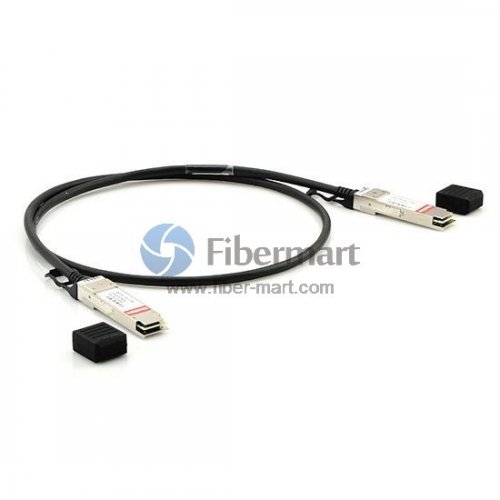
40G QSFP+ Direct Attach Copper Cable (DAC) is a high speed twinax cable with QSFP+ connector on either end of the cable. It is designed to meet emerging data center and high performance computing application needs for a short distance and high density cabling interconnect system capable of delivering an aggregate data bandwidth of 40Gb/s. The maximum transmission distance of QSFP+ direct attach copper cable is 10 meters, which makes the cable suitable for in-rack connections between servers and Top-of-Rack (ToR) switches because they often require shorter distances and not routed to the Main Distribution Frames.
How to Use 40G QSFP+ Direct Attach Copper Cable
According to the connector types on both ends. One is QSFP+ to 4 SFP+ direct attach breakout copper cable, and the other is QSFP+ to QSFP+ direct attach copper cable. In fact, it is not common for there is a third type QSFP+ direct attach copper cable called QSFP+ to 4 XFP breakout cable. For a QSFP+ to 4 SFP+ direct attach breakout copper cable, it has a QSFP+ connector on one end and four SFP+ connectors on the other end. In terms of a QSFP+ to QSFP+ direct attach copper cable, it has a QSFP+ connector on both ends of the cable. When we use a fiber optic transceiver and patch cable to establish a fiber link, we should firstly plug the transceiver to the switch and then plug the patch cable to the transceiver. But for a QSFP+ direct attach copper cable, either SFP+ connector or QSFP+ connector, before building the network, it is necessary to buy 40G DAC cables from reliable QSFP cables supplier and manufacturer.can be both directly inserted into the switch and don’t need a transceiver at all, which provides a really cost-effective solution for interconnecting high speed 40G switches to existing 10G equipment or 40G switches to 40G switches.

40G QSFP+ to 4 SFP+ Direct Attach Copper Cabling
The move from 10G to 40G Ethernet will be a gradual one. It is very likely that one may deploy switches that have 40G Ethernet ports while the servers still have 10G Ethernet ports. For that situation, we should use a QSFP+ to 4 SFP+ direct attach breakout copper cable.In 40G to 40G connection, QSFP+ to QSFP+ direct attach copper cables are suitable for very short distances and offer a highly cost-effective way to establish a 40G link between QSFP+ ports of QSFP+ switches within racks and across adjacent racks. These QSFP+ copper cables connect to a 40G QSFP port of a switch on one end and to another 40G QSFP port of a switch on the other end. It is noted that the distance between the two switches is within the cable length. These cables connect to a 40G QSFP Port of a switch on one end and to four 10G SFP+ ports of a switch on the other end, which allows a 40G Ethernet port to be used as four independent 10G ports thus providing increased density while permitting backward compatibility and a phased upgrade of equipment. As a lower cost alternative to MTP/MPO breakouts for short reach applications up to 5 meters, it helps IT organizations achieve new levels of infrastructure consolidation while expanding application and service capabilities.
40G QSFP+ to QSFP+ Direct Attach Copper Cabling
QSFP+ to QSFP+ direct attach copper cable are suitable for very short distances and offer a highly cost-effective way to establish a 40G link between QSFP+ ports of QSFP+ switches within racks and across adjacent racks. These cables connect to a 40G QSFP port of a switch on one end and to another 40G QSFP port of a switch on the other end. Supporting similar applications to SFP+, these four-lane high speed interconnects were designed for high density applications at 10Gb/s transmission speeds per lane. One QSFP+ to QSFP+ direct attach copper cable link is equivalent to 4 SFP+ cable links, providing greater density and reduced system cost. Passive and active QSFP+ to QSFP+ direct attach copper cables are both available. With a active QSFP+ to QSFP+ direct attach copper cable assembly, the connection is capable of distances of up to 10 meters.
Why Use 40G QSFP+ Direct Attach Copper Cable (DAC)?
For 40G short reach applications, 40G QSFP+ direct attach copper cable provides simple and inexpensive cabling solution.
The main advantages in following.
- Robust
- Cheap
- Low-power Consumption
- Easy Operation
Conclusion
With the wide deployment of 40 Gigabit Ethernet, the 40G QSFP+ direct attach copper cables are becoming more and more popular due to the compact size, low power and cost-effectiveness. Fiber-Mart supplies various kinds of high speed interconnect DAC cable assemblies including 10G SFP+ Cables, 40G QSFP+ Cables, and 120G CXP Cables. All of our direct attach cables can meet the ever growing need to cost-effectively deliver more bandwidth, and can be customized to meet different requirements. For more information, welcome to visit www.fiber-mart.com.or contact us .E-mail: service@fiber-mart.com
Basics of OTDR (Optical Time-Domain Reflectometer)
OTDR, short for optical time-domain reflectometer, is an optoelectronic instrument used to characterize an optical fiber. It injects a series of optical pulses into the fiber under test and extracts, from the same end of the fiber, light that is scattered (Rayleigh backscatter) or reflected back from points along the fiber.
OTDR, short for optical time-domain reflectometer, is an optoelectronic instrument used to characterize an optical fiber. It injects a series of optical pulses into the fiber under test and extracts, from the same end of the fiber, light that is scattered (Rayleigh backscatter) or reflected back from points along the fiber. It can offer you an overview of the whole system you test and can be used for estimating the fiber length and overall attenuation, including splice and mated-connector losses. It can also be used to locate faults, such as breaks, and to measure optical return loss.
How does an OTDR work?
OTDR is used to test the performance of newly installed fiber links and detect problems that may exist in them. Its purpose is to detect, locate, and measure elements at any location on a fiber optic link. OTDR works like radar—it sends pulse down the fiber and looks for a return signal, creating a display called a “trace”or “signature” from the measurement of the fiber.
the OTDR uses a unique optical phenomena “backscattered light” to make measurements along with reflected light from connectors or cleaved fiber ends, thus to measure loss indirectly.Unlike sources and power meters, which measure the loss of the fibre optic cable plant directly, the OTDR works indirectly. The source and meter duplicate the transmitter and receiver of the fibre optic transmission link, so the measurement correlates well with actual system loss.
During the process of OTDR testing, the instrument injects a higher power laser or fiber optic light source pulse into a fiber from one end of the fiber cable, with the OTDR port to receive the returning information. As the optical pulse is transmitted through the fiber, part of the scattered reflection will return to the OTDR. Only useful information returned could be measured by the OTDR detector which acts as the time or curve segments of fibers at different positions. By recording the time for signals from transmission to returning and the speed of transmission in fibers, the distance thus can be calculated.
When do you need an OTDR?
You can use an OTDR to locate a break or similar problem in a cable run, or to take a snapshot of fibers before turning an installation over to a customer. This snapshot, which is a paper copy of the ODTR trace, gives you a permanent record of the state of that fiber at any point in time. This can help installers when fibers have been damaged or altered after installation, proving where responsibility for the damage lies. In fact, some customers will demand OTDR testing as a condition for system acceptance.
Although OTDRs are not especially accurate for loss testing, they can be used to conduct loss testing on long, outdoor runs of singlemode fiber where access to both ends of the cable isn’t practical. It can also be helpful for preventive maintenance procedures, such as routine checkups on a facility’s fibers.
Characteristics of OTDR
Rayleigh scattering refers to the irregular scattering generated when the optical signals transmitting in the fiber. OTDR only measure the scattered light back on the OTDR port. The backscatter signal show the attenuation degree (loss/distance) of the optical fiber, and will be tracked as a downward curve, illustrating the power of backscatter is decreasing, this is because that both transmission signal and backscatter loss are attenuated.given the optical parameters, Rayleigh scattering power can be marked, if the wavelength is know, it is proportional with the pulse width of the signal: the longer the pulse width, the stronger backscatter power. Rayleigh scattering power is also related to the wavelength of transmitted signal: the shorter the wavelength, the power is stronger. That is to say, the backscatter loose generated by the trajectory of 1310nm will higher than that of 1550nm signals.
In the higher wavelength region (more than 1500nm), the Rayleigh scattering will continue to decrease, and the other one phenomenon which called infrared attenuation (or absorption) will appear to increase and cause an increase the overall attenuation values. Therefore, 1550nm wavelength is the lowest attenuation, this also explains why it is a long distance communication wavelength. Naturally, these phenomena will return to affect the OTDR. OTDR of 1550nm wavelength is also have low attenuation, so it can be used for long distance testing. While as the high attenuation wavelength 1310nm or 1625nm, OTDR testing distance is bound to be limited, because the test equipment need to test a sharp front in the OTDR trace, and the end of the spikes will quickly fall into the noise area.
Fresnel reflection falls into the category of discrete reflection that is caused by the individual point of the whole fibers. These points are the result of changes in reverse coefficient elements such as glass and air gap. At these points, a strong backscatter light will be reflected back. Therefore, OTDR uses the information of Fresnel reflection to locate the connection point, fiber optic terminal and breakpoints.
Conclusion
OTDRs are invaluable test instruments that can illuminate problems in your optical fiber before they bring your system to its knees. Once you’re familiar with its limitations and how to overcome them, you’ll be prepared to detect and eliminate your optical fiber events. Fiber-MART can offer OTDRs are available with a variety of fiber types and wavelengths, including single mode fiber, multimode fiber, 1310nm, 1550 nm, 1625 nm, etc.. And we also supply OTDRs of famous brands, such as AFL Noyes OFL & FLX series, JDSU MTS series, EXFO FTB series, YOKOGAWA AQ series and so on. OEM portable and handheld OTDRs (manufactured by Fiber-Mart) are also available.Pls not hesitate to contact us for any question, for more information, welcome to visit www.fiber-mart.com or E-mail: service@fiber-mart.com
Some things you must know about Fusion Splicer
What is Fusion Splicer?
Fusion splicing is the act of joining two optical fibers end-to-end using heat. The goal is to fuse the two fibers together in such a way that light passing through the fibers is not scattered or reflected back by the splice, and so that the splice and the region surrounding it are almost as strong as the intact fiber.
What is Fusion Splicer?
Fusion splicing is the act of joining two optical fibers end-to-end using heat. The goal is to fuse the two fibers together in such a way that light passing through the fibers is not scattered or reflected back by the splice, and so that the splice and the region surrounding it are almost as strong as the intact fiber. The source of heat is usually an electric arc, but can also be a laser, or a gas flame, or a tungsten filament through which current is passed. and thus the splice as well as the region surrounding it are almost as strong because virgin fiber itself.

The basic fusion splicer apparatus includes two fixtures which the fibers are mounted and two electrodes. Inspection microscope assists in the placement in the prepared fiber ends into a fusion-splicing apparatus. The fibers they fit in to the apparatus, aligned, and then fused together.
Initially, fusion splicing used nichrome wire as the heating unit to melt or fuse fibers together. New fusion-splicing techniques have replaced the nichrome wire with fractional co2 lasers, electric arcs, or gas flames to heat the fiber ends, causing them to fuse together. The little size of the fusion splice along with the development of automated fusion-splicing machines make electric arc fusion the most popular splicing approaches to commercial applications.

Fusion Splicing vs Mechanical Splicing
There are two types of optic fiber splicing. One is fusion splicing we mentioned above, another is mechanical splicing. In mechanical splicing two fiber optic cables are held end to end inside a sleeve using some mechanical mechanism. In this type of technique fibers aren’t joined permanently rather just accurately hold together, so that light can easily pass through from one end to another, while in fusion splicing two fibers are fused or wielded together using an electric arc, fusion splicing is most widely used technique because it provides a reliable join with lower insertions loss and practically no back reflection. Fusion splicing is generally applied on single mode fibers but in some special cases it can also be used for multi mode fibers.
The process of fusion splicing
The process of fusion splicing normally involves heat to melt or fuse the ends of two optical fibers together. The splicing process begins by preparing each fiber end for fusion.

1.Stripping the fiber
Stripping is the act of removing the protective polymer coating around optical fiber in preparation for fusion splicing. The splicing process begins by preparing both fiber ends for fusion, which requires that all protective coating is removed or stripped from the ends of each fiber.
2.Cleaning the fiber
The customary means to clean bare fibers is with alcohol and wipes. However, high purity isopropyl alcohol (IPA) is hygroscopic: it attracts moisture to itself. This is problematic as IPA is either procured in pre-saturated wiper format or in (host) containers ranging for USA quart to gallon to drums. From the host container the IPA is transferred to smaller more usable containers. The hydroscopic nature of IPA is such that the highest quality at 99.9% is also the most hygroscopic. This means that moisture absorption into both the host container as well as the actual user’s container begins with the time the original container is opened and continues as amounts are transferred and removed from both.
3.Cleaving the fiber
The fiber is then cleaved using the score-and-break method so that its end-face is perfectly flat and perpendicular to the axis of the fiber. The quality of each fiber end is inspected using a microscope. In fusion splicing, splice loss is a direct function of the angles and quality of the two fiber-end faces. The closer to 90 degrees the cleave angle is the lower optical loss the splice will yield. The quality of the cleave tool being used is critical.

4.Splicing the fibers
Fiber spliced, still unprotected, Current fusion splicers are either core or cladding alignment. Using one of these methods the two cleaved fibers are automatically aligned by the fusion splicer[1] in the x,y,z plane, then are fused together. Prior to the removal of the spliced fiber from the fusion splicer, a proof-test is performed to ensure that the splice is strong enough to survive handling, packaging and extended use. The bare fiber area is protected either by recoating or with a splice protector. A splice protector is a heat shrinkable tube with a strength membrane and less loss.
5.Protecting the fiber
After the fibers have been successfully fused together, the bare fiber is protected either by re-applying a coating or by using a splice protector.

A simplified optical splicing procedure includes:
Characteristics of placement of the splicing
A simplified optical splicing procedure includes:
Characteristics of placement of the splicing process.
Checking fiber optic splice closure content and supplementary kits.
Cable installation in oval outlet.
Cable preparation.
Organization of the fibers inside the tray.
Installing the heat-shrinkable sleeve and testing it.

Conclusion
Fusion splicing provides permanent low-loss connections that are performed quickly and easily, which are definite advantages over competing technologies.When it comes to optical fiber fusion splicers, no other company in the world can match Fiber-MART for innovation, speed, and performance. The entire industry-leading range of splicers offers quick termination and new standards in heater shrink time. Fiber-Mart strives for even better standards each day. Like Sumitomo Type-81C Fusion Splicer, Innovation is key. It can revolutionized on-site connectivity, speed and brought lower project costs for the migration of the network. As the major leader in optical fiber and connectivity solutions, customers can expect reliability, flexibility and unbelievable performance. After all, network infrastructure expansion becomes easy when you use state-of-the-art fusion splicer solutions.Any question or need pls feel free to contact with us. E-mail: product@fiber-mart.com.
How to Select a Fiber Optic Patch Cable?