Fiber Optic Connector Types for data center

by http://www.fiber-mart.com

LC and MPO Fiber Optic connectors were defined for data center applications in accordance with ISO/IEC 24764, EN 50173-5 and TIA-942 standards for fiber optic cabling systems.
MPO Connector (IEC 61754-7)
MPO (multipath push-on) is based on a plastic ferrule that provides the ability to house up to 24 fibers in a single connector. Connectors with up to 72 fibers are already in development by this time. This connector stands out because of its compact design and easy operation, but brings disadvantages in optical performance and reliability.
This connector type is of crucial importance because of its increased packing density and ability to migrate to 40/100 Gigabit Ethernet.optical-fiber-mpo-connector_400
LC Connector (IEC 61754-20)
This connector is part of a new generation of compact connectors. It was developed by Lucent (LC stands for Lucent Connector). Its design is based on a 1.25 mm-diameter ferrule. Its duplex adapter matches the size of an SC adapter. As a result, it can achieve extremely high packing densities, which makes the connector attractive for use in data centers.connector_lc
SC Connector (IEC 61751-4)
SC stands for square connector or subscriber connector. It makes high packing densities possible because of its compact design, and can be combined into duplex and multiple connections. Despite its age, the SC continues to gain in importance because of its outstanding properties. It has been the most important WAN connector worldwide up to today, usually as a duplex version, because of its good optical properties.connector_sc-pc-apc
E-2000™ Connector (LSH, IEC 61753-15)
This connector is a development by the company Diamond SA which specializes in LAN and CATV applications. It is produced by three licensed manufacturers in Switzerland, which has also led to its unequaled quality standard. The integrated protective flap provides protection from dust and scratches as well as laser beams. The connector can be locked using grids and levers which can be coded by color and also mechanically.
Important Criteria for Choosing a Datacenter OTDR

by http://www.fiber-mart.com

With the technological evolution occurring in data centers, test requirements dramatically changed for the fiber networks that connect mission-critical servers, networking and storage devices. Selecting the proper OTDR to test your network not only strengthens its reliability, but also improves how quickly and efficiently the job is done, as well as documenting the quality of work. Here are some recommended criteria to consider, aside from the basic OTDR testing capabilities.
1. A simplified and task-focused user interface: Populating a data center with thousands of tested fibers is an enormously time consuming job. Maintaining fiber health is just as challenging and makes fast troubleshooting critical. Almost every OTDR on the market today is designed to cover carrier applications. As a result, many have very complicated user interfaces, which require the user to grapple with numerous buttons and controls and navigate cumbersome multi-level menus. While this is suitable for the fiber enthusiasts who test Telco fiber on a daily basis, it’s a different story for enterprise network technicians. An OTDR designed around the enterprise workflow,
with an intuitive user interface, greatly improves operating efficiency. Simple-to-use test equipment shortens the learning curve, reduces testing time and ultimately saves money.
2. Precision fiber channel information: With the increasing use of short patch fibers and multi-fiber connectors, details on every link—loss, connector, and reflectance—are critical to ensuring performance. OTDRs with an attenuation dead zone of more than 3 m are no longer applicable for testing datacenter fiber. Ultra-short dead zones are needed to find issues that jeopardize the link loss budget or cause serious signal degradation. In addition, fast problem resolution requires that faults and events be presented in a simple, graphical map so users at various skill levels can efficiently perform fiber troubleshooting and accelerate network recovery.
3. Effective planning and documentation: As data centers grow and change, coordinating projects and ensuring that all fibers are installed with certified quality is challenging. There are a number of software applications available for project management, but until recently none have been integrated with an OTDR. Integrated project management capabilities with cable-by-cable granularity can save time and planning effort. Look for an OTDR with built-in project management capability that allows you to plan day-to-day activities without using a PC or laptop. You should be able to use a single tool to control, monitor, consolidate and document all test results.

How to choose 3G Digital Video SFP ?

In fiber optic network industry,  Digital video SFP is responsible for transmitting HD or higher standard video.


In fiber optic network industry,  Digital video SFP is responsible for transmitting HD or higher standard video, so there are 3G digital video SFPs suitable for SD/HD/3G-SDI. and so more and more people are interested in SFP modules.


What is SDI?


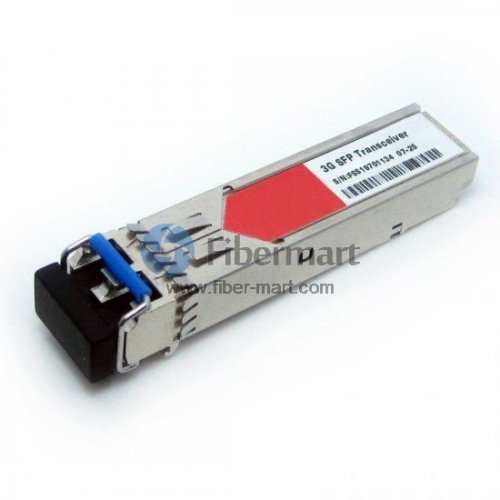
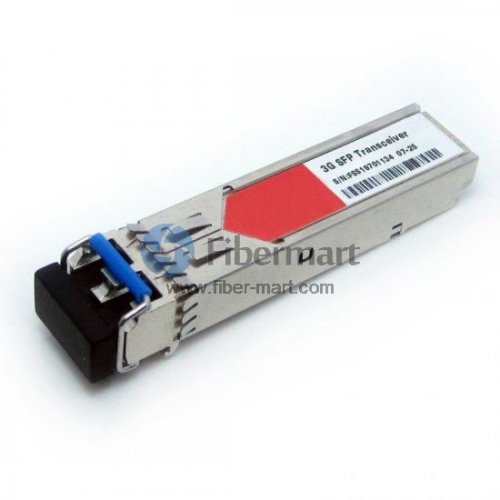
Digital Video SFP is a 3G-SDI standard optical transceiver designed to transmit SDI, HD-SDI, or DVB digital video signals over fiber. It is a dual channel optical transmitter module which transmits optical serial digital signals that defined in SMPTE 297-2006.

3G.jpg
Digital Video 3G Transmitter CWDM

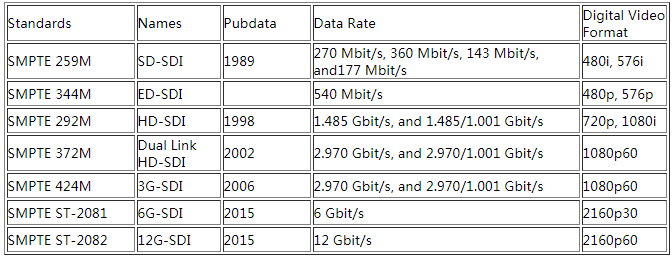
Fiber Optic Transport of HD/SD-SDI It is becoming increasingly necessary and economically feasible to transport HD/SD-SDI signals over fiber instead of coaxial cable. SDI, the abbreviation for Serial Digital Interface, is a digital video interface standard made by SMPTE organization. This serial interface transmits every bit of data word and corresponding data through single channel. Due to the high data rate of serial digital signal(a kind of digital baseband signal), it must be processed before transmission.Additional SDI standards include HD-SDI, 3G-SDI, 6G-SDI, and 12G-SDI. HD-SDI was standardized by SMPTE 372M in 1998. It can support 1.485Gbps interface. 3G-SDI consists of a single 2.970Gbps serial link that allows replacing dual link HD-SDI.


3G Digital Video SFPs Types


3G digital video SFPs include 3G SDI SFP, BiDi SFP and CWDM SFP. According to different standards, it can be divided into different types. Based on the transmission mode, it can be divided into single Tx, single Rx, dual Tx, dual Rx and TR transceivers; by standards into MSA and non-MSA; by operating wavelength into 1310nm, 1490nm, 1550nm and CWDM wave length.It also exists video modules of electrical interfaces that adapting mini BNC port to coordinate with SFP slot-supporting digital matrix. Currently there are also on the market some crossover video transceivers, for example, transfer the encoded SG-SDI to IP protocol conversion module can be used in traditional Ethernet switch, replacing video codec equipment. 3G digital video SFPs also have 3G video SFP and 3G video pathological patterns due to different applications.the data rate of digital SDI as below.


图片1.png


Now we say that what are 3G-SDI pathological patterns? Pathological patterns, also called SDI proving ground, are a whole test signal. And it must be done during blackout. This signal is tough to handle by serial digital system, and significant to check the system performance. Pathological patterns often contain the richest low-frequency energy which statistically happens one per frame. Pathological patterns test is also an important indicator of video SFP modules.  Fiber-Mart provides a series of 3G-SDI SFP modules to support transmission rates from 50 Mbps to 3 Gbps. These digital video modules are specifically designed for SMPTE SDI pathological patterns, allowing hot-plug capability with the 20-pin SFP connectors.


According to this article, i believe you have known some knowledges about 3G Digital Video SFP. Fiber-MART can  provide you custom service and  a series of 3G-SDI SFP modules to support transmission rates from 50 Mbps to 3 Gbps. Any question pls not hesitate to contact us.E-mail:service@fiber-mart.com

Five Tips for Choosing QSFP28 Fiber Optic Transceivers

by http://www.fiber-mart.com

The QSFP28 standard is designed to carry 100 Gigabit Ethernet, EDR InfiniBand. or 32G Fibre Channel. This transceiver type is also used with direct-attach breakout cables to adapt a single 100GbE port to four independent 25 gigabit ethernet ports (QSFP28-to-4x-SFP28). Sometimes this transceiver type is also referred to as “QSFP100” or “100G QSFP” for sake of simplicity. Please refer to the following tips for choose the right 100G Optical Modules for your modern data center.
Optical Modules Selection Based on Distance
<100 meter, When the transmission distance is within 100m, The QSFP28 SR4 optical module is highly recommended. The QSFP28 SR4 supports links up to 70m via OM3 Multimode fiber and 100m via OM4 Multimode fiber, with MPO / MTP fiber interface. It offers 4 independent transmitting and receiving channels, and each is with 25Gbps able to be aggregated into 100Gbps. Meanwhile, the QSFP28 SR4 optic module is also ideal for the connections from rack to rack in the data center.
100m to 10km, When the transmission distance is over 100m but shorter than 10 km, the QSFP28 LR4 optical transceiver is preferred. The QSFP28 LR4 is a fully integrated 4 × 25Gbit/s optical transceiver module, supporting distance up to 10 km. So for long span 100G deployment, such as cabling between two buildings, QSFP28 LR4 with duplex LC and single-mode fiber cable is the perfect option.
>10km, When transmission distance exceeds 10 km, the QSFP28 ER4 module is ideal for very long transmission distance. It provides superior performance for 100G Ethernet applications up to 30km links and converts 4 input channels of 25Gb/s electrical data to 4 channels of LAN WDM optical signals and then multiplexes them into a single channel for 100Gb/s optical transmission.
Optical Modules Selection Based on Applications
QSFP28 CWDM4 provides a 100G Ethernet high-speed link with a maximum transmission distance of 2 km, which interfaces with LC duplex connectors, and uses Mux/Demux technologies with 4 lanes of 25Gbps optically multiplexed into and demultiplexed from duplex single-mode fiber.
QSFP28 PSM4 doesnot need any MUX/DEMUX technology for each laser but it does need either a directly modulated DFB laser (DML) or an external modulator for each fiber. Besides, with an MPO/MTP interface, PSM4 modules can transmit data at 100Gb/s from point to point over 2 km or can be divided into dual 50Gb/s or quad 25Gb/s links for linking to servers, storage and other subsystems.
It’s seen from that both of QSFP28 CWDM4 and QSFP28 PSM4 are designed to meet the requirement for intermediate or mid-reaches for datacenter applications (500 m to 2 km). And they both use WDM and parallel single mode fiber technologies and support transmission distance up to 2 km.
When faced with such a situation, maybe we can make a decision from the two aspects. For one thing, from the aspect of an inner transceiver module structure, by comparison , PSM4 can be more cost-effective due to its lower component costs. For another thing, from the infrastructure viewpoint, PSM4 will be more expensive when the link distance is long, because PSM4 uses 8 optical single-mode fibers while CWDM uses only 2 optical single-mode fibers.

QSFP28 Transceiver Modules Installation Guide

by http://www.fiber-mart.com

CAUTION:
When installing or removing a transceiver module, avoid touching the golden plating on the transceiver module with a bare hand.
Do not remove the dust plug from a transceiver module if you are not to connect an optical fiber to it.
Remove the optical fibers, if any, from the transceiver module before installing it.
To avoid ESD damage, wear an ESD wrist strap when installing or removing an QSFP28 transceiver module or network cable. Make sure the wrist strap makes good skin contact and attach the wrist strap wire to the ESD jack (if any) on the device chassis as shown in the left part of Figure 1, or to the rack with an alligator clip as shown in the right part of Figure 1.
Installing and removing a QSFP28 transceiver module
QSFP28 transceiver module can have either a plastic bail-clasp latch or a metallic bail-clasp latch. The following uses the QSFP28 transceiver module with a metallic bail-clasp latch as an example.
Installing a transceiver module
Remove the optical fiber, if any, from the module.
Pivot the bail-clasp latch of the module up, as shown by callout 1 in Figure 1. (Skip this step if the bail-clasp latch is plastic.)
Align the module correctly with the port in the chassis. Gently push in the module until it is firmly seated in the port, as shown by callout 2 in Figure 1.
In case of limited space, you can gently push against the front face of the transceiver module instead of holding the sides.
If you are not to connect an optical fiber to the transceiver module, attach the dust plug to the module port.
Removing a transceiver module
Remove the optical fiber, if any, from the module.
Pivot the bail-clasp latch of the module down to the horizontal position. (Skip this step if the bail-clasp latch is plastic.)
Gently pull the module out of the port.

Overview of 100G QSFP28 Optical Transceivers

by http://www.fiber-mart.com

QSFP28 fiber optic module has become the dominant form factor for 100G high-speed networks. The interconnect offers multiple channels of high-speed differential signals with data rates ranging from 25Gbps up to potentially 40Gbps, and meets 100Gbps Ethernet (4×25Gbps) and 100Gbps 4X InfiniBand Enhanced Data Rate (EDR) requirements. TARLUZ 100G QSFP28 optical transceiver including SR4, LR4, PSM4, CWDM4 and AOCs, complied with IEEE 802.3bm and SFF-8636, compatible with network device from different vendors, designed for applications of 100G Data Center Internal Network, Data Center Interconnection and Metro Network.
The following list is QSFP28 fiber optic transceivers form TARLUZ, it is able to compatible with the main network device provider like Cisco, HPE, Huawei, etc.
QSFP28 SR4: The QSFP28-SR4 optical module supports links of 70m over OM3 MMF and 100m over OM4 MMF with MPO-12 or MTP-12 connectors. This transceiver is a parallel 100G QSFP28 optical module with 4 independent transmit and receive channels each capable of 25Gb/s operation. The 100G QSFP28-SR4 modules are ideal for rack to rack connections in the datacenter and short reach telecom applications.The QSFP28-100G-eSR4 is extended version of QSFP for transmit over 300m.
QSFP28 PSM4: The 100G PSM4 specification defines requirements for a point-to-point 100 Gbps link over eight single mode fibers (4 transmit and 4 receive) of at least 500m, each transmitting at 25Gbps. Four identical and independent lanes are used for each signal direction. PSM4 does not need a MUX/DEMUX for each laser but it does need either a directly modulated DFB laser (DML) or an external modulator for each fiber. With an MTP interface, PSM4 modules can bus 100Gbps point-to-point over 2km or can be broken out into dual 50Gbps or quad 25Gbps links for linking to servers, storage and other subsystems.
QSFP28 CWDM4: The CWDM4 module uses Mux/Demux technologies with 4 lanes of 25 Gbps optically multiplexed onto and demultiplexed from duplex single-mode fiber. It is centered around the 1310nm band with 20nm channel spacing as defined by the ITU standard. With a reach of 2km, QSFP28 CWDM4 transmits 100G optical signals via a duplex LC interface.
QSFP28 LR4: This module is for longer span 100GbE deployment, such as connectivity between two buildings, QSFP28-LR4 with duplex LC fiber interface and transmitted over single-mode fiber cable. This LR4 module uses WDM technologies to achieve 100G transmission over four different wavelengths around 1310nm. It can support distances up to 10km.
QSFP28 ER4 Lite: QSFP28-ER4 Lite is a 100Gbps transceiver designed for optical communication applications compliant to Ethernet 100GBASE-ER4 Lite standard. The high performance cooled LAN WDM EA-DFB transmitters and high sensitivity APD receivers provide superior performance for 100Gigabit Ethernet applications up to 25km links without FEC and 32km links with FEC.