
What is Power-over-Ethernet (PoE)?

by http://www.fiber-mart.com

PoE Definition

Short for Power over Ethernet, PoE is a standard that allows Ethernet cables to simultaneously transmit data and power using a single network cable. This allows system integrators and network installers to deploy powered devices in locations that lack electrical circuitry. PoE eliminates the expense of installing additional electrical wiring which entails hiring professional electrical installers to ensure that strict conduit regulations are followed. Typical PoE users are businesses adding to their network or adding VoIP phones in buildings where new power lines would be expensive or inconvenient.

What are the advantages of Power over Ethernet?

Cost savings– PoE significantly reduces the need for electricians to install conduit, electrical wiring, and outlets throughout the enterprise.   With PoE, only one cable – a simple CAT-5 Ethernet – is required.
Quick Deployment– PoE simply requires plugging in networking cabling to the proper equipment in order to function correctly.
Flexibility– Network administrators can deploy powered devices at nearly any location. Shielded cabling can be used for outdoor environments. Industrial-grade powered devices can be used for industrial environments.
Safety– Because PoE utilizes a relatively low voltage, it presents low risks of electrical hazards.
Reliability– PoE falls under IEEE’s strict 802.3 standard umbrage.
Scalability– PoE makes it simple to add new equipment to a network.

PoE Applications

VoIP phones
IP cameras
Wireless Access Points
PoE lighting
ATM machines
IP Intercoms
Security Card Readers
IP Clocks
Vending Machines

802.3af and 802.3at PoE Standards

There are currently two PoE standards available. The 802.3af standard supports 15.44 watts of power. But even though 802.3af Powered Sourcing Equipment (PSE) are able to transmit 15.44 watts of power, powered devices (PDs) can only reliably receive 12.95 watts of power due to power dissipation. In 2009, IEEE introduced the higher powered 802.3at standard, also known as PoE+. The standard supports 30 watts of power, but in a similar fashion to the 802.3af standard, power dissipation causes powered devices to receive slightly lower amounts of power, specifically 25.5 watts of power.

IEEE is currently overseeing yet another higher powered PoE standard. As the utility of PoE expands beyond the networking sector, higher powered PoE will be able to support nurse call systems, the point of sale systems, IP turrets used by financial traders, and higher powered IP cameras such as PTZ Cameras, among many other applications. 802.3bt, also known as PoE++, the new standard is expected to be ratified in early 2017, will utilize all four twisted pairs to transmit power. The 802.3bt standard will be able to achieve 49-70 watts of power using this method. The new standard will essentially combine both Mode A and Mode B to achieve the higher voltage. Some sources even site that the standard will be able to supply up to 100 watts of DC power. This newer standard will not only allow for higher power but will also be able to support 10 Gbps connections. Type A specifies for 60W (50 watts of power) and Type B specifies for about 100 watts of power (approximately 80 watts of power with power dissipation).
40G & 100G Optical Transceivers Basics

by http://www.fiber-mart.com

A recent report from market research company LightCounting talks about the 40G & 100G optical transceivers basics, here are the details.

40G and 100G have two main types in the data center. Short reach (SR4) for ~100 meters transmission on multimode fiber and Long Reach (LR4) for 100 meters to 10km using single-mode fiber. We can use SR/LR transceivers to connect compute clusters and various switches layers in data centers. 40G transceivers are typically deployed as four 10G lanes in QSFP or CFP MSAs. 40G SR transceiver uses 8 multi-mode fibers, VCSEL lasers, and the QSFP MSA. Using edge-emitting lasers and multiplexes the four 10G lanes onto two single-mode fibers, 40G LR4 reach a 10km distance per CFP MSA, CFP/2 or QSFP28 MSAs. The 40G SR4 and LR4 transceivers can be used in the same QSFP switch port without any issues.

100G SR10 transceivers use 20 multi-mode fibers, VCSELs and the CXP MSA, the 100G LR4 transceivers uses CFP form and 2 single-mode fibers. The 100G SR10 CXP transceivers and AOCs are typically designed for the link of large aggregation and core switches at <50 meters. Since 2008, 40G QSFP transceivers and AOCs have been available, but until 2012, several transceiver companies announced CXP 100G SR transceivers.

FAQ about 100G Ethernet Transmission

by http://www.fiber-mart.com

What standard addresses 100G, and when will this standard be complete?
The IEEE 802.3ba technical requirements were ratified in the recent April 2010 sponsor ballot. The document has been forwarded for approval to RevCom and is expected to be released in June 2010.

When is customer implementation of 100G expected?
Early end-user adoption is expected in 2010. Industry adoption is anticipated in 2013.

Where will 100G be used (in what applications)?
Core networking applications will have a future need for bandwidth beyond existing capabilities. Switching, routing and aggregation in data centers, internet exchanges and service provider peering points, and high-bandwidth applications such as video-on-demand and high-performance computing environments will drive the need for 100 Gb/s Ethernet interfaces.

What parameters affect a product’s ability to support 100G? Which of these is the limiting factor?
Bandwidth and insertion loss each impact the ability to meet the standard’s transmission distance of at least 100 meters over OM3 fiber and 150 meters over OM4 fiber. The transceiver specifications impact distance, transceiver cost and the amount of loss allocated for the fiber and connectors in the system. For products that meet the bandwidth and the cable fiber skew performance criteria, system loss will be the limiting factor in transmission distance.

What are the distances and insertion loss budgets for 100 GbE?
For multimode systems, 40 and 100 Gigabit Ethernet specify a minimum distance of 100 meters over OM3 fiber and 150 meters over OM4 fiber. OM3 and OM4 are the only multimode fiber types included in the standard. The OM3 and OM4 channel loss budgets are 1.9 dB that includes a 1.5 dB total connector loss and 1.5 dB that includes a 1.0 dB total connector loss, respectively.

What transmission method will be used for 40G and 100G?
Parallel optics transmission has been adopted for 40 and 100 Gigabit Ethernet over OM3 and OM4 fibers. Parallel optics transmission, compared to traditional serial transmission, uses a parallel optical interface where data is simultaneously transmitted and received over multiple fibers. The 40 Gigabit interface utilizes 4 x 10 Gigabit Ethernet channels on four fibers per direction. The 100 Gigabit interface utilizes 10 x 10 Gigabit Ethernet channels on 10 fibers per direction.

What is skew?
Skew is the difference in time of flight between light signals traveling on different fibers. This is relevant to the 100 Gigabit Ethernet standard that uses parallel optics. In parallel optic systems, one data stream is divided into multiple data streams and transmitted over different optical fibers to enable lower-cost transceivers to be used.

The IEEE 802.3ba standard has a cabling skew of 79 ns. Corning Cable Systems has done internal skew testing on 100G Ready Products that demonstrated compliance to a strict 0.75 ns skew requirement as defined in the InfiniBand Standard. Deployment of a connectivity solution with strict skew performance ensures compatibility of the cabling infrastructure across a variety of applications. When evaluating optical cabling infrastructure solutions for 40/100G applications, selecting one that meets the 0.75 ns skew requirement ensures performance not only for 40/100G, but for InfiniBand and future Fibre Channel data rates of 32G and beyond. Additionally, low-skew connectivity solutions validate the quality and consistency of cable designs and terminations to provide long-term reliable operation.

How will polarity work for 100G?
The CXP transceiver will be utilized for 100G transmission. The CXP transceiver has 10 transmit and 10 receive optical lane positions as depicted in Figure 1. The CXP transceiver contains 24 total positions arranged in two rows of 10 or 12 positions. One row is dedicated to transmit optical lanes and the other row to receive optical lanes. A 24-fiber MTP® Connector interfaces with the CXP transceiver. Plug & Play™ Universal Systems trunks are compatible with the CXP transceiver polarity requirements.

What about 40G transmission?
The IEEE standard addresses both 40G and 100G Ethernet transmission, so similar parameters apply. 100G Ready solutions are backwards-compatible with 40G.

Introduction to Active Optical Cable (AOC Cable)

by http://www.fiber-mart.com

226f6963924fc3c5e6ac066efe76103a.image.300x300

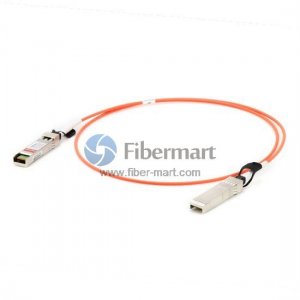
Data requirement is tremendous increase in year 2016 to year 2020, thus a high transmission media is required, Active Optical Cables (AOCs) could achieve high data transmission over distances, The AOC with electrical inputs as a traditional copper cable, and use optical fiber as transmission media, it is an ideal to streamlined installation for high-performance computing and storage applications with sacrificing compatibility of the existing standard electrical interfaces.
The AOC Cable generally composed  as follow:
The Active connectors are QSFP+, complied with SFF-8436 standard, could be hot-swappable in switch, router, etc.
The system with 4Tx and 4 Rx channels, could transmit data in parallel to reach duplex data transmission.
The AOC with O-E (Optical-Electronic) and E-O (Electronic – Optical) conversion module.
The ribbon optical fiber cable (generally yellow cable for SM (single mode) Cable, and Orange or Aqua for Multimode Cable).
Why Use Active Optical Cable (AOC)?
1. Compared to Copper Cables
Longer reach, using single mode fiber, could transmit over kilo meters
Lower weight and tighter bend radius, compared with traditional bulky  cooper cable, the cable is light weight and with small bending radius, easy for installation, as well as enable simpler cable management
Thinner cables, It allows better airflow for cooling
Lower power consumption
No need for power-hungry conditioning ICs on the host board
2. Compared to Optical Transceivers
Cost effective: Compatible with existing cooper interface, no need new investment
Data center/Consumer friendly: No need to worry about contamination on fiber connector
Disadvantage: Have to use extra cabinets for wiring, not able to use fiber optic patch panel

Introduction to OSFP Optical Transceiver

by http://www.fiber-mart.com

580248b14f42d3ec505a05812693f404.image.300x300

OSFP is short for Octal Small Form Factor Pluggable. it is being designed to use eight electrical lanes and each lane for 50GBE to deliver 400GbE. compared with QSFP transceiver, It is slightly wider and deeper, but it still supports 36 OSFP ports per 1U front panel, enabling 14.4 Tbps per 1U.
OSFP is a conventional style of electrical interconnect, leveraging best practices that the industry has learned in the past from SFP and QSFP connectors. The electrical connector in OSFP has a single row of contacts on both top and bottom, and it provides robust electrical and signal-integrity performance. Because it’s faceplate pluggable and eld replaceable, it has a single-receptacle electrical connector.
One of the nontraditional aspects of OSFP is that it integrates thermal management (heat sinking) directly into the form factor to help cool the module, similar to the microQSFP form factor that predates it. An OSFP integrated heat sink is intended to enable modules with up to 15 W of power in a switch chassis with conventional front-to-back air ow. This accomplishes two things over a more conventional riding heat sink: It eliminates the high thermal resistance between the module and the heat sink, and, secondarily, once the air exits the back of the module form factor, it is available for cooling the silicon switch or compute chips that are downstream inside the equipment enclosure.
The OSFP receptacle does not offer backwards intermate-ability to existing modules since it favors optimizing the electrical, packaging, and thermal aspects over legacy application support.
There are multiple type of connectors supported by OSFP; Duplex LC, MPO/MTP, CS, and copper.

ST Connector Introduction

by http://www.fiber-mart.com

The ST connector (Straight Tip or Bayonet Fiber Optic Connector ), mainly applied in Multimode, rarely single-mode, complied with IEC 61754-2, the ST Connector features a 2.5 mm ferrule with a quick release bayonet (stick and twist) style body for ease of use. ST connectors are available for single mode UPC with yellow boots, APC with green boots and multimode PC with black or red boots suitable for either 900µm, 2.0mm or 3.0mm cable diameters.connector_st
Features
Complies with IEC 61754-2 and TIA 604-2-B, FOCIS-2
Low insertion loss and back reflection capability
Bayonet style (stick and twist) housing for easy connection
Nickel plated metal body
Zirconia ceramic ferrule available in several performance grades
RoHS materials, REACH SvHC compliant
Individual parts packed in bulk package
Applications
Local area networks
Data processing networks
Distribution application
Premises distribution