WHAT IS A FIBER LOOPBACK CABLE?

by http://www.fiber-mart.com

Fiber loopback is a media of return patch for a fiber optic signal that widely used for fiber optic testing, fiber network repair and fiber optic equipment diagnosis. Loopback test is a hardware or software method to test physical link problems of the fiber optic networks. It is realized by feeding a received signal or data back to the sender. Fiber optic loopback cables types is classified based on the fiber connector types, optic fiber modes.
Traditional fiber optic loopback is like a fiber optic patch cable with two fiber connectors at each end, forming a loop. Nowadays there are also another improved fiber loopbacks which called molded fiber optic loopbacks or fiber optic loopback modules. It is more compact sized and stronger. The molded loopback use an outer enclosure to protect it and from the outside you do not see the optical cables, they are more compacted size and stronger then the fiber loopback cables.
Just like the fiber patch cable, the fiber loopbacks is made up of different kinds of outer jackets, cable diameters, length or terminations that various according to customers’ special requirements.
Fiber Optic Loopback Applications
Fiber amplifier
Optical fiber sensor
Tester, Cable TV systems
Communications connections
Fiber Optic Loopback Types
Based on the optical connector types on the loopback, there are SC, LC, MTRJ, ST, FDDI etc. The most commonly used fiber optic loopbacks are SC and LC type.
According to the optic fiber mode type of the loopback cable, there are single mode 9/125 fiber optic loopbacks, 10G multimode loopback, multimode 50/125 fiber optic loopbacks and 62.5/125 fiber optic loopbacks. 10G loopback module is used in 10G multimode 50/125 Fiber Testing application. Typically single mode SC type and LC type fiber optic loopbacks are blue color, typical multimode LC and SC type fiber loop backs are beige color, this also goes with the practice of fiber optic patch cables.
Specifications
Connector type: SC, LC, MTRJ available
Optical fiber mode: multimode 50/125 um, multimode 62.5/125 um, single mode 9/125 um
Working wavelength: Available wavelengths are 850nm, 1310nm and 1550nm. 850nm and 1310nm are for multimode applications and 1550nm is for single mode applications.
Insertion Loss (dB) ≤ 0.2
Exchangeability ≤ 0.2 (500 cycle passed)
Temp. Range ≤ 0.2 dB ( – 40 to +80 degree centigrade)
Wide ranges of fiber loopback cables are available at ingellen.com, they are designed with compact size, totally complied with the industrial standard which is ideal choice for your fiber optic testing. Besides we also provide custom fiber loopback according to your required jacket types and cable diameters, length or terminations. All our products are fully tested to comply with compliant with fast ethernet, fiber channel, ATM and Gigabit Ethernet Welcome to purchase or customize fiber optic loopback cables or the connector configurations and special polished for them via ingellen.com or contact sales@ingellen.com right now!
NEW GENERATION 100G WDM NETWORK TECHNOLOGY

by http://www.fiber-mart.com

Huawei announced that, KPN International introduced the based on second generation of soft decision 100G WDM technology from Huawei. 100G signals transmitted from the existing network of Amsterdam to Paris, via Germany, transmission distance up to 1,400 km. Because the system has a great margin, and later at the end of the site added 300 km fiber, the signal is still being successfully transmitted. The successful launch marks the 100G technology entered into a new commercial era.
Soft-decision is the most leading optical signal powerful error correction technology, is the key of 100G technology to large-scale commercial. And the second generation of soft decision adopts oDSP module, developed for Huawei’s 400G technology, in essence is with 400G technology to enhance the performance of 100G, realizes the further optimization of the FEC algorithm, achieve a lower damage in transmission performance, lower single-bit power consumption. Benefit from the breakthroughs in key technologies, compare to the first generation of soft-decision system, the second generation soft decision improves the transmission distance from 3000 km to 4000 km, the transmission performance is improved by 30%.
KPN International introduced the second generation of soft decision technology sucessfully, fully demonstrated the new generation 100G technology has matured, and also verified the Huawei 400G core modules maturity. KPN International began using Huawei next WDM system in pan-European wavelength division trunk in 2008, the network is one of Europe’s largest and most leading WDM networks, KPN International was the first to deploy Huawei coherent 100G WDM technology in 2011.
“Customer success is the constant pursuit of Huawei,” Huawei Transport Network Product Line CEO Wang Weibin said, “Huawei has long-term cooperation with leading operators such as KPN , to meet the needs of customers, and work with customers to open a window to the future.”
Huawei is the best partner for next-generation WDM network customers, so far, has builded over 90 100G commercial network. According to industry authority consulting company Ovum statistics, as the first quarter of 2013, Huawei continues to rank first in the global optical network market, ranks first in the global WDM/OTN market, ranks first in the global 100G and 40G market.

How to choose the basic 40G QSFP + optical components ?

With high-speed development of the optical communication industry,why is the third-party 40G QSFP with good compatibility and high stability the perfect choice for customers?

With high-speed development of the optical communication industry,why is the third-party 40G QSFP with good compatibility and high stability the perfect choice for customers?


40G LR4 QSFP+ Transceiver

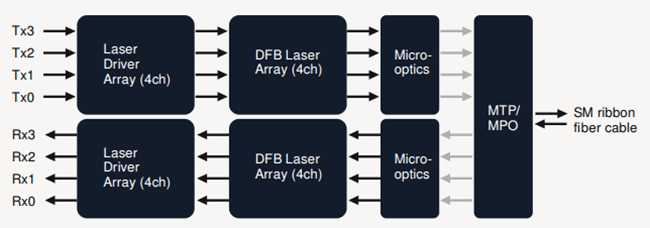
Conforming to the 802.3ba (40GBASE-LR4) standard, the 40G LR4 QSFP+ transceiver together with the LC connector can support an optical link length up to 10 kilometers over single mode fiber. 40G LR4 QSFP+ transceivers offer 4 independent transmit and receive channels. And to realize the function of transmitting the 4-channel signals over the single mode fiber, this kind of transceiver has to introduce MUX/DEMUX to multiplex/de-multiplex optical signals.the working principle of this kind of QSFP+ transceiver is : In the transmit side, four 10 Gbp/s serial data streams are passed to laser drivers. The laser drivers control directly modulated lasers (DMLs) with wavelengths. the output of the four DMLs are optically multiplexed to a single-mode fiber through an industry-standard LC connector. In the receive side, the four 10 Gbp/s optical data streams are optically de-multiplexed by the integrated optical demultiplexer; then, each data steam is recovered by a PIN photodetector/transimpedance amplifier and passed to an output driver. The following figure shows the functional block diagram of the 40G LR4 QSFP+ transceiver.

图片1.png

40G SR4 QSFP+ Transceiver

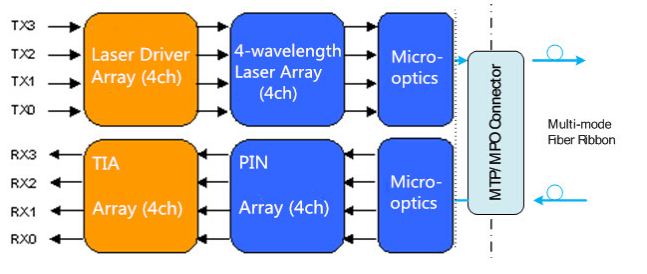
40GBASE-SR4 QSFP+, Short-reach (SR) transceivers for 40G connectivity in a QSFP form factor, uses independent transmitter and receiver sections, each with 4 parallel fiber strands. It can transmit 150 meters over OM4 MMF. For a 40G connection, 8 fiber strands are required, and 12-fiber MPO connectors are used. Consequently, 4 fiber strands in each connection are wasted .For most data center networks, the aggregation-layer fiber infrastructure is built for 10G connectivity. That either supports direct connections between devices over LC-to-LC MMF, or uses LC-to-LC fibers to attach devices to patch panels. Regular duplex LC-to-LC fibers cannot be directly reused for 40G connectivity using traditional 40G transceivers.The operating principle of the 40G SR4 QSFP+ Transceiver is : the transmitter converts parallel electrical input signals into parallel optical signals through the use of a laser array. Then the parallel optical signals are transmitted parallelly through the multimode fiber ribbon. Reversely, the receiver converts parallel optical input signals via a photo detector array into parallel electrical output signals. The following figure shows the functional block diagram of the 40G SR4 QSFP+ Transceiver.

图片2.png

Features of OEM 40G QSFP Transceiver Modules

As we know, the OEM 40G QSFP transceiver from name brand like Cisco, Juniper and Brocade is widely used in data center and enterprise network. They all have some great features. The Cisco 40G QSFP transceiver offers a wide variety of high-density and low-power 40 Gigabit Ethernet connectivity options for data center, high-performance computing networks, enterprise core and distribution layers, and service provider applications. Here are some benefits of Cisco 40 Gbps transceiver:

  • Hot-swappable input/output device that plugs into a 40 Gigabit Ethernet Cisco QSFP port
  • Flexibility of interface choice (for different reach requirements and fiber types)
  • Interoperable with other IEEE-compliant 40GBASE interfaces where applicable
  • Certified and tested on Cisco QSFP 40G ports for superior performance, quality, and reliability
  • High-speed electrical interface compliant to IEEE 802.3ba
  • QSFP Form factor, 2-wire I2C communication interface and other low-speed electrical interface compliant to SFF 8436 and QSFP
  • The Brocade 40 Gbps transceiver supports highly reliable operations in data center and is optimized for Brocade switching platforms. It undergoes strict qualification and certification testing.

Conclusion

For the 40 Gbps transceiver, Fiber-MART provides high quality QSFP+ transceivers and various of compatible brands for you, Cisco, Genetic, Juniper Networks, Arista Networks, Brocode, HPE, Dell, Intel, IBM, etc. All have passed the compatibility testing. and the prices are much lower than other vendors,if you any question pls feel free to contact me .E-mail :service@fiber-mart.com

TIPS TO CLEAN FIBER OPTIC CONNECTORS

by http://www.fiber-mart.com

Fiber Optic Connectors are susceptible to be damaged which is not immediately obvious to the naked eye. The damage can have significant effects on measurements. Member any degradation of a fiber ferrule or fiber endface, any stray particles or finger oil on the endface, can have a significant effect on connector performance.
Fiber optic connector and connector ferrules have to be completely cleaned to make sure the trouble totally free working of fiber optic systems. As you’ve devote superior money installing a fiber optic, you might want to opt for a world course fiber optic connector cleaner and bnc coaxial connector to help keep it in superior shape.
Well, cleaning fiber optic connector can be done either with the help of a professional service provider or with the help of DIY kits. Below are a couple of time-tested methods.
1. Use Wipes And Solvents
This is probably the most widely used method of cleaning for the fiber optic parts. Cotton, cloth or lens paper is usually used for using this technique. Fabric and/or composite material wipes provide combined mechanical action and absorbency to remove contamination. Wipes should be used with a resilient pad in order avoid potential scratching of the connector end-face. Most solvents can provide good cleaning for the surfaces and tend to leave a slight residue that evaporates after a while.
This method is appropriate for cleaning connectors with exposed ferrules or termini but cannot be used to clean connector end-faces within alignment sleeves. The wipe should be constructed of material that is lint free and non-debris producing during the cleaning process. Please note that dry wipes have been shown to leave a static charge on the end-face of the connector which can thereafter attract particulate contamination. Therefore it is recommended that a static dissipative solvent be used with a dry wipe to eliminate this condition.
If the connector is not clean after the first cleaning, the process can be repeated perhaps with slightly more pressure on the connector to increase the mechanical action and perhaps making several stokes from the damp to dry sections of the cleaning material.
2. Cleaning Through Connector Reels
Optipop and Cletop are the most widely used reel connectors that are used in the industry for proper cleaning solutions. These work on the function of a resilient pad, sliding dust cover as well as a certain mechanism that tends to keep these small parts of the gadget working known as the ratcheting mechanism. The connector is inserted into an Fiber Optic Inspection scopes. This is done to check how clean the connector is.
About Solvents
Solvents used to clean fiber optics should be static-dissipative and residue-free. Many solvents are flammable and/or packaged so that transportation of the solvent is considered a hazardous material increasing cost of shipment and storage of the solvent. However, there are solvents available that are non-flammable and non-hazardous and packaged so that shipping requires no additional fees or paperwork.
Mind:
The methods require technical skill and expertize, it is advisable to trust the best in line professionals for fiber optic cleaning. Professional groups will not only ensure that your connectors are taken good care of, but also will prevent any sort of technical failures due to improper cleaning techniques.

SOMETHING YOU SHOULD KNOW BEFORE USING FIBER OPTIC JUMPER

by http://www.fiber-mart.com

Classifications of fiber optic jumper
Fiber optic jumper is a fiber optic cable with optical fiber connector plugs on both ends. Fiber optic jumpers are divided into the following three types by termination type basically: ST-ST, SC-SC, ST-SC.
According to the optical fiber type, optical fiber jumper mainly includes single-mode fiber and multimode fiber. The specifications of the jumper wire length are 0.5m, 1m, 2m, 3m, 5m, 10m and so on.
According to the fiber optic jumper connection structure, it can be divided into: FC fiber patch cable(Product Recommendation: 1m FC-FC Duplex 10G OM4 50/125 Multimode Fiber Patch Cable), LC fiber patch cable, MTRJ, MPO, MU, SMA, FDDI, E2000, DIN4, D4, etc.
According to the cable outer sheath material, fiber optic jumper can be divided into ordinary, ordinary flame retardancy, low smoke halogen, low smoke halogen flame retardant, etc.
According to the requirements of the level of building fire protection and for materials refractory, integrated wiring system should take corresponding measures. In an area where flammable and building shaft inside the cloth cable or fiber optic cable, flame retardant cable and optical cable should be adopted. In large-scale public places should be flame retardant, low smoke, low toxicity; Equipment between should use flame retardant wiring devices.
Applications for fiber optic jumper
Fiber optic jumper wire is used for patch cords from the device to the optical fiber link. It has a thicker layer in using in optical transceiver and the connection between the terminal box.
1. Optical fiber communication system
2. Fiber-optic broadband access network
3. Optical fiber for CATV
4. Local Area Network(LAN)
5. Fiber optic instrument
6. OFS(optical fiber sensor)
7. Optical fiber data transmission system
8. Testing equipment
What should we pay attention to when using fiber optic jumper?
When using fiber optic jumper, you should make sure that wire light wavelength of transceiver module at the ends of the fiber optic jumper must be identical, that is to say, the ends of the optical fiber must be the same wavelengths as light module. A simple way to distinguish is the color of the optic module.
In general cases, short wave optical module uses multimode optical fiber with orange, and long wave module uses single-mode optical fiber with yellow. To ensure the accuracy of the data transmission, please do not bend the optical fiber jumper too excessively, which will increase the light attenuation in the transmission process. After using the fiber optic jumper, you must guard the fiber optic connector by protective material, dust and oil pollution which can damage the coupling of optical fiber.
Furthermore, to ensure the quality of the joint, you must pay attention to the radius of curvature. Each fiber optic jumper should be in accordance with ISO/IEC and ANSI/TIA/EIA for durability, moisture, coupling stress, optical fiber tensile force and the moisture, temperature extremes, insertion force and cable tension stress, impact and vibration and other bad environment to meet the requirements.

CHOOSING FIBER OPTIC CABLE OR COPPER WIRE FOR COMMUNICATION

by http://www.fiber-mart.com

When computer networks were invented, copper wiring was used for the cables that handled the Internet. But nowadays fiber optic cable is more often used for new cabling installations and upgrades, including backbone, horizontal, and even desktop applications. They are more favored for today’s high-speed data communications, such as Gigabit Ethernet, FDDI, multimedia, ATM, SONET, Fiber Channel, or any other network that requires the transfer of large, bandwidth-consuming data files, particularly over long distances.
Fiber optic cables offer a number of advantages over copper.
Lower Cost–While fiber optic cable itself is cheaper than an equivalent length of copper cable, fiber optic cable connectors and the equipment needed to install them are more expensive than their copper counterparts.
Long Distance And High Capacity–Fiber optic cables carry communication signals using pulses of light. Only fiber optics can go the long distance. Not only is fiber optic cable capable of carrying far more data than copper, it also has the ability to carry that information for much longer distances. Fiber to the Home (FTTH) installations are becoming more common as a way to bring ultra-high speed Internet service (100 Mbps and higher) to residences.
Higher Bandwith–Fiber has a higher bandwidth than copper. Example: cat6 network cable is classified by the Telecommunications Industry Association (TIA) to handle a bandwidth up to 600 MHz over 100 meters, which theoretically, could carry around 18,000 calls at the same time. Multimode Fiber, on the other hand, would have a bandwidth of over 1000 MHz which could carry almost 31,000 simultaneous calls.
Adaptable To Any Environment–Fiber optic cables don’t mind roughing it. Since fiber optic cables are glass-based, glass fibers don’t only escape interference. They are virtually free from the threat of corrosion, too. While copper cabling is sensitive to water and chemicals, fiber optic cabling runs almost no risk of being damaged by harsher elements. Fiber optic cables can be used outdoors — and in close proximity to electrical cables –without concern. As a result, fiber optic cable can easily endure “living conditions” that coaxial cable just can’t, such as being put in direct contact with soil, or in close proximity to chemicals.
For reasons stated above, fiber optic cable is a more reliable means of communication. While the decision on using copper cables or fiber optic cables may be difficult. It will often depend on your current network, your future networking needs, and your particular application, including bandwidth, distances, environment, and cost. While in some cases, copper may be a better choice.
Copper works on simple ADSL connections since there is not much of a distance from a modem to a phone jack on a wall. Copper usually transmits data without loss at distances of two kilometers or less. On top of all that, the demand for bandwidth in an ADSL connection is often low enough (around 6 to 8 Mbps on average) to use copper wires.
As the mature of fiber optic cables production, they are more affordable. Choosing fiber optic cables or copper wire for your communication is completely up to your future networking needs and your particular application.