TESTING OF FIBER OPTIC CONNECT

Different fibers and different connectors fiber adapter panels to choose.such as MTRJ patch panel, SC fiber patch panel ST fiber patch panel, FC fiber patch panel, LC fiber patch panel,MTP/MPO Fiber Adapter Panels and Customized Rack-Mount Fiber Patch Panels. Currently ,MTP / MPO cabling system helps ease the migration to 40 / 100G networks,The next step we will have to do is to see if the specific fiber link we are using is working properly.

Different fibers and different connectors fiber adapter panels to choose.such as MTRJ patch panel, SC fiber patch panel ST fiber patch panel, FC fiber patch panel, LC fiber patch panel,MTP/MPO Fiber Adapter Panels and Customized Rack-Mount Fiber Patch Panels. Currently ,MTP / MPO cabling system helps ease the migration to 40 / 100G networks,The next step we will have to do is to see if the specific fiber link we are using is working properly.

To finish the test, two technology are required. Required materials needed are a roll of tape and the electric torch. Each technician is stationed at each end of the fiber link, perhaps in two different telecom closets which is where the fibers are usually terminated. Each technician must identify the specific fiber’s connector end, which in most cases is connected to an adapter on the back plane of the Fibre Optic Patch Panel or termination box.the test include the fiber connector (called the ferrule) directly against the electric torch with the light on. it must unlink the fiber connector from the patch panel adapter so that the tip of the fiber can be directly applied to the electric torch’s lens. When unlink the connector and extracting it a short distance from the patch panel, with at least enough slack to reach the electric torch lens. There are two prevalent types of fiber connectors in use today. The ST or round connector disconnects by pushing the connector toward the adapter and turning the connector body counter clockwise ¼ turn and then pulling the connector away from the termination. The SC or square connector is a push-pull termination and can be removed by simply grasping the connector body and pulling it out. In no case should a technician use any hand tools such as pliers to remove the connectors; if you cannot get the connector free by using just your fingers you are not doing the disconnection correctly.


Superiority of MPO/MTP Assemblies

Actual practice proves that MPO/MTP components are superior to other assemblies in high density applications.No tools are required to install the cassette in the panel enclosure, and the push-pull connection offers an easier way to be locked or unlocked in patch panels. recommended MPO/MTP products for high density patching as below.


MTP/MPO Fiber Adapter Panel

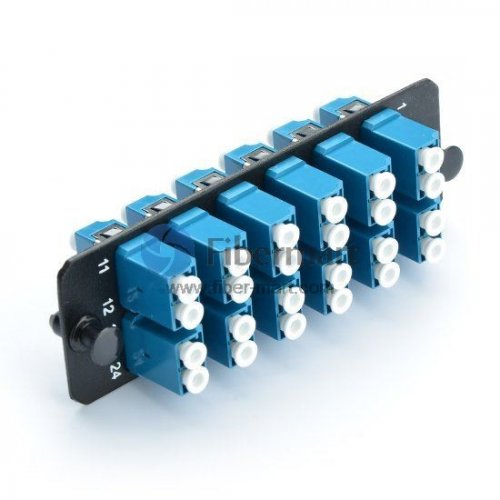
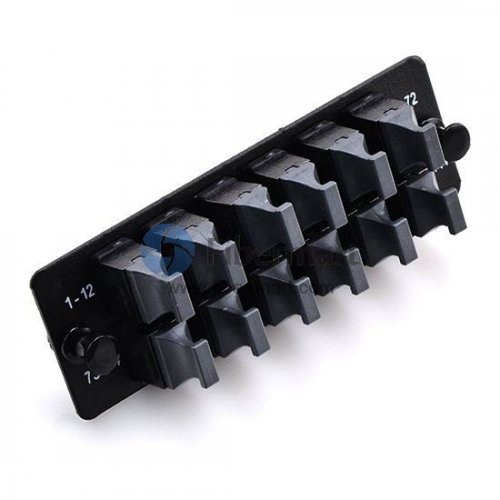
To efficiently handle the cabling congestion problem associated with 40G/100G network connections, employing a high-density fiber patch panel is proved to be an ideal choice. MTP/MPO fiber adapter panel is designed to assure flexibility and ease of network deployment and facilitate migration from 10G to 40/100G infrastructure. It is used in high-density network applications for cross connects in main distribution, horizontal distribution, and equipment distribution areas. This fiber adapter panel ensures efficient use of space, quick deployment and the highest reliability for the lowest installed cost. Which in turn provide a high return on investment.
ca.jpg

MTP/MPO Cassette

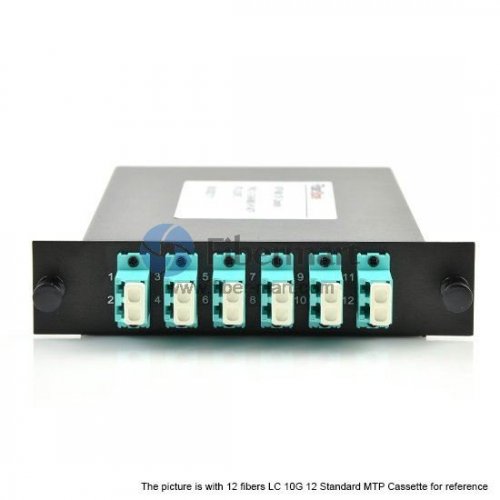
MTP/MPO cassette is the kind of module that allows for rapid deployment of high-density data center infrastructure as well as improved troubleshooting and reconfiguration during moves, adds and changes. Which is proved to be time and energy saving as well as cost efficient. Moreover, it enables users to take the fibers brought by a trunk cable and distribute them to a duplex cable. This cassette modules are fitted with 12 or 24 fibers and have LC, SC or E2000 adapters on the front side and MTP/MPO at the rear.
0a673b2a0c46d7fcd2b0baa500f2e5f5.image.500x500

MPO/MTP Fiber Enclosure

As a scalable modular, the MPO/MTP fiber enclosure is designed for high density Gigabit Ethernet application. MPO/MTP fiber enclosures are used for terminating backbone cables at the main distribution area (MDA) and horizontal distribution area (HDA). They are available in 1U, 2 U and 4U (as shown in the following figure).
124.jpg

Conclusion

Fiber-MART provides a series of MPO/MTP solutions and have a number of different customized options available to fit whatever application you require. With products compatible for trusted brands including Black Box, Wirewerks, Mr-technologies, Corning, Leviton, Panduit Opticom adapter panel and more. For more information, welcome to visit www.fiber-mart.com or contact me by E-mail: service@fiber-mart.com

Fiber Optic Fusion Splicers and How They Work

by http://www.fiber-mart.com

What is a fiber optic fusion splicer?
A fiber optic fusion splicer is a device that uses an electric arc to melt two optical fibers together at their end faces, to form a single long fiber. The resulting joint, or fusion splice, permanently joins the two glass fibers end to end, so that optical light signals can pass from one fiber into the other with very little loss.
How does a fusion splicer work?
Before optical fibers can be successfully fusion-spliced, they need to be carefully stripped of their outer jackets and polymer coating, thoroughly cleaned, and then precisely cleaved to form smooth, perpendicular end faces. Once all of this has been completed, each fiber is placed into a holder in the splicer’s enclosure. From this point on, the fiber optic fusion splicer takes over the rest of the process, which involves 3 steps:
Alignment: Using small, precise motors, the fusion splicer makes minute adjustments to the fibers’ positions until they’re properly aligned, so the finished splice will be as seamless and attenuation-free as possible. During the alignment process, the fiber optic technician is able to view the fiber alignment, thanks to magnification by optical power meter, video camera, or viewing scope.
Impurity Burn-Off: Since the slightest trace of dust or other impurities can wreak havoc on a splice’s ability to transmit optical signals, you can never be too clean when it comes to fusion splicing. Even though fibers are hand-cleaned before being inserted into the splicing device, many fusion splicers incorporate an extra precautionary cleaning step into the process: prior to fusing, they generate a small spark between the fiber ends to burn off any remaining dust or moisture.
Fusion: After fibers have been properly positioned and any remaining moisture and dust have been burned off, it’s time to fuse the fibers ends together to form a permanent splice. The splicer emits a second, larger spark that melts the optical fiber end faces without causing the fibers’ cladding and molten glass core to run together (keeping the cladding and core separate is vital for a good splice – it minimizes optical loss). The melted fiber tips are then joined together, forming the final fusion splice. Estimated splice-loss tests are then performed, with most fiber fusion splices showing a typical optical loss of 0.1 dB or less.

Introduction of Fiber Connector Cleaning

With the widespread use of optical fiber in high-speed communications, reliable and efficient fiber installations and maintenance are critical to the high-performance network.With the deployment of 40G and 100G systems in the data center reliable and efficient,fiber installations are critical to the high performance network.Contaminated fiber optic connectors can often lead to degraded performance and costly, but preventable failures. In industry studies the #1 cause of link failure is a contaminated or dirty connector or fiber.

With the widespread use of optical fiber in high-speed communications, reliable and efficient fiber installations and maintenance are critical to the high-performance network.With the deployment of 40G and 100G systems in the data center reliable and efficient,fiber installations are critical to the high performance network.Contaminated fiber optic connectors can often lead to degraded performance and costly, but preventable failures. In industry studies the #1 cause of link failure is a contaminated or dirty connector or fiber. To ensure proper performance and reliability care must be taken with the installation and maintenance of removable fiber connectors. Ideally, a properly maintained and cleaned fiber optic cable will help reduce contaminant transfer to a removable or non-removable optical interface, lessening or removing the need to clean expensive and delicate gear. Cabling industry best practices recommend that both field and pre-terminated connections should be inspected and cleaned prior to mating to other connectors or equipment.

11

Preparation for the Cleaning Process

  • Always inspect your connectors or adapters before you begin the cleaning process.
  • Use the connector housing to plug or unplug a fiber.
  • Turn off any laser sources before you inspect and clean fiber connectors.
  • Disconnect the cables at both ends and remove the pluggable receiver from the chassis.
  • Store unused protective caps in a resealable container to prevent any transfer of dust to the fiber.
  • Discard any used tissues or swabs.

Fiber Optic Connector Cleaning Procedure

Step 1: Inspect the fiber optic connector, component, or bulkhead with a fiberscope.

Step 2: If the connector is dirty, clean it with a dry cleaning technique.

22

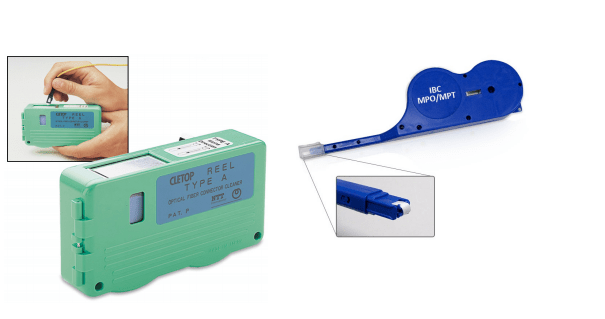
Dry cleaning: Using a reel-based cassette cleaner (see the picture below) with medium pressure, wipe the connector end face against a dry cleaning cloth (single swipe per exposure) in one direction. For angled physical contact (APC) polished connectors, ensure that the entire end face surface mates with the cleaning cloth. Dry cleaning will generally remove airborne contamination and should be attempted first. Inspect the connector end face for contamination after cleaning.

Step 3: Inspect the connector.

Step 4: If the connector is still dirty, repeat the dry cleaning technique.

Step 5: Inspect the connector.

Step 6: If the connector is still dirty, clean it with a wet cleaning technique followed immediately with a dry cleaning in order to ensure no residue is left on the end face.

33

Wet cleaning: Lightly moisten a portion of a lint free wipe with fiber optic cleaning solution (or > 91% Isopropyl Alcohol) and applying medium pressure, first wipe the end face against the wet area and then onto a dry area to clean potential residue from the end face. For APC polished connectors, ensure that the entire end face surface mates with the cleaning wipes. Wet cleaning is more aggressive than dry cleaning, and will remove airborne contamination as well as light oil residue and films.

44

Step 7: Inspect the connector again.

Step 8: If the contaminate still cannot be removed, repeat the cleaning procedure until the end face is clean.

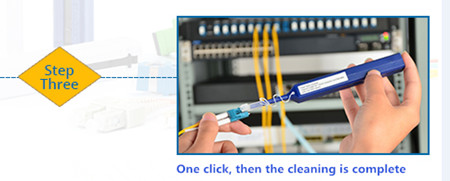
Note: Never use alcohol or wet cleaning without a way to ensure that it does not leave residue on the end face. Or it will cause equipment damage. The following images shows how to use fiber optic cleaner, just three steps will help you out.

111

222

333

Avoid These Common Mistakes

  • Do not use a cleaning process that will leave a residue on the end-face.Alcohol or wet cleaning processes are the most common procedures that will leave residue on the surface of the devices.
  • Do not touch the products without being properly grounded.
  • Do not connect the end face of the fiber connectors.
  • Do not twist or pull on the fiber cable forcefully.
  • Do not connect fiber to a fiberscope while system lasers are still on.
  • Do not touch the cleaned area with a swab, tissue, or cleaning fabric.
  • Do not reuse any tissues or swabs.
  • Do not touch a portion of the tissue or swab.
  • Do not use alcohol around an open flame or spark.
  • Extend the Life of Your Fiber Optic Connectors With Proper Cleaning Methods
  • Always extend the life of your fiber optic connectors by using one of these popular cleaning methods. They are safe to use and will prevent premature failure of your devices. Follow the instructions for more stability in your systems.

Summary

The following context has briefly introduced the procedures of cleaning fiber optic connectors. Note that if you are not sure how to proceed this, you’d better ask an expert for help. Besides this, choose the suitable cleaning tools would also be significant. Fiber-Mart has various fiber optic cleaning tools, such as pen cleaner, cassette cleaner, etc. All of these cleaning tools are provided with high quality and reasonable price. Moreover, we also supply a full range of fiber optic cables like LC to ST fiber cable, SC fiber cable, SC FC patch cord, etc. If you have any requirement of our products, please contact us: product@fiber-mart.com.


Basics of OTDR (Optical Time-Domain Reflectometer)

OTDR, short for optical time-domain reflectometer, is an optoelectronic instrument used to characterize an optical fiber. It injects a series of optical pulses into the fiber under test and extracts, from the same end of the fiber, light that is scattered (Rayleigh backscatter) or reflected back from points along the fiber.

OTDR, short for optical time-domain reflectometer, is an optoelectronic instrument used to characterize an optical fiber. It injects a series of optical pulses into the fiber under test and extracts, from the same end of the fiber, light that is scattered (Rayleigh backscatter) or reflected back from points along the fiber.  It can offer you an overview of the whole system you test and can be used for estimating the fiber length and overall attenuation, including splice and mated-connector losses. It can also be used to locate faults, such as breaks, and to measure optical return loss.

How does an OTDR work?

OTDR is used to test the performance of newly installed fiber links and detect problems that may exist in them. Its purpose is to detect, locate, and measure elements at any location on a fiber optic link. OTDR works like radar—it sends pulse down the fiber and looks for a return signal, creating a display called a “trace”or “signature” from the measurement of the fiber.

the OTDR uses a unique optical phenomena “backscattered light” to make measurements along with reflected light from connectors or cleaved fiber ends, thus to measure loss indirectly.Unlike sources and power meters, which measure the loss of the fibre optic cable plant directly, the OTDR works indirectly. The source and meter duplicate the transmitter and receiver of the fibre optic transmission link, so the measurement correlates well with actual system loss.

During the process of OTDR testing, the instrument injects a higher power laser or fiber optic light source pulse into a fiber from one end of the fiber cable, with the OTDR port to receive the returning information. As the optical pulse is transmitted through the fiber, part of the scattered reflection will return to the OTDR. Only useful information returned could be measured by the OTDR detector which acts as the time or curve segments of fibers at different positions. By recording the time for signals from transmission to returning and the speed of transmission in fibers, the distance thus can be calculated.

When do you need an OTDR? 

You can use an OTDR to locate a break or similar problem in a cable run, or to take a snapshot of fibers before turning an installation over to a customer. This snapshot, which is a paper copy of the ODTR trace, gives you a permanent record of the state of that fiber at any point in time. This can help installers when fibers have been damaged or altered after installation, proving where responsibility for the damage lies. In fact, some customers will demand OTDR testing as a condition for system acceptance.

Although OTDRs are not especially accurate for loss testing, they can be used to conduct loss testing on long, outdoor runs of singlemode fiber where access to both ends of the cable isn’t practical. It can also be helpful for preventive maintenance procedures, such as routine checkups on a facility’s fibers.

Characteristics of OTDR

Rayleigh scattering refers to the irregular scattering generated when the optical signals transmitting in the fiber. OTDR only measure the scattered light back on the OTDR port. The backscatter signal show the attenuation degree (loss/distance) of the optical fiber, and will be tracked as a downward curve, illustrating the power of backscatter is decreasing, this is because that both transmission signal and backscatter loss are attenuated.given the optical parameters, Rayleigh scattering power can be marked, if the wavelength is know, it is proportional with the pulse width of the signal: the longer the pulse width, the stronger backscatter power. Rayleigh scattering power is also related to the wavelength of transmitted signal: the shorter the wavelength, the power is stronger. That is to say, the backscatter loose generated by the trajectory of 1310nm will higher than that of 1550nm signals.

In the higher wavelength region (more than 1500nm), the Rayleigh scattering will continue to decrease, and the other one phenomenon which called infrared attenuation (or absorption) will appear to increase and cause an increase the overall attenuation values. Therefore, 1550nm wavelength is the lowest attenuation, this also explains why it is a long distance communication wavelength. Naturally, these phenomena will return to affect the OTDR. OTDR of 1550nm wavelength is also have low attenuation, so it can be used for long distance testing. While as the high attenuation wavelength 1310nm or 1625nm, OTDR testing distance is bound to be limited, because the test equipment need to test a sharp front in the OTDR trace, and the end of the spikes will quickly fall into the noise area.

Fresnel reflection falls into the category of discrete reflection that is caused by the individual point of the whole fibers. These points are the result of changes in reverse coefficient elements such as glass and air gap. At these points, a strong backscatter light will be reflected back. Therefore, OTDR uses the information of Fresnel reflection to locate the connection point, fiber optic terminal and breakpoints.

Conclusion

OTDRs are invaluable test instruments that can illuminate problems in your optical fiber before they bring your system to its knees. Once you’re familiar with its limitations and how to overcome them, you’ll be prepared to detect and eliminate your optical fiber events. Fiber-MART can offer OTDRs are available with a variety of fiber types and wavelengths, including single mode fiber, multimode fiber, 1310nm, 1550 nm, 1625 nm, etc.. And we also supply OTDRs of famous brands, such as AFL Noyes OFL & FLX series, JDSU MTS series, EXFO FTB series, YOKOGAWA AQ series and so on. OEM portable and handheld OTDRs (manufactured by Fiber-Mart) are also available.Pls not hesitate to contact us for any question, for more information, welcome to visit www.fiber-mart.com or E-mail: service@fiber-mart.com

Some things you must know about Fusion Splicer

What is Fusion Splicer?

Fusion splicing is the act of joining two optical fibers end-to-end using heat. The goal is to fuse the two fibers together in such a way that light passing through the fibers is not scattered or reflected back by the splice, and so that the splice and the region surrounding it are almost as strong as the intact fiber.

What is Fusion Splicer?

Fusion splicing is the act of joining two optical fibers end-to-end using heat. The goal is to fuse the two fibers together in such a way that light passing through the fibers is not scattered or reflected back by the splice, and so that the splice and the region surrounding it are almost as strong as the intact fiber. The source of heat is usually an electric arc, but can also be a laser, or a gas flame, or a tungsten filament through which current is passed. and thus the splice as well as the region surrounding it are almost as strong because virgin fiber itself.

81cc

The basic fusion splicer apparatus includes two fixtures which the fibers are mounted and two electrodes. Inspection microscope assists in the placement in the prepared fiber ends into a fusion-splicing apparatus. The fibers they fit in to the apparatus, aligned, and then fused together.

Initially, fusion splicing used nichrome wire as the heating unit to melt or fuse fibers together. New fusion-splicing techniques have replaced the nichrome wire with fractional co2 lasers, electric arcs, or gas flames to heat the fiber ends, causing them to fuse together. The little size of the fusion splice along with the development of automated fusion-splicing machines make electric arc fusion the most popular splicing approaches to commercial applications.

81c

Fusion Splicing vs Mechanical Splicing

There are two types of optic fiber splicing. One is fusion splicing we mentioned above, another is mechanical splicing. In mechanical splicing two fiber optic cables are held end to end inside a sleeve using some mechanical mechanism. In this type of technique fibers aren’t joined permanently rather just accurately hold together, so that light can easily pass through from one end to another, while in fusion splicing two fibers are fused or wielded together using an electric arc, fusion splicing is most widely used technique because it provides a reliable join with lower insertions loss and practically no back reflection. Fusion splicing is generally applied on single mode fibers but in some special cases it can also be used for multi mode fibers.

The process of fusion splicing

The process of fusion splicing normally involves heat to melt or fuse the ends of two optical fibers together. The splicing process begins by preparing each fiber end for fusion.

121

1.Stripping the fiber

Stripping is the act of removing the protective polymer coating around optical fiber in preparation for fusion splicing. The splicing process begins by preparing both fiber ends for fusion, which requires that all protective coating is removed or stripped from the ends of each fiber.

2.Cleaning the fiber

The customary means to clean bare fibers is with alcohol and wipes. However, high purity isopropyl alcohol (IPA) is hygroscopic: it attracts moisture to itself. This is problematic as IPA is either procured in pre-saturated wiper format or in (host) containers ranging for USA quart to gallon to drums. From the host container the IPA is transferred to smaller more usable containers. The hydroscopic nature of IPA is such that the highest quality at 99.9% is also the most hygroscopic. This means that moisture absorption into both the host container as well as the actual user’s container begins with the time the original container is opened and continues as amounts are transferred and removed from both.

3.Cleaving the fiber

The fiber is then cleaved using the score-and-break method so that its end-face is perfectly flat and perpendicular to the axis of the fiber. The quality of each fiber end is inspected using a microscope. In fusion splicing, splice loss is a direct function of the angles and quality of the two fiber-end faces. The closer to 90 degrees the cleave angle is the lower optical loss the splice will yield. The quality of the cleave tool being used is critical.

6s

4.Splicing the fibers

Fiber spliced, still unprotected, Current fusion splicers are either core or cladding alignment. Using one of these methods the two cleaved fibers are automatically aligned by the fusion splicer[1] in the x,y,z plane, then are fused together. Prior to the removal of the spliced fiber from the fusion splicer, a proof-test is performed to ensure that the splice is strong enough to survive handling, packaging and extended use. The bare fiber area is protected either by recoating or with a splice protector. A splice protector is a heat shrinkable tube with a strength membrane and less loss.

5.Protecting the fiber

After the fibers have been successfully fused together, the bare fiber is protected either by re-applying a coating or by using a splice protector.

565

A simplified optical splicing procedure includes:

Characteristics of placement of the splicing

A simplified optical splicing procedure includes:

Characteristics of placement of the splicing process.

Checking fiber optic splice closure content and supplementary kits.

Cable installation in oval outlet.

Cable preparation.

Organization of the fibers inside the tray.

Installing the heat-shrinkable sleeve and testing it.

81

Conclusion

Fusion splicing provides permanent low-loss connections that are performed quickly and easily, which are definite advantages over competing technologies.When it comes to optical fiber fusion splicers, no other company in the world can match Fiber-MART for innovation, speed, and performance. The entire industry-leading range of splicers offers quick termination and new standards in heater shrink time. Fiber-Mart strives for even better standards each day. Like Sumitomo Type-81C Fusion Splicer, Innovation is key. It can revolutionized on-site connectivity, speed and brought lower project costs for the migration of the network. As the major leader in optical fiber and connectivity solutions, customers can expect reliability, flexibility and unbelievable performance. After all, network infrastructure expansion becomes easy when you use state-of-the-art fusion splicer solutions.Any question or need pls feel free to contact with us. E-mail: product@fiber-mart.com.


Introduction of Fiber Optic Cleaving

As we know, in most cases, when a fiber is used or spliced, it is essential to prepare clean ends. Stripping, cleaving, polishing are the basic steps to ensure fiber ends clean and smooth. Cleaving, an essential step of making fiber ends clean, though it’s a simple mean, but it works surprisingly well, at least for standard glass fibers. Thus, I want to share something about the cleaving in this paper today.

As we know, in most cases, when a fiber is used or spliced, it is essential to prepare clean ends. Stripping, cleaving, polishing are the basic steps to ensure fiber ends clean and smooth. Cleaving, an essential step of making fiber ends clean, though it’s a simple mean, but it works surprisingly well, at least for standard glass fibers. Thus, I want to share something about the cleaving in this paper today.

图片1

Basics of Fiber Optic Cleaving

Fiber optic cleaving is one of the several processes in the preparation for a fiber splice operation. The purpose of cleaving is to prepare the end of the fiber so that it makes a very nearly perfect right angle with the body of the fiber and that this end face is nearly perfectly smooth. With a well-performed cleaving operation, a clean and flat endface was created perpendicular to the length of the fiber, with no protruding glass on either end. Besides it can also help to achieve a successful low loss splice of an optical fiber.


The technique of Fiber Optic Cleaving

A general strategy involved in the technique of fiber optic cleaving is known as the scribe-and-tension or scribe-and-break strategy. With the use of cutting tool made from materials such as diamond, sapphire or tungsten carbide, this process involves the introduction of a crack in the fiber, then followed by the application of tensile stress in the vicinity of the crack.

However, the specific implementations of the cleaving can be various thus lead to cleaves of different qualities. Some implementations may apply the tensile force uniformly across the cross section of the fiber while others might bend the fiber around a curved surface, causing excessive tensile stress on the outside of the bend. Besides, the crack in the fiber may also be generated in different ways: the crack may be introduced at a single point on the circumference or it may be generated all along the circumference of the fiber prior to the application of the tensile force. The circumferential introduction of the crack often allows fibers of considerably large diameters to be cleaved while maintaining high quality of the cleave.

图片2

Two Types of Fiber Optic Cleavers

As mentioned before, fiber optic cleavers can be classified into precision cleavers and cheap or scribe cleavers.

Scribe Cleavers—The scribe or manual cleaver, which is cheaper than the precision cleaver, is the most original type of fiber optic cleaver. Scribe cleavers are usually shaped like ballpoint pens with diamond tipped wedges or come in the form of tile squares. The scribe has a hard and sharp tip, generally made of carbide or diamond, to scratch the fiber manually. Then the operator pulls the fiber to break it. Since the breaking process is under manual control, it is hard to control the force, which makes the cleaving less accurate and precise. That’s why most technicians shy away from these cheap cleavers.

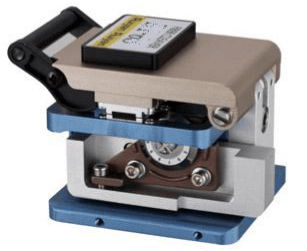
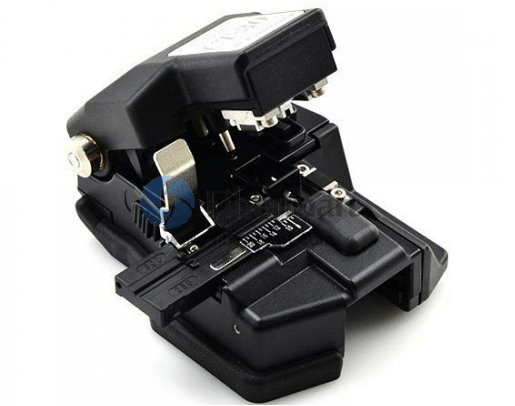
Precision Cleavers—As the name implies, precision cleavers can do a preciser cleaving job compared to the scribe cleavers. A precision cleaver uses a diamond or tungsten wheel/blade to provide the nick in the fiber. Tension is then applied to the fiber to create the cleaved end face. The advantage of the precision cleavers is that they can produce repeatable results through thousands of cleaves by simply just rotating the wheel/blade accordingly. Although they are more costly than scribe cleavers, precision cleavers can cut multiple fibers with increasing speed, efficiency, and accuracy. As the fusion splicers became popular, precision cleavers were developed to support various splicing works. Precision cleavers are deal for fusion splicing standard 125/250um & 125/900um fibers and preparing fiber for various pre-polished connectors.

3

Operation Procedure for Fiber Cleavers

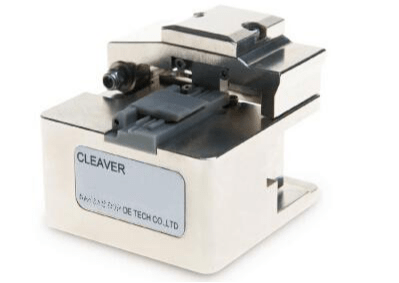
A fiber cleaver utilizes an automatic anvil drop for fewer required steps and better cleaving consistency. The automated anvil design can save time and significantly improve the quality of the cleave by eliminating human error and subpar cleaves associated with scribes and manual cleavers. To perfectly cleave optical fibers, perform the following steps:

Step 1: Open the body cover and put the stripped fiber on the v-groove.

Step 2: Close the holder cover.

Step 3: Close the cover and move the slider forward to cleave the fiber.

Step 4: Open the cover and check the cleaved fiber.

Step 5: Open the holder cover and take out the cleaved fiber.

Step 6: Remove the chip of cleaved fiber with a pair of tweezers.

6

Tips on Choosing Fiber Cleavers

1.Select fiber cleavers according to your application requirements. Fiber cleavers, designed for fusion splicing, need a low average angle that is one degree or less, whereas cleavers appropriate for mechanical connectors require angles below three degrees. So determine whether you require a single-fiber or multi-fiber cleaver before you cleave the fibers at one time.

2.Think twice before purchasing a cleaver built into a splicer. If you intend to purchase the built-in cleavers, you must check whether the cleaver or splicer requires maintenance. It may cause inconvenience to technician if they loses valuable tools, which can hold up the job at hand.

3.Purchase a cleaver with the latest automation features that can save a lot of labour and time. Fiber cleavers are always continuing to evolve with new and improved features, such as automated fiber scrap collection, automated scoring mechanisms, and the latest automatic blade rotation technology.


Conclusion

To get good fiber optic splices or terminations, especially when using the pre-polished connectors with internal splices, it is extremely important to cleave the fiber properly. As we know, fiber splicing requires mating two fiber ends. Any defect of the ends would impact the performance of fiber splicing.To buy reliable and high precision fiber cleavers, please visit www.fiber-mart.com or contact us product@fiber-mart.com.